image

Jan 18 2024
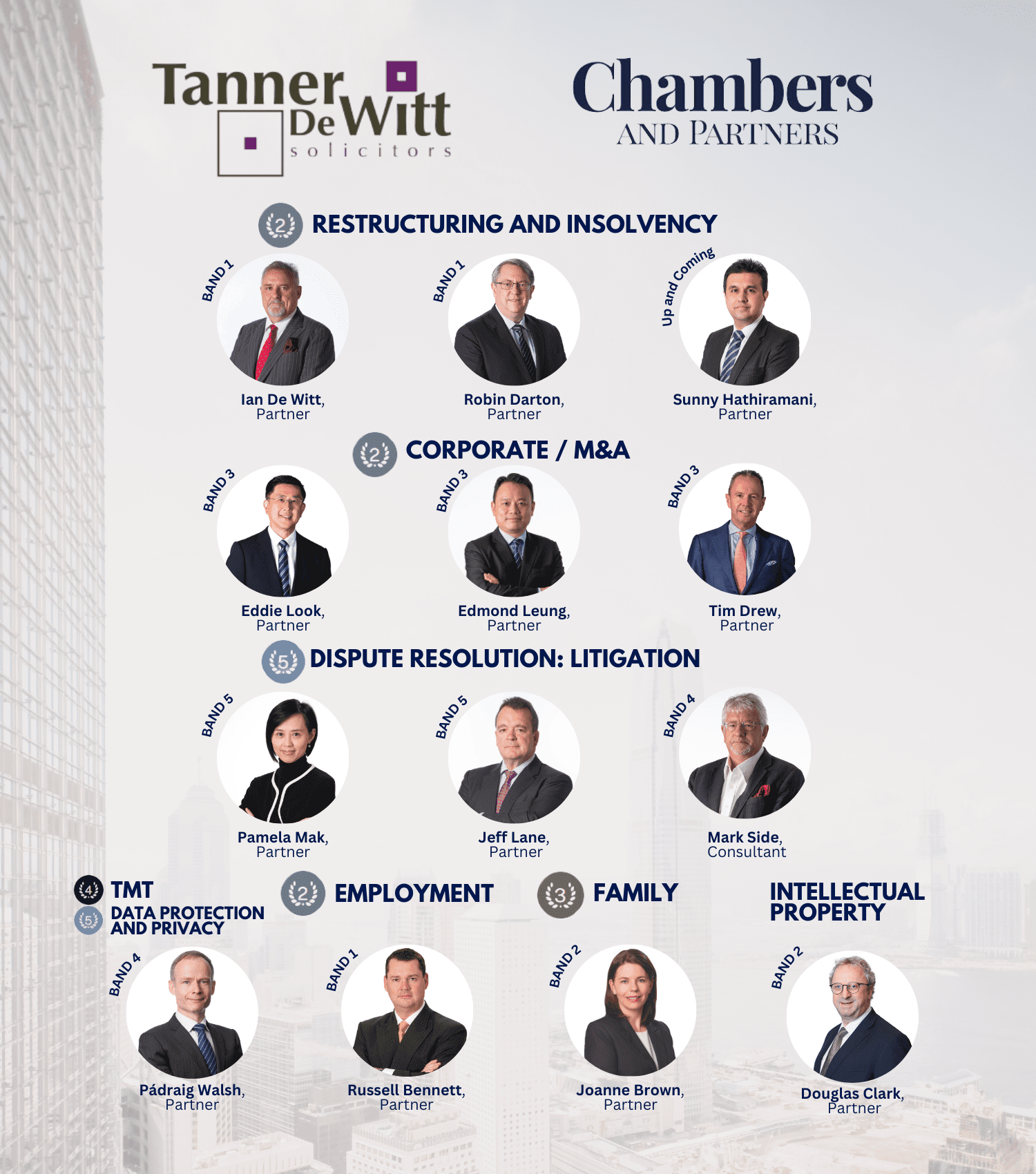
Tanner De Witt is delighted that our law firm has achieved consistent recognition in Chambers and Partners Greater China Region Guide 2024. We are honoured to have maintained top-notch rankings for an impressive 14-year stretch. Big congratulations to our exceptional team for earning this well-deserved recognition.

Restructuring & Insolvency: 14 years and 3 lawyers ranked
Corporate/M&A: Independent Hong Kong Firms: 12 years and 3 lawyers ranked
Dispute Resolution: Litigation: 10 years and 3 lawyers ranked
Family & Matrimonial: 6 years and 1 lawyer ranked
Employment: 3 years and 1 lawyer ranked
TMT: 2 years and 1 lawyer ranked
Data Protection & Privacy: 1 year and 1 lawyer ranked

Featured Articles

Insights
What Is the Right Measure of Compensation in Hong Kong Discrimination Claims?
Insights
News update: Finfluencers on the SFC regulatory radar
Insights
News update: Secondary Trading of Tokenised Authorised Investment Products Permitted in Hong Kong
Insights
News update: Hong Kong Privacy Commissioner claws back privacy protection from agentic AI tools
Insights
Enforcement action follows PCPD finding of ineffective data privacy training
Insights
What you need to know about the Protection of Critical Infrastructures (Computer Systems) Ordinance, the cybersecurity legislation in Hong Kong (Part 6)

image

Jan 17 2024
Happy to share that Pamela Mak, the Head of our Dispute Resolution Department has been named in The A List 2023-2024: Growth Drivers by the China Business Law Journal that identifies elite lawyers in Hong Kong and other cities in the PRC.

Featured Articles

Insights
What Is the Right Measure of Compensation in Hong Kong Discrimination Claims?
Insights
News update: Finfluencers on the SFC regulatory radar
Insights
News update: Secondary Trading of Tokenised Authorised Investment Products Permitted in Hong Kong
Insights
News update: Hong Kong Privacy Commissioner claws back privacy protection from agentic AI tools
Insights
Enforcement action follows PCPD finding of ineffective data privacy training
Insights
What you need to know about the Protection of Critical Infrastructures (Computer Systems) Ordinance, the cybersecurity legislation in Hong Kong (Part 6)

image

Dec 08 2023
Ian De Witt and Jeff Lane have been listed as Who’s Who Legal 2023 Recommended for Commercial Litigation. 
Our Partner, Douglas Clark, has been listed asWho’s Who Legal 2023 Global Elite Thought Leader for IP Copyright/Trademarks.

Featured Articles

Insights
What Is the Right Measure of Compensation in Hong Kong Discrimination Claims?
Insights
News update: Finfluencers on the SFC regulatory radar
Insights
News update: Secondary Trading of Tokenised Authorised Investment Products Permitted in Hong Kong
Insights
News update: Hong Kong Privacy Commissioner claws back privacy protection from agentic AI tools
Insights
Enforcement action follows PCPD finding of ineffective data privacy training
Insights
What you need to know about the Protection of Critical Infrastructures (Computer Systems) Ordinance, the cybersecurity legislation in Hong Kong (Part 6)

image

Sep 18 2023

This article was initially published by The Global Legal Post.

1 . What is the structure and organisation of local courts dealing with commercial claims? What are the main procedural rules governing commercial litigation?

The Basic Law of Hong Kong (HKBL) is the constitutional document upon which the Special Administrative Region is founded. Section 4 of the HKBL expressly provides that Hong Kong will have an independent judiciary, which will exercise judicial powers free from any interference.[1] The Hong Kong legal system is thus separate from the legal system of the People’s Republic of China (PRC).

The court system in Hong Kong is bilingual and proceedings can be conducted in either or both Chinese and English.[2] Pursuant to Article 81 of the HKBL, the courts in Hong Kong comprise of: 

Major commercial disputes are usually brought before the CFI as it has unlimited civil jurisdiction. The District Court has jurisdiction over smaller commercial disputes (of values over HKD 75,000 and up to HKD 3 million). Claims below HKD 75,000 are dealt with by the Small Claims Tribunal. 

In addition, the CFI reserves jurisdiction in certain types of disputes, in particular the:

Procedures in civil proceedings in Hong Kong are set out in the Rules of the High Court (Cap 4A) (RHC) and the Rules of the District Court (Cap 336H) (which is very similar to the RHC). Practice Directions are also published to provide further practical guidance to civil and criminal procedures in the Hong Kong Courts.

[1] Article 85, HKBL.

[2] Article 9, HKBL.

[3] Article 82, HKBL

[4] Practice Direction 6.1.

[5] Practice Direction 22.1.

[6] Practice Direction 26.1 and SL3.

[7] Practice Direction SL1.1.

2 . What pre-action considerations apply?

There are no specific rules on pre-action conduct but it is customary (though not necessary) for actions to be preceded by letter(s) before action. This is because the court has wide discretion in dealing with the matter of costs (see Question 7 below) and the court may take into account parties’ pre-action conduct in determining costs issues.[8] As such, parties should ensure that they act reasonably before, as well as during, the proceedings. 

It may also be relevant to consider the matter of limitation periods in Hong Kong, which are set out in the Limitation Ordinance (Cap. 347).

[8] Order 62, rule 5(1)(e) and (2)(d), RHC.

3 . What are the main alternative dispute resolution (ADR) methods used to settle large commercial disputes?

The most common ADR methods in Hong Kong are mediation and arbitration.

Mediation

Mediation involves the appointment of a neutral third party to help facilitate settlement discussions. Since Hong Kong’s implementation of the Civil Justice Reform (CJR) in 2009, solicitors are required to file mediation certificates confirming that they have advised their client on the mediation process and indicating whether their clients are willing to participate in mediation. There is also a Practice Direction providing a practical framework for incorporating mediation into the court process. 

Arbitration

Arbitration is an ADR method which is particularly popular with parties involved in high-value and complex international commercial disputes. Arbitration is favourable to the parties in these disputes due to its relative procedural flexibility (compared to court proceedings) and its confidential nature. Arbitral awards are generally final and binding (see Question 11 below) and can be enforced through the Hong Kong courts (as well as in foreign courts).

4 . How long, on average, do court proceedings take to reach trial?

Relatively straightforward civil matters commenced by writ of summons could be ready for trial two to three years from the commencement of proceedings. However, more complex matters where the timeline is delayed by multiple interlocutory applications could take many years before they are ready to be set down for trial. In addition, the date of the actual trial would depend on the number of days required (to be directed by the court, having consulted with the parties) and the court’s diary.

In certain circumstances, a plaintiff may obtain judgment without a full trial. These circumstances are discussed further in Question 8 below. 

5 . What disclosure obligations apply? Are parties required to disclose unhelpful documents as well as those on which they rely?

There are two main types of discovery: automatic discovery and specific discovery.

Automatic discovery

Pursuant to Order 24, rule 1, RHC, parties are required to provide discovery of documents “which are or have been in their possession, custody or power relating to matters in question in the action”. These include documents that are not favourable to the parties’ own cases and may include any paper documents and any electronic data contained in any tapes, discs or other electronic means. Order 24 rule 2(1), RHC requires discovery to take place within 14 days after the close of pleadings (where matters are commenced by writ).

‘Relevance’ in this context has typically been given a wide meaning, and would cover, for example, documents that would assist a party in proving or disproving a matter. However, in the interest of wider case management, the court has express powers under Order 24, rule 15A, RHC to limit the discovery of documents.

Where a party is concerned that some of the documents are privileged, the claim for privilege must be set out in the list of documents[9] and the relevant documents must still be identified. It can then refuse to allow the other party to inspect the documents. 

Specific discovery

Where, after the completion of automatic discovery, a party is of the view that the other party has failed to disclose documents in accordance with the above procedure, it can apply to the court for an order compelling the other party to disclose those documents.[10]

[9] Order 24, rule 5(2), RHC.

[10] Order 24, rule 3, RHC.

6 . Can witnesses be required to attend trial and face cross-examination?

As a general rule, Order 38, rule 1, RHC provides that “any fact required to be proved at the trial of any action begun by writ by the evidence of witnesses shall be proved by the examination of the witnesses orally and in open court”.

Where parties have prepared and filed witness statements, they must ensure that their witnesses are available to attend trial. Where a party is unsure whether its witness will attend the trial, it can consider issuing a writ of subpoena to compel the witness to attend.[11]

[11] Order 38, rule 14, RHC.

7 . What discretion do the courts have in making costs orders?

Generally, costs will follow the event and the unsuccessful party will be ordered to pay the successful party’s costs. However, the court has discretion to make any costs orders it considers appropriate,[12] having regard to matters such as the parties’ respective conduct in the proceedings, whether settlement offers have been made, or the level of success (i.e., whether the successful party had only been partially successful). In rare situations, the court also has the discretion to order costs against a legal representative.[13]

Unless the parties can reach an agreement on the amount of costs to be paid, the amount claimed by the receiving party will have to be assessed (or taxed) by the court, whereby a taxing master will consider the case and the papers and assess the costs claimed by the receiving party.[14]

The receiving party is generally also entitled to interest on any costs from the date of the costs order. However, if the taxing master considers that there has been undue delay in commencing taxation proceedings or in proceeding with the taxation, they may exercise their discretion to disallow interest or reduce the rate of interest or period during which it is payable.[15]

[12] Order 62, rule 3, RHC.

[13] Order 62, rules 8 to 8E, RHC.

[14] Order 62, rule 12, RHC.

[15] Order 62, rule 22(5)(c), RHC.

8 . What are the main types of interim remedies available?

The procedural rules provide for a number of different applications for interim remedies. What is appropriate in each case will be different as each case will develop according to the manner in which the case is defended. 

Default judgment 

A plaintiff can apply for default judgment where the defendant:

A defendant may also apply to the court to have an action dismissed if the plaintiff fails to serve a statement of claim within the prescribed time limit.[18]

Summary judgment

Where the defendant serves a defence but the plaintiff considers that the defendant has put forward no arguable defence against its claim, the plaintiff can apply to the court for summary judgment.[19] This application is made by way of summons supported by affidavit setting out the plaintiff’s belief that “there is no defence to that claim or part, […] or no defence except as to the amount of any damages claimed”.[20] To avoid summary judgment being entered against it, the defendant would need to show, primarily, that there is an issue in dispute that ought to be tried.[21] However, summary judgment is not available for certain causes of action.[22]

Security for costs

Plaintiffs based overseas may be subject to an application by the defendant for security for costs. A defendant (or a plaintiff who is a defendant in a counterclaim) can apply for an order for security for costs to be paid by the plaintiff on a number of grounds:

If one of the above grounds are satisfied, then the court may exercise its discretion to grant security of costs. In exercising this discretion, the court will have regard to all the circumstances of the case, including the merits of the claims.[28]

Other interim measures, such as injunctions, are available to preserve assets and assist with the enforcement of judgments. These are discussed at Question 16 below.

[16] Order 13, rules 1 to 6, RHC.

[17] Order 19, rules 2 to 6, RHC.

[18] Order 19, rule 1, RHC.

[19] Order 14, rule 1, RHC.

[20] Order 14, rule 2(1), RHC.

[21] Order 14, rule 3(1), RHC.

[22] Order 14, rule 1(2), RHC.

[23] Order 23, rule 1(1)(a), RHC.

[24] Order 23, rule 1(1)(b), RHC.

[25] Order 23, rules 1(1)(c) and (2), RHC.

[26] Order 23, rule 1(1)(d), RHC.

[27] Section 905, Companies Ordinance (Cap. 622).

[28] Order 23, rule 1, RHC; See also §23/3/3 of Hong Kong Civil Procedure 2023.

9 . What approach do the local courts adopt with respect to arbitration? What arbitration law applies and is it based on the UNCITRAL Model Law?

Arbitration in Hong Kong is governed by the Arbitration Ordinance (Cap 609) (AO), which came into force in June 2011. The AO is largely based on the UNCITRAL Model Law, with each article of the UNCITRAL Model Law forming a section in the AO, supplemented by details of any modifications which have been included to fit the local context.

Parties cannot unilaterally force the other to arbitrate and therefore there must be a valid arbitration agreement. In most cases, the arbitration agreement is incorporated as part of the contract from which the dispute arose. However, if there is no arbitration agreement in the contract, there can still be a separate arbitration agreement between the parties providing for the dispute to be referred to arbitration.

If one party commences legal proceedings in the court, notwithstanding that such party had previously agreed to arbitration, the other party may apply to court for the proceedings to be stayed in favour of arbitration. The party requesting the stay must show prima facie that there is a binding arbitration agreement.[29] Then, the court will only refuse to stay the proceedings in limited situations, for example:[30]

Section 12 of the AO provides that the court cannot intervene in arbitration proceedings, except where court intervention is specifically provided for in the AO.

[29] Tommy CP Sze v. Li & Fung (Trading) Ltd [2003] 1 HKC 418; see also L v. M N & Anor [2021] HKCFI 2829.

[30] Section 20(1), AO.

10 . Can arbitrators grant interim relief?

The arbitral tribunal is empowered by section 35 of the AO to grant interim measures pending the determination of the matter, which include injunctions as well as other interim measures and procedural orders such as provision of security and disclosure of documents. 

Section 45 of the AO also specifically allows parties to go to court to seek interim relief in relation to any arbitral proceedings which have been or are to be commenced in or outside Hong Kong. This is particularly valuable for urgent situations because, notwithstanding sections 22A and 22B of the AO which provides for emergency relief, it would be much quicker to make an urgent application to the court.

11 . On what grounds can an arbitration award be appealed?

An arbitrator’s award is final and binding.[31] There is no automatic right to appeal unless the parties have expressly opted for certain provisions. Where the award cannot be appealed, the only other available recourse is an application to the court for the award to be set aside on the grounds set out in section 81 of the AO.

Courts in Hong Kong are generally careful to not be seen to be interfering with arbitration proceedings. The grounds set out above are applied narrowly and the threshold that must be met before an arbitration award can be set aside is high.[32]

[31] Section 73, AO.

[32] LY v. HW [2022] HKCFI 2267.

12 . What international conventions and agreements on enforcement of judgments or arbitral awards is your jurisdiction a party to?

Hong Kong is a party to the 1958 New York Convention on the Recognition and Enforcement of Foreign Arbitral AwardsHong Kong is otherwise not a party to any international conventions and agreements dealing with the enforcement of foreign judgments. For a foreign judgment to be enforceable in Hong Kong, it must either be registrable under the limited statutory regime that exists, or recognised under the common law by way of bringing separate proceedings on the judgment. 

13 . What types of judgments in commercial matters are enforceable and what types are excluded?

Domestic judgment 

Generally speaking, all types of domestic judgments can be enforced. Even where a judgment is in the process of being appealed, it is still enforceable unless the defendant applies for a stay of execution.

Foreign judgment

The process of the enforcement of foreign judgments will be discussed below in Question 14 and, generally speaking, only final money judgments can be enforced. Where a judgment is to be registered under the Mainland Judgments (Reciprocal Enforcement) Ordinance (Cap 597) (MJREO), only final money judgments in relation to a commercial contract can be enforced.

Other foreign judgments, such as interlocutory judgments and judgments for non-monetary relief (e.g., specific performance) cannot be enforced in Hong Kong. 

14 . What is the process for registration of foreign judgments and arbitral awards?

In Hong Kong, foreign judgments can either be: 

The statutory regime applies in the first instance and where a foreign judgment falls within the scope of the statutory regime it must be registered under it. The common law can only be used when statutory registration is not possible.

Statutory registration

Foreign judgments

Pursuant to the Foreign Judgments (Reciprocal Enforcement) Ordinance (Cap. 319) (FJREO), an application can be made to the CFI to register a foreign judgment. This judgment must satisfy the following requirements:

The application is made ex parte to the CFI but the court may direct the matter to be determined inter partes. If the judgment is registered, notice of registration should be served on the judgment debtor and the foreign judgment can be enforced in the same way as a Hong Kong judgment. 

Mainland Chinese judgment

To enforce a judgment granted by a court in any part of China other than Hong Kong, Macau and Taiwan (Mainland Judgment) in Hong Kong, it must be registrable under the MJREO and must satisfy the same requirements under the FJREO with the following modifications:

The procedure for an application under the MJREO is similar to an application made under the FJREO and is also made ex parte to the CFI. 

Common Law recognition

Other judgments that cannot be registered will have to be recognised at common law. The foreign judgment or award will form the basis of a cause of action and the judgment will be treated as a debt between the parties. 

For a judgment to be enforceable at common law, the following requirements must be met:[40]

The practice under the common law is that the judgment creditor will issue proceedings by way of a writ of summons, endorsed with a short statement of claim referring to the foreign judgment. Then, if the judgment debtor acknowledges service of the proceedings, the judgment creditor will make an application for summary judgment. The court will then determine whether the judgment debtor has any bona fide defence (see Question 8 above on summary judgment in general).

Arbitral awards

Section 84, AO states that, with the court’s leave, an arbitration award, whether made in or outside Hong Kong, may be enforced in the same manner as a judgment of the High Court provided there is no pending request to the court to challenge the award.[41]

Leave is obtained by way of ex parte application with an affidavit in support but the court may direct that the application be dealt with inter partes. Leave is not granted as of right but is a matter of judicial discretion. Once leave has been obtained from the court (and where no application has been made for the leave to be set aside), a judgment can then be entered in the terms of the arbitral award.[42]

[33] Section 2(2), FJREO.

[34] Section 3(2)(a), FJREO.

[35] Section 3(2)(b), FJREO.

[36] Section 4(1), FJREO.

[37] Section 4(1)(a), FJREO.

[38] Section 4(4), FJREO.

[39] Section 4(1)(b), FJREO.

[40] §E3/0/5, Hong Kong Civil Procedure 2023.

[41] Section 26(2), AO.

[42] Section 84(2), AO.

15 . Once the judgment or award is registered, what are the available methods of execution?

Once registered or recognised (whichever is appropriate), the foreign judgment will be enforceable in the same way as any Hong Kong judgment. All methods available for the enforcement of Hong Kong judgments would be at the party’s disposal.

The judgment creditor may enforce the judgment by way of one or more of the following:

Where the judgment to be enforced is a money judgment, garnishee proceedings are usually the most efficient, especially if the judgment creditor knows that there is sufficient balance in the debtor’s bank account.

16 . What interim measures are available pending enforcement?

There are a number of interim measures that have been developed to assist with the enforcement of judgments.

Disclosure orders

As with many other jurisdictions, disclosure orders such as Norwich Pharmacal Orders[43] and Bankers Trust Orders[44] are available to assist plaintiffs with tracing their assets and proceeds to parties that have stolen or misappropriated or received misappropriated funds and assets. This allows plaintiffs to obtain pre-action evidence against a wrongdoer, which will allow them to pursue the wrongdoers and ultimately enforce judgments against the wrongdoers. 

Where the third party is a bank, the court has an additional power, under section 21 of the Evidence Ordinance (Cap 8), to direct a bank to provide copies of its bankers’ records to a plaintiff to assist them with tracing their assets. 

Mareva injunction

Mareva injunction is a type of interlocutory injunction that restrains a defendant from removing, transferring, disposing of, dissipating or otherwise dealing assets pending judgment or further order.[45] In granting an application for a Mareva injunction, the court must be satisfied that:

Proprietary injunction 

A proprietary injunction is granted where the plaintiff has a proprietary claim over the defendant’s assets and it is necessary to preserve the assets so that they can be returned to the plaintiff if it is successful in the action. A plaintiff is required to show that there is a serious question to be tried.[46] Unlike the case for a Mareva injunction, the court is not required to be satisfied that there is a risk of dissipation of assets.[47] 

Interim measures in aid of foreign proceedings

Pursuant to section 21M, HCO, the court has jurisdiction to grant interim relief, including Mareva injunctions or proprietary injunctions in Hong Kong, in aid of foreign proceedings.[48] The court will need to be satisfied that: 

Where an ancillary injunction has been obtained under section 21M, HCO, the defendant’s assets will be preserved. When a foreign judgment has been obtained, an application can be made for the enforcement of the same in Hong Kong (see Question 14 above) against the defendant’s assets. 

Prohibition order

This is an order prohibiting a judgment debtor from leaving Hong Kong. The CFI’s jurisdiction to make prohibition orders are provided under section 21B(1) of the HCO,[51] which also sets out the judgments in relation to which a prohibition order can be obtained. As with injunctions, prohibition orders are discretionary reliefs. Prohibition orders are initially granted with a one-month period (but may be extended to up to 3 months).

In deciding to grant a prohibition order, the court must consider the following:[52]

Stop order

Pending enforcement of judgment, judgment creditors may apply for a “stop notice”[53] in relation to securities held by the judgment creditor. This has the effect of preventing any transfer of the securities being registered until 14 days after notice of the proposed transfer has been sent to the judgment creditor.[54]

[43] Originated from Norwich Pharmacal Co. v. Customs and Excise Commissioners [1974] AC 133.

[44] Originated from Bankers Trust Co v. Shapira [1980] 1WLR1274 CA.

[45] Section 21L(3), High Court Ordinance (HCO).

[46] American Cyanamid v. Ethicon Ltd. [1975] AC 396.

[47] Zimmer Sweden AB v. KPN Hong Kong Ltd (Unreported, HCA 2264/2013, 2 May 2014).

[48] Compania Sud Americana De Vapores S.A. v. Hin-Pro International Logistics Ltd [2015] HKEC 398.

[49] Section 21M(1)(b), HCO.

[50] Section 21M(4), HCO.

[51] There is a similar provision at section 52E of the District Court Ordinance.

[52] Yue Wah Chuk Richard & Anor v. Mckeon Bredan Hugh (unreported) DCCJ 7088/2003, 24 August 2004, as cited in Questnet LTD v. Kurt Georg Rocco Rinck and Anor (unreported) HCA 1475/2006, 22 February 2008 and CWYJ v. LTYE [2020] HKCA 913.

[53] Order 50, RHC.

[54] Order 50 rule 12, RHC.

Ian De Witt and Natalie Lam

If you would like to discuss any of the matters raised in this article, please contact:

Ian De Witt

Partner | Email

Disclaimer: This publication is general in nature and is not intended to constitute legal advice. You should seek professional advice before taking any action in relation to the matters dealt with in this publication. 

image

Aug 23 2023

The recent Hong Kong Court of First Instance decision of Re Shandong Chenming Paper Holdings Limited marks another intersection between the public domain of insolvency and the private realm of arbitration. 

In this and previous decisions, the Hong Kong courts have grappled with the issue of which should take priority – a winding-up petition, or the contractual term in the relevant contract that states disputes are to be resolved through arbitration or litigation. 

Two primary considerations fuel this debate:

  • The need to protect the interests of creditors in the event of insolvency, and the principle that parties cannot contract out of insolvency legislation. 
  • The rights of contracting parties to agree with the terms of their own contract without interference, and therefore to be able to settle any disputes through contractual terms referring such matters to arbitration or litigation. Incidentally, under s 20 of the Arbitration Ordinance, there is the ability to stay in court proceedings if the arbitration agreement is valid and capable of being performed, emphasising the importance of parties’ autonomy to choose how to resolve their disputes. 

So, which is it? Or perhaps the challenge is to strike a balance, which promotes a consistent approach across both ordinary actions and insolvency proceedings, where exclusive jurisdiction or arbitration clauses are engaged. 

An Overview of Recent Case Law

It used to be the case that when the court was faced with a winding up petition, and the relevant contractual terms between the parties included a clause dealing with how disputes between those parties should be settled, the court would first consider whether there was a genuine good faith dispute on substantial grounds. In other words, an arbitration clause, for example, would not have come into play when determining that question. The courts viewed winding up proceedings as a class remedy, a remedy being sought on behalf of all creditors, not to be derailed by the terms of a contract.

Then in Lasmos Ltd v Southwest Pacific Bauxite (HK) Ltd in 2018, when the Court had to decide whether to dismiss a winding-up petition where the relevant contractual terms included an arbitration clause, this time the Court departed from the usual approach after considering case law from other jurisdictions. The court decided that because there was an arbitration clause a winding-up petition should generally be dismissed. Matters to be considered are:

  • Whether the company (which is the subject of the petition) contests the debt on which the petitioner relies.
  • Whether the debt in question arises from a contract that includes an arbitration clause that covers the dispute relating to the debt. 
  • Whether the company has initiated the contractually-mandated dispute resolution process. 

The Court added that, despite this decision, it still retained a discretion to decide whether to make a winding up order in such cases.

In Re But Ka Chon v Interactive Brokers LLC the next year (see TDW’s article here), the Court of Appeal did not have to determine the appropriateness, or otherwise, of the Lasmos approach but commented obiter that the Lasmos approach would be a substantial curtailment of the court’s insolvency jurisdiction, noting that s 20 of the Arbitration Ordinance did not cover winding up petitions.

A similar issue came before the Court of Final Appeal in early May this year, in Re Guy Kwok-Hung Lam. This case concerned the courts’ discretion to decline jurisdiction to make a bankruptcy order where the underlying dispute was subject to an exclusive jurisdiction clause favouring a jurisdiction other than Hong Kong (an exclusive jurisdiction clause).

The majority of the court held that a petition should not proceed where the debt is disputed and the dispute is subject to an exclusive jurisdiction clause in favour of a foreign court. It opined that, in general, parties should be held to their contractual agreements. However, exceptions apply for example where there is a risk of insolvency affecting third parties or if the defence is frivolous or an abuse of process.

Hot on the heels of Guy Lam, the Court at first instance in Simplicity & Vogue Retailing (HK) Co Ltd commented that:

  • it retained a discretion to wind up companies even where there is an arbitration clause, stating that the Guy Lam approach applied only to exclusive jurisdiction clauses and not arbitration clauses, and 
  • that the court should not adopt a purely mechanistic approach that fetters the courts’ discretion.

The Court stated that an arbitration clause should not invariably lead to a refusal to consider the merits of any defence and require the parties to litigate or arbitrate their dispute. Rather, the courts should decide (without considering any detailed arguments or disputed evidence) whether the defence is wholly without merit or one which “borders on the frivolous or abuse of process” (citing Guy Lam). 

Shan Dong: Spotlight on the Latest CFI Decision

The Shandong Chenming litigation concerns a winding-up petition which was presented six years ago based on a debt arising from an arbitration award. The petition was put on hold due to a dispute over whether the second core requirement for making a winding-up order against a foreign company (namely that there must be a reasonable possibility that the winding-up order would benefit those applying for it) could be satisfied. The issue was whether the threat of a winding-up petition could be viewed as a benefit satisfying this requirement. The dispute was resolved in favour of the creditor in June 2022 and the winding-up petition was then “revived”.

In the latest saga of the Shandong case, the debtor company had launched a second arbitration against the petitioner alleging that it had a cross-claim against the petitioner which exceeded the petitioning debt. In a recent judgment (published on 11 August 2023), the debtor company successfully resisted the winding-up petition on the basis that its cross-claim would be subject to arbitration taking place in May 2024.  

The Court held that the principles established in the Guy Lam case applied equally to cases involving arbitration clauses and in relation to cross-claims being raised by debtors. In circumstances where the petitioner was unable to argue that the subject matter of the second arbitration was frivolous or amounted to an abuse of process, the petition stayed pending future arbitration.

The State of Play

The legal landscape in this area is still evolving. Several decisions, including those from the Court of Final Appeal, lean towards giving prominence to exclusive jurisdiction or arbitration clauses. However, as can be seen, the court’s discretion still remains and nothing is certain.  

Ian De Witt, Tim Au, Elizabeth Chan

If you would like to discuss any of the matters raised in this article, please contact:

Ian De Witt

Partner | [email protected]

Tim Au

Partner | [email protected]

Disclaimer: This publication is general in nature and is not intended to constitute legal advice. You should seek professional advice before taking any action in relation to the matters dealt with in this publication. 

Featured Articles

Insights
What Is the Right Measure of Compensation in Hong Kong Discrimination Claims?
Insights
News update: Finfluencers on the SFC regulatory radar
Insights
News update: Secondary Trading of Tokenised Authorised Investment Products Permitted in Hong Kong
Insights
News update: Hong Kong Privacy Commissioner claws back privacy protection from agentic AI tools
Insights
Enforcement action follows PCPD finding of ineffective data privacy training
Insights
What you need to know about the Protection of Critical Infrastructures (Computer Systems) Ordinance, the cybersecurity legislation in Hong Kong (Part 6)

image

Jun 12 2023

On 16 May 2023, The Honourable Mr Justice Wilson Chan handed down a written decision dismissing Grand Network Technology Limited’s (“GNT”) appeal against the dismissal of its application or security for costs against a foreign plaintiff XY, LLC in XY, LLC v Jesse Zhu (also known as Jia-Bei Zhu and Jessie Jia-Bei Zhu) and Grand Network Technology Limited [2023] HKCFI 1317. This is a rare case in which a foreign plaintiff with no assets or presence within the Hong Kong jurisdiction has successfully defeated a defendant’s application for security for costs.  

The context of GNT’s application for security for costs – and its appeal – is a long-standing dispute that has been the subject of extensive litigation in the Courts of British Columbia, Canada and Hong Kong.  

At issue before the Court was whether, for the purpose of defeating an application for security for costs, XY, LLC has a “high probability of success” in this action against GNT. This threshold has been described by the Court as “very high indeed” and is to be established without the need for the Court to conduct a “mini-trial” or make a “preliminary run” at deciding the ultimate result of an action.  

The Court agreed with submissions made on behalf of XY, LLC that it has a high probability of success in this action against GNT, having regard to and agreeing with earlier findings made by (1) the High Court in November 2015 in relation to GNT’s unsuccessful application to discharge the exceptional remedy of a Chabra injunction successfully obtained by XY and (2) a decision of the Court of Appeal in December 2016 dismissing GNT’s appeal against that earlier decision of the High Court. The Court noted that although the threshold in question before the Court of Appeal was different, the “the findings… are enough to lead to the conclusion that the plaintiff has a high probability of success against GNT in this action” (§31).  

The Court also considered that XY, LLC’s position is strengthened by the fact that there are substantial costs orders granted in favour of XY, LLC against GNT and that these costs orders are available for a set-off in case costs is awarded against XY, LLC in this action.  

GNT has applied for leave to appeal to the Court of Appeal. A further update is to follow. 

Mark Side, Partner, and associates Sharina Mahtani and Ling Meng of TDW’s Dispute Resolution team and Ernest Ng of Parkside Chambers represented XY, LLC at both first instance before a Master and the appeal before Chan J. 

Mark Side, Sharina Mahtani and Ling Meng

For more information on commercial litigation, asset tracing and recovery, please contact:

Tanner De Witt
[email protected]

Disclaimer: This publication is general in nature and is not intended to constitute legal advice. You should seek professional advice before taking any action in relation to the matters dealt with in this publication.

Featured Articles

Insights
What Is the Right Measure of Compensation in Hong Kong Discrimination Claims?
Insights
News update: Finfluencers on the SFC regulatory radar
Insights
News update: Secondary Trading of Tokenised Authorised Investment Products Permitted in Hong Kong
Insights
News update: Hong Kong Privacy Commissioner claws back privacy protection from agentic AI tools
Insights
Enforcement action follows PCPD finding of ineffective data privacy training
Insights
What you need to know about the Protection of Critical Infrastructures (Computer Systems) Ordinance, the cybersecurity legislation in Hong Kong (Part 6)

image

Mar 29 2023

Students spend a big part of the day at school.  Parents need to ensure that the learning environment of their children is safe. However, accidents happen from time to time at school.

A few examples of the common causes of student injury at school are slips, playground accidents, food poisoning, contact with other students and sports activities. While some school accidents are unavoidable, some may be avoided if the school has a proper supervision and health and safety policy in place.

In this article, we discuss the possible legal responsibility of the school for injuries sustained by students at school.

The concepts of duty of care and negligence

In summary, a duty of care refers to the responsibility to prevent someone being harmed by one’s conduct or inaction. In a school setting, the school and teachers owe their students a duty of care. This means they have a duty to provide a safe learning environment for the students when their parents are absent and to prevent physical, emotional and mental harm.

A failure to meet the duty of care caused by the negligence of the school or teachers can result in a claim against a school.  Please note that not all injuries generate claims.  There must be an element of negligence that contributed to the cause of the injury. Whether the duty of care has been breached depends on the facts of each case.

The Court’s approach is to carefully examine the evidence when deciding whether the school is a contributor to the injury of a student. Besides witness evidence and medical evidence, the Court may also examine in detail the policies of the school on prevention of injuries and bullying and also the follow up actions a school had taken after alleged incidents. 

In Chan Kin Bun v Wong Sze Ming and another [2006] 3 HKLRD 208 two students had a mock sword fight using T-square rulers. As a result, the plaintiff’s eye was injured.  He brought a claim against the other student and the school, who then became the defendants. The plaintiff argued that his injury was caused by deliberate and/reckless act of the other student and by the negligence of the school.

The Court held that the defendant student should not be held responsible because he did not cause the injury of the plaintiff intentionally and that the mock fight was only good-natured horseplay.

The Court explained that it is a school’s duty to ensure that reasonable care is taken of students whilst they are on the school premises.  A school must ensure that a system is established that would enable teachers to show such care towards students under its charge as would be exercised by a reasonably careful parent.  A school’s duty exists whilst there are students on the premises, including before and after school and the period at the end of lessons or exams when students are permitted to remain at school.  However, there is no duty to provide continuous supervision of all students at all times, because this would impose an unreasonable burden on a school.

On the day the mock fight took place, an appropriate system of patrol was in place and properly put into effect.  As the incident happened in a very short period of time, the patrol system was not likely to be of help. The school was not negligent in supervision because it was not obliged to perform constant supervision to its students.

For the above reasons, the Court held that the school had not breached the duty of care and dismissed the claim against the school.

A note to parents: Do not let anger take the lead

It is understandable that parents become frustrated and worried when their children are injured at school, whether physically or psychologically. However, parents are advised to consider carefully and calmly, and after some time for reflection, to consult experienced legal professionals when deciding whether to make a claim against a school.

In BP v Graham Silverthorne [2022] HKCFI 1252, the Court discussed whether the foundation running an international school and the headmaster of the school should be held liable for the psychiatric injury sustained by a primary school student with special education needs.

In this case, the student was the plaintiff. The school and the headmasters were the defendants. The plaintiff sued the defendants for damages for continuing psychiatric injury suffered by him said to be as a result of bullying.

The plaintiff recalled that on one occasion he was photographed by another student in a school changing room without his consent (Photo-Taking Incident).

On the other occasion the plaintiff said that a student attempted to kick the plaintiff outside a classroom (Attempted-Kicking Incident). The plaintiff claimed that the two bullying incidents complained of were not isolated incidents and such things had been happening for some years. 

The Court identified the following definition of bullying:

  1. Repetition – bullying repeats over time. It is not a single incident.
  2. Malicious intent – bullies oppress and hurt others deliberately.
  3. Imbalance of power – bullies are apparently more powerful and bullying occurs when the victims are unable to defend themselves.

One of the arguments put forward by the defendants was that there was no evidence of the incidents alleged before the Photo-Taking Incident and the complete absence of proof of the Attempted-Kicking Incident. The Photo-Taking Incident was an unforeseeable, isolated incident. The defendants said that the plaintiff had failed to establish that he was bullied as properly defined.

The Court concluded in favour of the defendants that there was insufficient evidence to prove that the Photo-Taking Incident and Attempted-Kicking Incident were bullying within its proper definition.

Wilson Chan J found that the plaintiff’s parent brought the claim with a demand that the school should expel the alleged bully.  Wilson Chan J found the problems of the plaintiff to be “exacerbated by over-protective parents”. The Court dismissed the plaintiff’s claim.

Are there any consequences if a student tries to defend himself from the bully?

There is a possibility that as well as the school authorities, a victim and a bully become involved with the police if they fight.  The victim may then say that the victim was acting in self-defence.

Whether a person has acted in self-defence is partly objective and partly subjective. On the subjective element, the Court will consider all the facts and available evidence to decide if the party asserting the defence genuinely believed they were acting in self defence.

On the objective element, self-defence is generally established if the Court finds that a reasonable person acting rationally could conclude that they were under attack and needed to respond with violence.  Once the Court concludes that violent defence was justified it will go on to consider the proportionality of the actual violence used.  The defendant must not over-react in self-defence and become an aggressor.

Conclusion

If you are a parent who has concerns over your child being bullied or injured at school and conclude that the school is not handling the issue properly, you are recommended to seek advice from a legal professional who may help find appropriate resolution. One should bear in mind that bringing matter to Court is not the only option. There are alternative methods to resolve disputes, such as mediation, depending on the nature and facts of the matter.  Tanner De Witt can assist on all aspects of this type of problem.

Mark Side and Teresa Lau

For specific advice on your situation, please contact:

Mark Side
Email

Disclaimer: This publication is general in nature and is not intended to constitute legal advice. You should seek professional advice before taking any action in relation to the matters dealt with in this publication.

Featured Articles

Insights
What Is the Right Measure of Compensation in Hong Kong Discrimination Claims?
Insights
News update: Finfluencers on the SFC regulatory radar
Insights
News update: Secondary Trading of Tokenised Authorised Investment Products Permitted in Hong Kong
Insights
News update: Hong Kong Privacy Commissioner claws back privacy protection from agentic AI tools
Insights
Enforcement action follows PCPD finding of ineffective data privacy training
Insights
What you need to know about the Protection of Critical Infrastructures (Computer Systems) Ordinance, the cybersecurity legislation in Hong Kong (Part 6)

image

Feb 13 2023

2022 was a big year for divorce law in England & Wales. With the introduction of the Divorce, Dissolution and Separation Act 2020 coming into force on 6 April 2022, anyone seeking to petition for divorce or dissolution of marriage no longer has to apportion blame on their spouse.

Before the new law came into effect, there is only one ground for divorce, namely the marriage has broken down irretrievably; parties seeking divorce or dissolution must then rely on one of five facts for the irretrievable breakdown: separation for specific periods (2 years with consent or 5 years without consent), adultery, desertion or conduct of the other party (i.e. unreasonable behaviour).

The terminology “unreasonable behaviour” is somewhat misleading as the law does not require that the behaviour of a spouse should have been unreasonable but that the expectation of continued life together with that spouse should be unreasonable. Specifically, the Petitioner will plead that the Respondent has acted in such a way that he or she cannot be reasonably expected to live with the Respondent.  Often, this can be a hard pill to swallow for the Respondent – and understandably so.

In practice, nevertheless, we see many “unreasonable behaviour” petitions, which is conduct-based.  Although it is well established principle that the Court’s role is not to investigate the reasons behind the breakdown of a marriage, a conduct petition can lead to resistance towards settlement.

“No-Fault Divorce” removes the blame element and hopefully, also, the resistance. This allows focus on financial and children’s arrangements, rather than time, effort and emotions wasted on addressing the particulars of “unreasonable behaviour”. 

The need for change: Owens v Owens [2018] 2 FLR 1067

The case of Owens v Owens in England highlighted the need for change. Mrs Owens petitioned for divorce in May 2015 citing unreasonable behaviour.  Mr Owens disagreed and defended the petition as he did not consider his behaviour to be unreasonable.  The petition was dismissed after a Judge considered that there was no behaviour pleaded in the Petition that Mrs Owens could not have been reasonably expected to live with and there was no irretrievable breakdown of marriage. Specifically, the Judge identified that the particulars pleaded (i.e. the allegations of unreasonable behaviour” were “flimsy”, “anodyne” and “scraping the barrel”. The Judge concluded that the husband’s behaviour, as pleaded, amounted to “minor altercations of a kind to be expected in a marriage”. This meant without the consent of Mr Owens, Mrs Owens had to wait until 2020 (5 years post separation without consent) to be granted the divorce.

Mrs Owens, dissatisfied with the first instance decision, appealed. ]

On appeal to the Supreme Court in 2018, the Supreme Court judges also agreed with the Court of First Instance. However, they admitted they felt uneasy by the decision, noting however it is not their role to change the law.

This case was the catalyst for the campaign for “No-Fault Divorce”. It took another 4 years for the law to take effect.

The need for change in Hong Kong

In Hong Kong, we still rely on fault behaviour or separation similar to England or Wales before the 2020 Act. It is common for parties to rely on anodyne or mild particulars to promote settlement which it often does..  The recent case of K (江) v W (黄) [2022] HKFC 200 is a rare example of a contested petition and sets out the Hong Kong Court’s approach in cases of “unreasonable behaviour”. Notably, there was significant discussion about the common practice of lawyers to rely on mild behaviour petitions to promote settlement between parties, but which had caused Mrs Owens to rely on incomplete evidence of the Respondent’s behaviour.

Facts

In K v W, the parties separated in July 2021 when the Husband moved out of the former matrimonial home. He petitioned for divorce in August 2021 alleging the following behaviours against the Wife:-

  1. the Wife kicked him in the street due to difference in their views;
  2. the Wife often threw tantrum without a reason towards him. She would leave their home 2 or 4 times a week after throwing tantrum; and
  3. the Wife often unreasonably demanded him to make extra payment for expenses or expenses which were beyond his means and without regard to debts already owed, including spending frivolously without his knowledge (spending unnecessarily on purchasing cats, re-installing air conditioners, taking out big-ticket loans for renovations) . She failed to discuss with him before she made important decisions.

The Wife sought to resist the divorce and raised the following defences:-

  1. she does not agree with the particulars of behaviour alleged by the Husband;
  2. it was the Husband who chose to evade from their family problems by not returning to home or losing contact;
  3. the Husband unilaterally divorced her in order to avoid his family responsibility; and
  4. the Husband physically assaulted her during the marriage.

Ruling

The Court adopted the 3-stage enquiry approach in Owens v Owens [2018] 2 FLR 1067 when deciding this case of “unreasonable behaviour”, namely:-

  1. by reference to the allegations of behaviour in the petition to determine what the respondent did or did not do;
  2. to access the effect that the behaviour had upon this particular petitioner in light of the latter’s personality and disposition and of all circumstances in which it occurred; and
  3. to make an evaluation whether, as a result of the respondent’s behaviour and in the light of its effect on the petitioner, an expectation that the petitioner should continue to live with the respondent would be unreasonable.

The Judgement clearly sets out the Court’s findings.

Stage 1:  did the Wife behave as alleged?

This is a factual exercise. The Court analysed the Wife’s behaviour as alleged by the Husband by examining the facts presented by the Husband. On evidence, the Court foundamongst other things that:

  1. the Wife did often throw tantrum over trivial matters throughout the marriage, after which she would not say a word to the Husband, but leave home until the next morning. She would continue to throw tantrums by throwing items such as shoes and books. The Husband did try to soothe her time and time again;
  2. the Wife did often make unreasonable financial requests or decision, which caused the Husband to bear the heavy financial burden for the family; and
  3. the Husband allowed the Wife to manage his finances, but the Wife did not disclose to the Husband her actual income, nor was her income ever paid into the joint account. It was only the Husband who paid money into the joint account.

Stage 2: effect of the Wife’s behaviour on the Husband

The Court found that the cumulative effect of the Wife’s behaviour had led to Husband to a breaking point taking into account his personality which the Court has observed to be “easy-breezy” and “rather care-free”. The Court considered him to be a person who wished to enjoy life, rather than being restrained, especially when it came to finances.

Stage 3: evaluate if it is unreasonable to expect the husband to continue to live with the wife 

Upon evaluation and due to the cumulative effect of all the matters, the Judge came to the conclusion that it is unreasonable to expect this Husband to continue to live with this Wife. Their marriage had broken down irretrievably.

The Judge then made directions for the Parties to proceed with their ancillary relief proceedings.

Conclusion

Family practitioners often advise that if one party to a marriage wishes to divorce, they will become divorced. It is an inevitability and simply a matter of time.

It may take time for a spouse to come to terms that the marriage has broken down and accept a mild behaviour petition. It may take time for a spouse to appreciate that defending a petition can become a costly and ultimately futile exercise, especially if they agree that the marriage has broken down or a separation period of over a year has occurred. Parties may themselves use separation periods to cool off before petitions are filed.

In K v W, the Petition was filed in August 2021. Trial took place on 28 August 2022 and this judgment was handed down in October 2022.  Over 1 year had passed since the issuance of the Petition and the decision made that the marriage has broken down. The associated time delay and costs incurred will vary from case to case, but one thing is clear: it is often driven primarily by emotions or a misunderstanding of the law, both of which can be prevented with statutory change.

Behaviour petitions in Hong Kong often rely on the mild and anodyne particulars. The purpose of this is to proceed before the relevant separation period has elapsed and to reduce potential conflict and offence to the respondent spouse in hope to avoid (i) the petition being defended and (ii) a lengthy trial on the Main Suit of the divorce. 

In K v W, the Husband did not rely on these standard facts. If he had, there is very real possibility that the Court may not have accepted the behaviours as pleaded as was see in Owens v Owens.  Further delays may arise if the Petition had to be amended.

With over 10,000 new petitions each year, the Hong Kong Family Court is inundated with a heavy case-load. The Court also addresses ongoing cases, as well as adjudicating on matters relating to children and/or finances after a divorce is finalised. The statutory change in the UK has been effective for less than a year and so it remains to be seen how effective it has been in reducing conflicts, costs and resources. However, it is commonly accepted that a  “No-Fault” divorce regime will undoubtedly help to end the blame game,  help parties reduce conflict, especially from the start, and allow parties to focus on more pertinent matters at hand and free invaluable court resources.

Joanne Brown and Joanne Lam

For specific advice on your situation, please contact:

Joanne Brown
Partner | [email protected]

Disclaimer: This publication is general in nature and is not intended to constitute legal advice. You should seek professional advice before taking any action in relation to the matters dealt with in this publication.
Featured Articles

Insights
What Is the Right Measure of Compensation in Hong Kong Discrimination Claims?
Insights
News update: Finfluencers on the SFC regulatory radar
Insights
News update: Secondary Trading of Tokenised Authorised Investment Products Permitted in Hong Kong
Insights
News update: Hong Kong Privacy Commissioner claws back privacy protection from agentic AI tools
Insights
Enforcement action follows PCPD finding of ineffective data privacy training
Insights
What you need to know about the Protection of Critical Infrastructures (Computer Systems) Ordinance, the cybersecurity legislation in Hong Kong (Part 6)

image

Jan 13 2023

Tanner De Witt is delighted once again to be recognised by Chambers & Partners in their inaugural 2023 Greater China Region Guide for each of its main practice areas. Please see full results and editorial commentary below.

Corporate/M&A: Independent Hong Kong Firms (Band 2)
Full ranking here.

Tanner De Witt remains part of a global referral network with elite law firms, frequently handling cross-border mandates. Its services cover the full range of corporate and commercial matters, including investments, joint ventures and M&A transactions. The team is strong in dealing with regulatory compliance work related to corporate transactions. Tanner De Witt is additionally able to assist clients on venture capital transactions, as well as restructurings and reorganisations. The firm counts ZV France and Newborn Town among its major clients.

Strengths One client comments: “I always have very efficient and responsive communication with Tanner De Witt.”

Another client compliments the team’s “very commercial and practical advice without complicating the issues.”

Work highlights 

  • Tanner De Witt assisted Qima in its acquisition of an inspection services provider.

Eddie Look wins praise for his handling of cross-border M&A, joint venture establishments and private equity transactions. He is regularly mandated by clients from the manufacturing, financial services and life science industries.

One client says “Eddie not only has vast experience of corporate transactions in Hong Kong, but also has a deep understanding of our business.”

While another adds, “He is easy to communicate with and very willing to help.”

Edmond Leung focuses his practice on multi-jurisdictional private equity and M&A, and frequently acts on behalf of international companies and investors. He has extensive experience advising on acquisitions, divestments and corporate reorganisations. Clients comment that he is “technically sound but pragmatic as well in his advice to deliver effective legal solutions” while maintaining “good client relations and [being] very good to work with.”

Tim Drew co-leads the corporate department of Tanner De Witt. He has over two decades’ experience in the Hong Kong corporate market, handling all manner of cross-border corporate and transactional mandates, including M&A, disposals and shareholders’ agreements.

“Tim takes a highly commercial approach combined with a positive ‘can do’ attitude. Tim gets deals done and is a pleasure to work with. He is accessible and I can always get hold of him” says a client.

“Tim has a good awareness of the potential commercial pitfalls we may face and always has a good solution for us.”

Dispute Resolution: Litigation (International Firms) (Band 4)
Full ranking here.

What the team is known for 

Tanner De Witt is a respected, independent Hong Kong firm, acknowledged for its broad commercial disputes offering. Its areas of expertise include professional negligence claims, shareholder disputes, debt and asset recovery, fraud, and contentious trusts and probate. The team often acts for clients in the financial services sector, international investors and high net worth individuals and families. Its key clients include Kroll, KPMG and FraudNet.

Strengths A client comments that “The team are all very capable and articulate and offer immediate responses, even when on holiday. They are also aware of latest events and case law that will have an impact on the matters at hand.”

A different client praises the team for being: “always ready with documents and advice and the team all worked well together.”

A third happy client states: “Tanner De Witt always offers exemplary levels of service and is one of our go-to Hong Kong firms. They are always commercial and responsive.”

Work highlights 

  • Tanner De Witt acted for a Chinese cement producer in a longstanding shareholders’ dispute case.

Jeff Lane is well versed in fraud claims and various tracing and recovery actions. He is also experienced with cyber-fraud claims. A client states: ““He’s very experienced and efficient, with a good network.”

Mark Side is head of the firm’s dispute resolution team. He is known for handling employment disputes, as well as contentious regulatory matters and white-collar crime investigations. Chambers Asia notes that Mark is “strategically very strong, mindful of our concerns and [he] always explains the contributing factors to his advice”.

Pamela Mak is co-head of Tanner De Witt’s China practice group in Hong Kong and often acts on contentious probate cases, as well as shareholder disputes and asset tracing and recovery. One source praises her client skills, observing that “she’s very skilled at handling even the most demanding client.”  Other clients comment that she “is excellent at handling sensitive matters.” and that “She’s very good at managing complex matters and gives practical and commercial advice.”

Richard Wilmot is a consultant in Tanner De Witt’s Hong Kong office. He frequently acts for lenders, bondholders and investors on recovery and enforcement actions.

One client says “working with Richard is a very good and interactive experience.” Another saying, “I have worked with Richard for many years. He and his team have never failed to solve any issues referred to him”

Employment: Hong Kong-based (International Firms) (Band 2)

What the team is known for 

The strong contentious employment team at Tanner De Witt possesses notable expertise representing employees in high-profile litigation cases. It is active on matters involving individuals employed in Hong Kong, including supporting foreign domestic workers on a pro bono basis, but it also advises employers on work policies, contracts and post-employment restrictions. Tanner De Witt is highly active on cases related to race and sex discrimination, and white-collar crime investigations.

Strengths One client appreciates its “ability to translate a complex matter into bite-sized issues for discussions and considerations.”

One impressed interviewee finds the team’s analyses “clear and concise.” Another client observes: “The employment team works closely with their civil litigation team and provides fast response on contentious matters.” While another adds, “They offer exceptional service and attention, with humour when needed!”

Russell Bennett is well placed to represent clients in disputes arising out of discrimination and harassment claims and contested terminations, with a focus on advising clients from the financial services sector. One happy client reports: “Russell is one of the few employee-friendly lawyers in town. His advice is practical and covers all corners.” Another source states: “Russell is a very experienced lawyer specialising in employment law.” And clients comment that “Russell is a great adviser. He’s realistic, reliable and totally practical.”

Family/Matrimonial (International Firms) (Band 3)

What the team is known for 

Tanner De Witt is an independent Hong Kong practice offering advice on a range of family and matrimonial matters. The firm is experienced in handling divorce proceedings and child-related cases. It assists on cross-border abduction matters, with particular expertise in cases involving the Hague Convention. The team also provides support in nuptial agreements and trust arrangements.

Strengths “The team has a hands-on, friendly and practical approach. They have the skills to break down stubborn parties and barriers and seek resolution with ease.”

Clients appreciate the team for “care(ing) about their clients and try to protect them. Their preparation is very on point, and they are knowledge of the law and procedures.”

Joanne Brown draws widespread support from sources and is especially skilled in divorce, custody and nuptial matters. Her expertise in cross-jurisdictional matters is regularly sought by clients. Clients find her to be “extremely fair and very practical” adding that “she has a very good strategic mind.” Another source also comments that “Joanne is solution-oriented, so she doesn’t shy away from telling the truth. She is respected among solicitors.”

Restructuring/Insolvency (International Firms) (Band 2)

What the team is known for 

Tanner De Witt fields a well-established independent Hong Kong restructuring and insolvency team that holds a strong reputation, particularly in relation to high-stakes contentious insolvency cases. The team regularly handles complex domestic and cross-jurisdictional litigations. Its clients include distressed companies and liquidators.

Strengths “Tanners De Witt is a big team and able to deploy team members in larger situations.” Sources also comment that the team are “excellent problem solvers.”

Work highlights

  • Tanner De Witt assisted a private bank and asset management firm, as petitioning creditor, with obtaining a bankruptcy order against an individual who held directorships in several companies listed in Hong Kong.

Ian De Witt‘s deep expertise spans both the advisory and contentious aspects of restructuring and insolvency-related work. He is a counsel of choice among liquidators and creditors. Clients see him as an “excellent problem solver” and that “He is commercial, approachable and a fountain of knowledge in Hong Kong law and procedure.”

Robin Darton is a highly regarded authority on international insolvency and liquidation matters. He offers impressive expertise handling contentious and non-contentious cases for liquidators and debtors.

Sources speak highly of Robin as “he knows very well how things work in the Hong Kong market, and what you need, be it legal advice or strategy.”

A client comments: “Robin has buckets of experience, and is technically strong.”

TMT (International Firms) (Band 4)

What the team is known for

Tanner De Witt’s TMT practice offers considerable experience in multi-jurisdictional technology transactions and offers technology businesses broad legal support through all stages of their growth and development. Key clients include DaRen Biotech, Bowtie Life Insurance and Brinc.

Strengths Sources praised the team for their timely, high-quality work: “Things move fast in our world, and the team at Tanner De Witt move fast with us, though urgency does not change work quality. Their documents are well laid out, and in language non-lawyers can understand. Their advice is clear and actionable. They are very reliable.” While a client states: “I was impressed with the turnaround time, the thoughtfulness of the documents, the responsiveness to my comments and the partner-level attention.”

Work Highlights

  • Tanner De Witt advised Nomura on the extension and modification of a transaction with Hitachi Vantara to provide the bank with global data capacity on a utility compute basis.

Pádraig Walsh

He received high praises from sources, stating: “Padraig was a joy to work with. He is responsive, smart, friendly and very accommodating of special requests – an excellent lawyer.” While clients admire his expertise, commenting that “He is a very highly skilled IT law expert with whom it is a pleasure to work.” Also that “He has in-depth knowledge of conducting venture capital investments and deep experience in various commercial and business issues. Mr. Walsh always considers our business needs and provides us with practical advice.” Speaking highly of Pádraig as he “has fulfilled and surpassed (their) expectations for legal expertise.”

For an archive of Tanner De Witt’s Chambers rankings, please click here.

Tanner De Witt, 17th Floor, Tower One, Lippo Centre, 89 Queensway, Admiralty, Hong Kong

– END –

Media Contact

[email protected]

Featured Articles

Insights
What Is the Right Measure of Compensation in Hong Kong Discrimination Claims?
Insights
News update: Finfluencers on the SFC regulatory radar
Insights
News update: Secondary Trading of Tokenised Authorised Investment Products Permitted in Hong Kong
Insights
News update: Hong Kong Privacy Commissioner claws back privacy protection from agentic AI tools
Insights
Enforcement action follows PCPD finding of ineffective data privacy training
Insights
What you need to know about the Protection of Critical Infrastructures (Computer Systems) Ordinance, the cybersecurity legislation in Hong Kong (Part 6)

image

Jan 12 2023

Tanner De Witt is proud to again be recommended in The Legal 500 Asia Pacific Guide 2023 for employmentrestructuring and insolvency, dispute resolutiontechnology, media, telecommunications (TMT), commercial, corporate and M&A, private client and family. Legal 500’s Hall of Fame includes Partners Ian De Witt and Robin Darton, while Pamela Mak and Russell Bennett are recognised as Leading Individuals. Sunny Hathiramani is listed as a next generation partner for our top tier Restructuring and Insolvency Practice. We are immensely pleased that Pádraig Walsh has made the list as a leading individual in TMT and River Stone as a next generation partner for commercial, corporate and M&A. The full rankings can be found here.

Restructuring and insolvency – ranked: tier 1

Tanner De Witt expertly leverages its independent Hong Kong origins to provide comprehensive advice across all elements of restructuring and insolvency, particularly relating to domestic matters. The firm has seen an increase in listed company work and has been active for a number of PRC property developers in recent months, as well as being regularly instructed by investors, financial institutions, insolvency practitioners and debtor companies. The R&I team is active in both contentious and non-contentious matters and has international capacity and experience. Practice heads, Ian De Witt⭐ and Robin Darton⭐, have extensive experience dealing with contentious and insolvency related matters, both in Hong Kong and cross border, and winding-up proceedings, bond restructurings and cross-border recognition proceedings, with expertise in off-shore matters.

Hall of Fame

Ian De Witt

Robin Darton

Next Generation Partner

Sunny Hathiramani

Other key lawyers:

Veronica Chan

Testimonials

‘When it comes to insolvency, TDW is really the best in town. They have probably forgotten more about insolvency than most know. Truly excellent in terms of knowledge, approach and service to clients. Could not recommend them more highly.’

‘Sunny Hathiramani and Veronica Chan are well connected in the Hong Kong market and add supporting firepower.’

‘Deep bench of talented and commercial lawyers led by Ian De Witt and Robin Darton. The firm offers seamless service with pragmatic and strategic advice.’

‘Tanner De Witt is a leading restructuring and insolvency law firm in Hong Kong. Their partners are trustworthy and always consider issues from different perspectives.’

‘Independent HK law firm with incredible depth of experience and packing a punch if not leading the pack amongst the international firms in the same area.’

‘Very knowledgeable about the insolvency landscape in Hong Kong. One of the most sure-footed insolvency firms in Hong Kong.’

‘An independent local practise focused on insolvency/restructuring situations. Whilst being a local practise, the size and spectrum of its team should rank ahead of many international firms.’

‘Ian de Witt and Robin Darton provide a very desirable mix of prior international law firm experience and working in a local team that has operated successfully in Hong Kong for many years, combining local knowledge with cross-border expertise.’

Employment – ranked: tier 2

The established and longstanding employment team at Tanner De Witt has been heavily involved in many of the contemporary issues within the Hong Kong market caused by the global pandemic, including vaccination requirements and remote working. The firm has an extensive advisory practice, providing advice to domestic and international clients in relation to employment documents, potential redundancies and terminations and discrimination claims. The practice still benefits from the wealth of experience provided by employment veteran Kim Boreham, despite stepping into a consultancy role. Russell Bennett is the founder and head of the team, with a significant part of his practice involving advising clients in the financial services industry, particularly when it comes to matters which require input on potential regulatory consequences.

Leading Individual

Russell Bennett

Other key lawyers:

Mark Chiu

Testimonials

‘The team looks at the big picture and very accurately addresses the way the Court will view the case. In one case, the team chose to attack ‘abuse of process’, which they did successfully. The Judge himself considered it a big leap, but he agreed.’

‘Russell Bennett always has a good view of the way to present a case.’

‘Mark Chiu is excellent at resolving details and issues of a case.’

‘I worked with Kim Boreham and her team on several employment related cases, they are responsive to client’s questions and give practical advice. The quality of her work is very good.’

‘Kim Boreham is a very experienced employment lawyer representing both the employers and the employees, hence, she gives very practical advice when advising employer’s. Her outstanding experience has successfully helped our company in stopping an ex-employee who kept on sending harassing emails to management for over 3 months.’

Dispute resolution: litigation – ranked: tier 3

Benefitting from an ‘excellent understanding of Hong Kong and the wider region’, independent local firm Tanner De Witt provides ‘responsive, very sensible and commercial advice’ directly to clients, as well as part of cross border teams with other firms. The scope of the work is broad and includes contentious insolvency matters, probate disputes, shareholder litigation, fraud and asset tracing. Pamela Mak  ‘is particularly skilled at dealing with mainland clients’ and co-heads the team alongside Mark Side , who specialises in contentious regulatory matters. ‘Top disputes lawyer’ Jeff Lane  is also recognisedparticularly in the context of fraud and asset recovery matters.

Leading Individual

Pamela Mak

Other key lawyers:

Jeff Lane

Testimonials

I have been impressed by Tanner De Witt’s thorough approach to every litigation matter I have worked on with them. They also have excellent relations with attorneys located in many other jurisdictions that gives them tremendous depth to address complex cross-border issues.’

‘Tanner De Witt is a highly sophisticated complex litigation firm in my experience and because they are independent they are more flexible than many of their competitors. The have a really good understanding of Hong Kong and the wider region and are staffed with experienced, diligent and careful associates.’

‘The team provides responsive, very sensible and commercial advice.’

‘The team is strong in disputes where there are allegations of serious wrongdoing and in applying for or responding to injunctive relief. They are also commercially sensible when it comes to pricing and are collegiate in the way that they work.’

Pamela Mak is particularly skilled at dealing with mainland clients, and skilled at soothing difficult clients.’

‘Jeff Lane is a top disputes lawyer, with particular expertise in fraud and asset recovery matters.’

Private client and Family – ranked: tier 3

Tanner De Witt possesses considerable depth and breadth in terms of its private client and family practice, involved in both complex cross-border work as well as contentious and non-contentious domestic matters. The team has a particularly strong family offering, with Joanne Brown heading the family side and regularly instructed regarding nuptial agreements, child removal and access and requests for injunctive relief. Eddie Look also heads the team and is highly active on private client matters, advising a wide range of clients including trustees, executors and administrators. Mark Side also comes highly recommended.

Testimonials

They have a truly well-rounded team, able to deal with the full gamut of family work. The partners have very different approaches and experiences, and are able to work off of that breadth of expertise.’

‘Tanner De Witt’s family law team is highly regarded in the sector. They are experienced and deliver a high level of service to their clients. They are very good at navigating family litigation, including complex cases, and also at avoiding contested litigation altogether.’

‘Joanne Brown’s team are some of the best family practitioners in Hong Kong, running cases with the minimum amount of conflict that is possible in their clients best interests.’

‘I have worked closely with Eddie Look on a number of matters and cannot praise his professionalism enough. He always makes himself available for an initial chat and his responses are thorough, clear and well-reasoned.’

‘Joanne Brown is a first class family lawyer, who always has time for her clients and can handle the toughest cases. She is both practical and strategic, and gets the best possible results.’

TMT – ranked: tier 3

Fielding ‘a very robust TMT practice‘, Tanner De Witt is consistently selected as Hong Kong co-counsel on major international technology transactions. Focused on founder representation, the firm’s domestic technology practice in Hong Kong routinely partners with government bodies, accelerator and incubation programmes, and other technology sector intermediaries. The practice of technology team leader and ‘standout lawyer‘ Pàdraig Walsh covers issues arising from new technologies, such as cloud, blockchain and AI. Foreign legal consultant Nigel Stamp, a commercial TMT law and outsourcing specialist, is a 2021 hire from K&L Gates, while Tara Chan and Alan Wong are the associates to note.

Leading Individual

Pádraig Walsh

Other key lawyers:

Tara Chan

Testimonials

‘There is a great team at Tanner De Witt. The lawyers are friendly and approachable, and they really know what they are doing.’

‘Tanner De Witt has a very robust TMT practice that can handle a variety of matters, including data privacy, telecoms, cybersecurity, and fintech issues. It is well known for transforming complex legal issues into pragmatic solutions that make sense to clients.’

‘Tanner De Witt has a very strong TMT practice team. Although it is not big, it is solid, and its fee arrangements are flexible and can be tailored to the client’s budgeting needs. The advice the lawyers provide is also very practical.’

‘Pàdraig Walsh is a seasoned TMT attorney, who understands the client’s business and commercial needs. The advice he provides is solid and practical, and he is supported by a group of talented attorneys.’

‘Pàdraig Walsh is very experienced and understands clients’ business. He has deep knowledge of the market, bringing all this to bear with straightforward and strategic advice. Clients know they are getting good advice that they can rely on.’

‘Pàdraig Walsh is a standout lawyer who is known for his ability to handle complex matters for clients from the fintech and technology sectors. He is certainly a leader in this practice area.’

‘Foreign legal consultant Nigel Stamp is very supportive and will go the extra mile to find out information that will be helpful for clients’ projects. Clients greatly appreciate his devotion and determination.’

Associate Tara Chan is very responsive, clear and direct in her advice. Clients know they can get the help they need even if there is a tight timeline.

Commercial, Corporate and M&A: Independent Hong Kong Law Firms – ranked: tier 3

Tanner De Witt is highly active in the Hong Kong corporate market, advising on both domestic and cross-border deals including the HK aspects of large-scale, multi-jurisdictional deals. Eddie Look and Tim Drew jointly lead the team and between them offer decades of experience in M&A, investments and joint ventures; elsewhere, River Stone stands out for his focus on public market transactions such as share sales and acquisitions. The team’s client base is broad and encompasses Hong Kong and international companies across sectors including technology, manufacturing and consumer goods.

Next Generation Partners

River Stone

Other key lawyers:

Edmond LeungRiver Stone; Carol Ling

Testimonials

‘The Tanner de Witt team are always great to work with. They have very talented lawyers, attract a fantastic calibre of clients, and are always a great bunch of people to work with.’

‘River Stone who heads the China desk, Edmond Leung (corporate/M&A) and Eddie Look are the key practitioners in the team. They’re always very approachable and responsive and give very practical and commercially savvy advice.’

‘We have worked with Tim Drew and Carol Ling from Tanner De Witt. Both are excellent and professional lawyers, who were extremely on the ball and highly responsive.’

‘An exceptional practice. A real feeling of total teamwork, from the most senior in the team which was assigned for my advisory work, to the next levels in the team. Each team member knew their role and there was evident synergy across the team members which meant that as a client, I felt all were aligned and on the same page with my situation and the details of my matters.’

‘The corporate practice has a strong bench and take a very hands on and pragmatic approach. The partners are really experienced and understand the market. They take the time to understand the client and what they are looking to achieve.’

‘Tim Drew has deep experience in the market. He is a delight to work with and gets deals done. He has a way of cutting through complexity and making you feel that you are in very safe hands.’

‘An independent boutique Hong Kong firm which punches above their weight. Very knowledgeable, commercial and value for money.’

‘Capable, quick and experienced.’

For an archive of Tanner De Witt’s Legal 500 rankings, please click here.

Tanner De Witt, 17th Floor, Tower One, Lippo Centre, 89 Queensway, Admiralty, Hong Kong

– END –

Media Contact

[email protected]

Featured Articles

Insights
What Is the Right Measure of Compensation in Hong Kong Discrimination Claims?
Insights
News update: Finfluencers on the SFC regulatory radar
Insights
News update: Secondary Trading of Tokenised Authorised Investment Products Permitted in Hong Kong
Insights
News update: Hong Kong Privacy Commissioner claws back privacy protection from agentic AI tools
Insights
Enforcement action follows PCPD finding of ineffective data privacy training
Insights
What you need to know about the Protection of Critical Infrastructures (Computer Systems) Ordinance, the cybersecurity legislation in Hong Kong (Part 6)