On 1 June 2023, the Competition Commission commenced a consultation on its proposal to accept legally binding commitments (“Proposed Commitments”) from two leading online food delivery platforms in Hong Kong, Foodpanda and Deliveroo (“Platforms”).
The Competition Commission conducted an investigation into the respective agreements between the Platforms and their partnering restaurants. The Competition Commission formed the view that certain terms and conditions in those agreements may harm competition and contravene the First Conduct Rule of the Competition Ordinance. In particular, these terms may hinder entry and expansion by new or smaller platforms. These terms include (“Provisions”):
1. exclusive terms, where the partnering restaurant will be charged a lower commission rate if it works exclusively with the respective Platform;
2. breach of exclusivity provision, where the partnering restaurant is restricted from, and will be penalised for, partnering with other platforms;
3. price restriction provisions, where the partnering restaurant may not charge lower prices on their own direct channels, or (in respect of the Foodpanda agreement only) on competing food delivery platforms;
4. (in respect of the Foodpanda agreement only) tying provisions that require the partnering restaurant which uses Foodpanda’s food delivery services to also use its order-to-pickup services.
The opinion of the Competition Commission was that the Provisions would reduce competition as it would preclude the smaller, competing platforms from entering the market for Order-to-Deliver Services in Hong Kong. The Competition Commission took into account that the Platforms have a degree of market power in the market for Order-to-Deliver Services. The Competition Commission took the view that the Provisions would allow the Platforms to charge higher commission rates, and eventually this would result in customers paying higher prices.
The inclusion of the Provisions in the agreements would have the effect of preventing, restricting or distorting competition in Hong Kong. This contravenes the First Conduct Rule of the Competition Ordinance.
Each of the Platforms has offered commitments (“Proposed Commitments”) to address the Competition Commission’s concerns in relation to a possible contravention of the First Conduct Rule. The Proposed Commitments by the Platforms include:
not enforcing the Provisions;
not entering into any new agreements that contain the Provisions; and
removing the Provisions from the existing agreements with partnering restaurants.
The following terms would replace the Provisions:
The partnering restaurants may switch from working exclusively to working non-exclusively with the respective Platform.
The partnering restaurants will need to give no more than two months’ prior notice to the respective Platform if it wishes to switch from working exclusively to working non-exclusively with the Platform.
If no prior notification is provided, the Platforms may clawback the difference in the applicable commission rate, but only for a maximum of two months.
The partnering restaurants may charge lower prices on their own direct delivery platforms, on their direct dine-in channels and (for Foodpanda’s Proposed Commitments) on competing platforms.
(In respect of Foodpanda’s Proposed Commitments only) Foodpanda must obtain explicit consent from the partnering restaurants to acquire Order-to-Pick-Up Services. Partnering restaurants may terminate Order-to-Pick-Up Services without terminating Order-to-Deliver Services.
Working exclusively with one of the Platforms means that the partnering restaurants cannot work with the other Platform or platforms that are not Low Market Share Platforms. Low Market Share Platforms are platforms that provide Order-to-Deliver Services and have a monthly market share of 10% or less. The partnering restaurants are not prohibited from working with Low Market Share Platform.
The Proposed Commitments would last for three years from their effective date unless terminated at an earlier date, with reporting and monitoring mechanisms in place to ensure compliance.
The consultation period ended on 15 June 2023. More information on the consultation is available on this link.
Pádraig Walsh and Carol Ling
If you would like to discuss any of the matters raised in this article, please contact:
Disclaimer: This publication is general in nature and is not intended to constitute legal advice. You should seek professional advice before taking any action in relation to the matters dealt with in this publication. This article was last updated on 9th August 2023.
The Financial Services and the Treasury Bureau (“FSTB”) published a public consultation in March 2023 on proposals relating to the introduction of a new company re-domiciliation regime in Hong Kong (“New Regime”). The New Regime follows the Hong Kong government’s earlier regime to implement user-friendly fund re-domiciliation mechanisms for Open-Ended Fund Companies and Limited Partnership Funds in November 2021. The consultation period for the public to provide responses to the FSTB has ended on 31 May 2023
Current status and the new re-domiciliation regime
Since there is currently no re-domiciliation regime in Hong Kong, a non-Hong Kong company seeking to change its place of domicile to Hong Kong would either need to:
wind up its original incorporation and incorporate a new entity in Hong Kong, which would result in significant costs and disruptions to its existing business and assets; or
enter into a court-sanctioned scheme of arrangement to convert into a wholly-owned subsidiary of a Hong Kong company with the consent of the shareholders and other stakeholders pursuant to the statutorily-prescribed threshold, which would involve significant costs and extensive procedures driven by the court. Further, even upon completing the conversion procedures, the company may still be subject to certain regulations of its original jurisdiction.
As comparable common law jurisdictions such as New Zealand and Singapore already have re-domiciliation mechanisms in place, the FSTB proposes implementing the New Regime to install user-friendly mechanisms for non-Hong Kong companies to re-domicile to Hong Kong to help Hong Kong stay competitive internationally.
The New Regime will operate on the basis that the property, rights, obligations and liabilities, as well as the relevant contractual and legal processes of the transferring non-Hong Kong company would not be affected. The re-domiciliation process should also not affect the transferring company’s tax obligations in its original jurisdiction.
FSTB proposes that the New Regime be introduced by amending the Companies Ordinance (Cap. 622) (“CO”). We summarise the proposed amendments as follows.
Eligibility for re-domiciliation
The Registrar of Companies will administer and approve applications for re-domiciliation. The FSTB proposes the following criteria for a non-Hong Kong company (“Applicant”) to apply for re-domiciliation under the new regime:
General
The Applicant is one of the following types of companies or a type that is substantially the same as one of the following types in its original jurisdiction: Private companies limited by shares; Public companies limited by shares. Companies limited by guarantee without a share capital. Private unlimited companies with a share capital; and Public unlimited companies with a share capital. The Applicant has complied with the requirements (if any) of the law of its original jurisdiction in relation to the transfer of its incorporation; and As at the date of application for re-domiciliation (“Application Date”), the Applicant’s first financial year end at its original jurisdiction has passed.
Integrity
The Applicant shall comply with all the requirements under the CO in respect of the incorporation of a local company. The Applicant will not be used for an unlawful purpose, contrary to the public interest or endangering national security.
Member and creditor protection
The application for re-domiciliation is made in good faith and not intended to defraud existing creditors of the Applicant. If the requirements of the Applicant’s original jurisdiction do not include consent to the re-domiciliation by the members of the Applicant, the members (i) have consented to the transfer by a resolution that has been passed by at least 75% of the votes cast by members entitled to vote on the resolution; and (ii) were given at least 21 days’ notice of the meeting and the proposed resolution.
Solvency
The Applicant is able to pay its debts as they fall due during the period of 12 months after the Application Date. The Applicant is not in liquidation or being wound up and no proceeding for liquidation or winding up against the Applicant is ongoing or pending. No receiver, or receiver and manager, is in possession of or has control over, any property of the Applicant and no relevant proceeding is ongoing or pending. No compromise or arrangement made between the Applicant and other persons is being administered and no relevant proceeding is ongoing or pending.
Others
The Registrar of Companies may also impose other conditions on the Applicant depending on the circumstances of each individual case.
No economic substance test is intended to be introduced for the New Regime in Hong Kong.
Application process
The following documents should be submitted to the Registrar of Companies along with the payment of the application fee:
The completed application form which shall include, among other things, the original jurisdiction of the Applicant and the proposed name of the Applicant in Hong Kong;
Certified copy of the certificate of incorporation (or a document of similar effect) of the Applicant;
Certified copy of the charter, statute, constitution or memorandum or articles of the Applicant in its original jurisdiction;
A copy of the articles of association that the Applicant proposes to adopt;
The latest audited financial statements of the Applicant as at a date no more than three months prior to the Application Date;
Certified copy of the special resolution authorising the re-domiciliation;
Statements and Consents to Act signed by each of the proposed directors of the Applicant;
Statement or certificate issued by the directors confirming that all the requirements for registration in respect of the re-domiciliation of the Applicant under the CO will, on the re-domiciliation date, be met in relation to the Applicant;
Statement or certificate issued by the directors confirming that the Applicant has complied with the requirements of the law in its original jurisdiction in relation to the re-domiciliation;
Statement or certificate issued by the directors that as soon as practicable after the re-domiciliation date of the Applicant, the Applicant, which has become a re-domiciled company, must take all reasonable steps to procure its deregistration in its original jurisdiction; and
Notice to Business Registration Office and the prescribed business registration fee and levy.
Upon successful application, the Applicant will be registered in the Companies Register maintained by the Companies Registry. The Registrar of Companies will issue a certificate of re-domiciliation, upon which the Applicant will be required to notify and provide evidence to the Registrar of Companies of its de-registration in its original jurisdiction within 60 days. If such documents required to be submitted to the Companies Registry are not English or Chinese, certified translations are necessary.
Conclusion
The introduction of a streamlined company re-domiciliation regime will be an important step to strengthen Hong Kong’s status as an international business hub and allow Hong Kong to remain competitive with other common law jurisdictions. The FSTB envisions to introduce and develop the amendment bill for submission to the Legislative Council in 2023/2024.
Eddie Look and John Lee
For more information on corporate matters, please contact:
Disclaimer: This publication is general in nature and is not intended to constitute legal advice. You should seek professional advice before taking any action in relation to the matters dealt with in this publication.
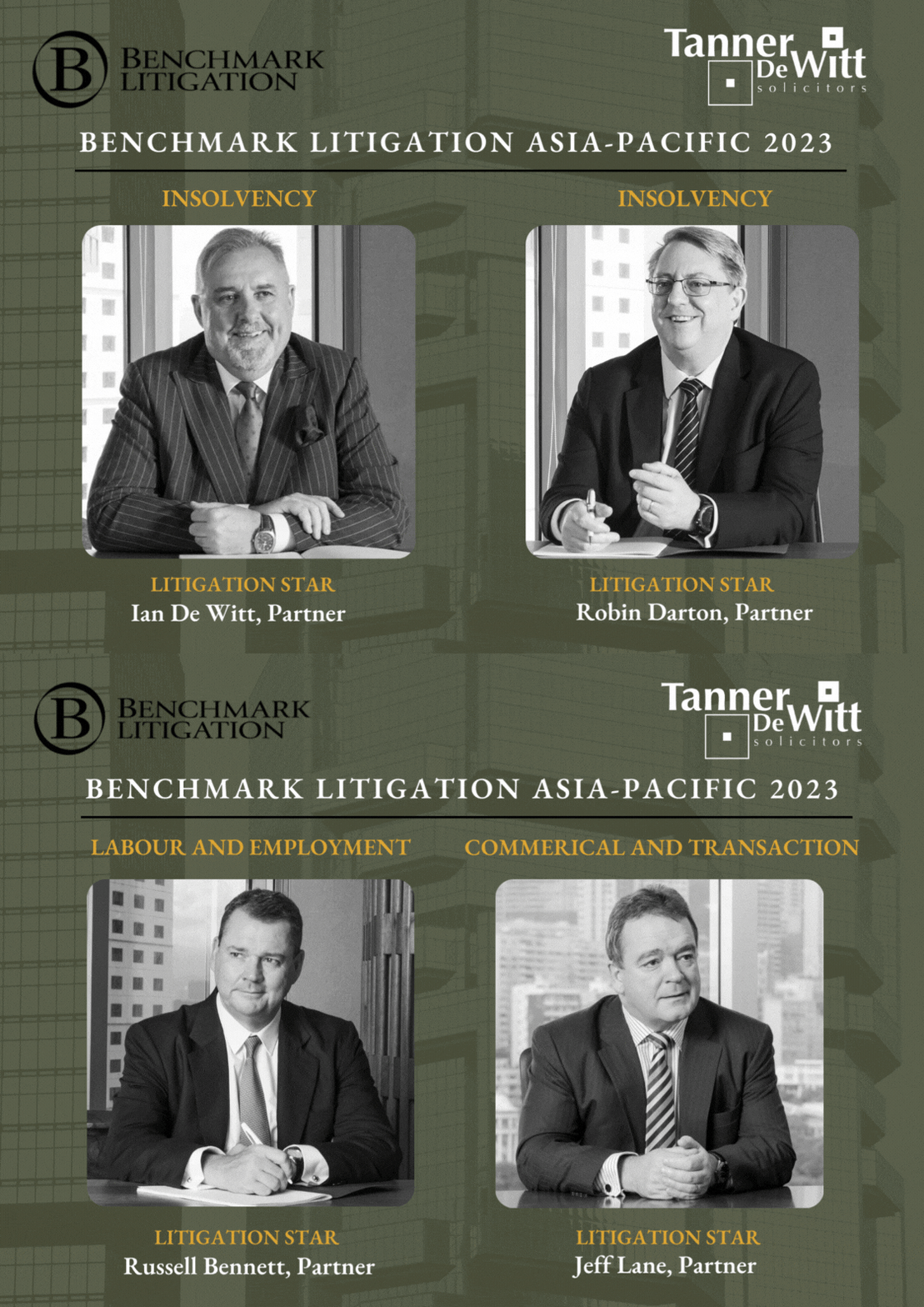
We are pleased to announce that Tanner De Witt has received recognition in the Benchmark Litigation Asia Pacific Guide 2023 across five practice areas, including Insolvency, Commercial and Transactions, Family and Matrimonial, Private Client, and Labor and Employment.
Tanner De Witt has received the following awards:
Tier 1
Insolvency – Domestic firms
Tier 2
Commercial and Transactions – Domestic firms
Tier 3
Family and Matrimonial
Recommended
Private Client – Domestic firms
Labor and Employment – Domestic firms
Furthermore, our partners, Ian De Witt, Robin Darton, Russell Bennett, and Jeff Lane, have been individually ranked as Litigation Stars. We extend our congratulations to all those involved.
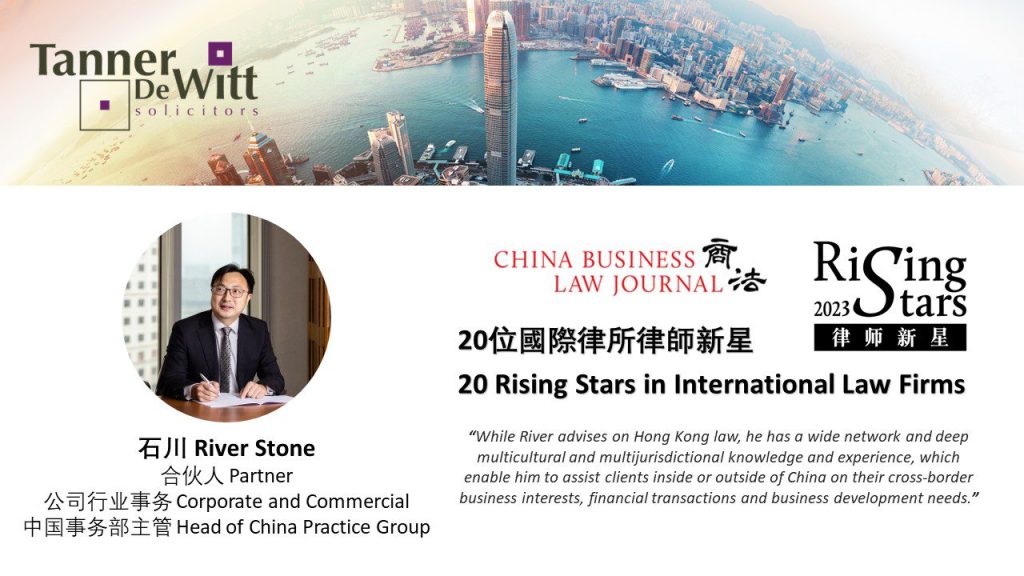
We are pleased to announce River Stone‘s inclusion in the China Business Law Journal list of 20 Rising Stars in International Law Firms committed to China-related Business.
The 2023 China Business Law Journal Rising Stars recognise lawyers that have demonstrated exceptional dedication and professionalism in their practice areas, successfully transitioning from associates to partners and deepening and expanding their practices.
On 31 January 2023, the Hong Kong Monetary Authority (the “HKMA”) issued the consultation conclusions to its discussion paper published on 12 January 2022 (the “Consultation Conclusions”). The Consultation Conclusions provide critical insights into the shape of the HKMA plans for stablecoin regulation in Hong Kong.
Regulation of fiat-linked stablecoins
Unsurprisingly, the HKMA proposes to bring certain activities relating to stablecoins into its regulatory perimeter under a mandatory licensing regime. The HKMA will regulate stablecoins that derive their value by referencing one or more fiat currencies. This type of stablecoin is more likely to be used for payments, and will be more closely linked to the traditional financial system. The HKMA perceives this as potentially posing more imminent monetary and financial risk.
The trigger for regulation will be the reference of the stablecoin to fiat currencies, and will be agnostic to the stabilisation mechanism deployed. This will provide more flexibility to the HKMA to decide if other types of stablecoins should be brought within its regulatory ambit.
The HKMA will exclude certain arrangements from the definition of stablecoins. This is intended to avoid regulatory overlap with regulatory regimes for virtual asset service providers and stored value facilities, in particular. The HKMA also expressed it would take account of the international environment in which stablecoins are used, and would consider international practice and standards in its regulatory approach.
Key activities to be regulated
The key activities that will be subject to the licensing regime are:
Governance: Establishment and maintenance of the rules governing a regulated stablecoin arrangement;
Issuance: Issuance, creation or destruction of regulated stablecoins;
Stabilisation: Stabilisation and reserve management arrangements of regulated stablecoins (whether or not the arrangements are provided by the issuer); and
Wallets: Provision of services that allow the storage of users’ cryptographical keys enabling access to the users’ holdings and management of regulated stablecoins.
The HKMA may include new types of regulated activities in future regulation.
The licensed entity performing regulated activities must retain ultimate control, even if certain activities are outsourced. More guidance on this and other aspects of the licensing regime will be elaborated in future guidelines.
Who will need to be licensed?
The following entities will need to be licensed by the HKMA:
Entities conducting a regulated activity in Hong Kong concerning a regulated stablecoin;
Entities actively marketing regulated activities in respect of a regulated stablecoin to the public of Hong Kong; and
Entities conducting stablecoin-related activities in which the stablecoin concerned purports to reference its value to the Hong Kong dollar (regardless of location or marketing to the public of Hong Kong).
The HKMA will be able to supplement these categories according to circumstances.
The HKMA considers that both authorised institutions and non-authorised institutions should be allowed to issue stablecoins, so long as they comply with licensing and regulatory requirements. The licensing conditions and regulatory approach will be calibrated to the risk each type of issuer presents.
Key regulatory principles
The HKMA will not have a single licence type for all activities. It will customise regulatory requirements to specific types of activities involving stablecoins. The HKMA will adopt these regulatory principles:
Comprehensive regulatory framework: We can expect regulations to cover:
ownership;
governance and management;
financial resources requirements;
risk management;
anti-money laundering and counter-terrorist financing;
user protection; and
regular audits and disclosure requirements
Full backing and redemption at par: The value of the reserve assets of a stablecoin arrangement should meet the value of the outstanding stablecoins at all times. The reserve assets should be of high quality and high liquidity. Stablecoins that derive their value based on arbitrage or algorithm will not be accepted. Stablecoin holders will have the right to convert stablecoins into the reference referenced fiat currency at par within a reasonable period of time.
Principal business restriction: Regulated entities will not be permitted to conduct activities other than its principal business under the relevant licences
Steps from here
The HKMA aims to put in place the regulatory regime for stablecoins by 2023/2024.
The draft legislation will cover key issues such as:
defining the arrangements and activities that will be subject to regulation;
the licensing, rulemaking and enforcement powers be granted to the HKMA; and
the key regulatory requirements.
The HKMA Consultation Conclusions in full is available on this link.
Pádraig Walsh & Raymond Li
If you would like to discuss any of the matters raised in this article, please contact:
Disclaimer: This publication is general in nature and is not intended to constitute legal advice. You should seek professional advice before taking any action in relation to the matters dealt with in this publication.
In this snapshot legal update, we report that on 20 February 2023, the Privacy Commissioner for Personal Data (“PCPD”) reported plans to put forward amendments to the Personal Data (Privacy) Ordinance (“PDPO”) in 2023. The PCPD’s target is to present concrete proposed amendments and consult with the Legislative Council Panel on Constitutional Affairs in the second quarter of 2023.
The proposed amendments will address:
Proposed amendments
Current regime
Establish a mandatory data breach notification mechanism.
There is no statutory mandatory data breach notification requirement. Data users are encouraged under a guidance note issued by PCPD in June 2020 to notify the affected data subjects, the PCPD and other relevant parties in response to a data breach.
Require data users to formulate a data retention policy setting out how personal data is to be retained.
There is no statutory requirement that data users should have a data retention policy.
Empower the PCPD to impose administrative fines.
The PCPD has the power to conduct investigations regarding breaches of the PDPO, issue enforcement notices and, in limited cases, institute prosecutions. However, the PCPD has no power to impose administrative fines.
Introduce direct regulation of data processors.
Data processors are not directly regulated under the PDPO; only data users are. The data user is directly liable for the conduct of the data processor as the principal. It is for the data user to take steps to monitor the data processor’s conduct and prevent the data processor’s non-compliance with the PDPO.
These changes are consistent with proposals announced in January 2020 [see our report here].
The Report on the Work of the Office of the PCPD in 2022 can be found here.
Pádraig Walsh, Tara Chan and Jane Du
If you would like to discuss any of the matters raised in this article, please contact:
Disclaimer: This publication is general in nature and is not intended to constitute legal advice. You should seek professional advice before taking any action in relation to the matters dealt with in this publication.
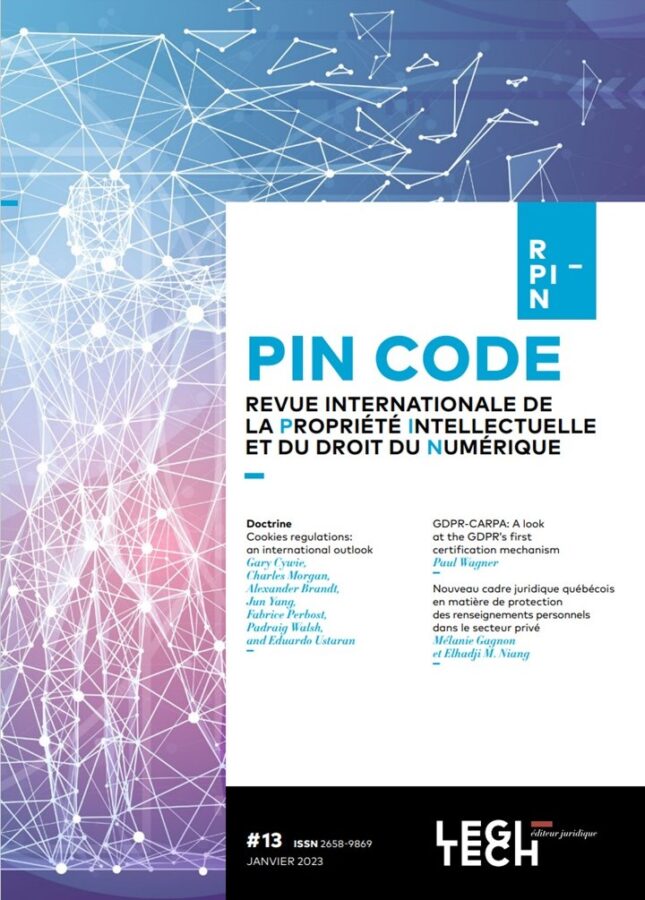
Partner Pádraig Walsh provides the following overview on Hong Kong Cookies Regulation as part of a coordinated international review published in PIN CODE.
Citation: Gary CYWIE, Charles MORGAN, Fabrice PERBOST, Alexander BRANDT, Padraig WALSH, Jun YANG and Eduardo USTARAN, ‘Cookies Regulations: An International Outlook’, Revue internationale de la propriété intellectuelle et du droit du numérique, 13 (Luxembourg, Legitech, 2023), 1-11.PDF copy available for download here.
The primary legislation in Hong Kong that regulates cookies is the Personal Data (Privacy) Ordinance (“PD PO” Cap. 486). Also, the Privacy Commissioner for Personal Data (“PCPD”) has issued guidance notes that provide helpful guidance to the public about personal data protection and use of cookies. PCPD guidance notes are not mandatory but are recommended practices for practitioners to follow.
1) Personal data in Hong Kong
The PDPO regulates how data users collect, process and use personal data.
A “data user”, in relation to personal data, means a person who, either alone or jointly or in common with other persons, controls the collection, holding, processing or use of personal data. It is the term under Hong Kong law that most closely approximates to data controllers. The PDPO defines “personal data” as any data that:
relates directly or indirectly to a living individual;
is practicable to ascertain the identity of the individual; and
is in a form in which access to or processing of the data is practicable.
Not all cookies are considered as processing personal data. If a cookie contains data that can identify a person uniquely, then the cookie will be considered personal data. An example would be information containing a name or telephone number. However, if the cookie does not uniquely identify a person, then the cookie may not be considered personal data and may fall outside the scope of protection under the PDPO. For example, an IP address was held not to be personal data as it was information about an inanimate computer, not an individual. The username “huoyan_1989” for a free email service provider was also not considered personal data as it was insufficient to ascertain the user’s identity. These are interesting points of contrast to the position in the European Economic Area under the General Data Protection Regulation, where a different definition of personal data is used and email addresses and IP addresses would likely be considered personal data.
2) Are consent statements required?
Hong Kong follows a practice of informed but implied consent upon collection of personal data, except if direct marketing is intended. This practice must be followed for cookies processing personal data.
On or before collection of the personal data of a data subject, a data user must inform the data subject of:
the personal data that will be collected;
the purposes for which the personal data will be used;
the classes of transferees to which the personal data may be transferred or shared;
whether it is obligatory or voluntary for the data subject to supply his personal data;
whether the personal data will be used for direct marketing; and
his right to access and correct his personal data and the contact details to do so.
These obligations are met by providing the data subject a personal information collection statement on or before collection of the personal data. Once this requirement is fulfilled, then express or written consent of the data subject is only required if the data user changes the purposes for which the personal data may be used (including the classes of transferees). The position is different if cookies contain personal data and their use will be for direct marketing purposes. In this situation, the express, voluntary, specific and separate consent of the data subject must be obtained on or before collection of the personal data by the relevant cookie.
3) What should data users do?
The PCPD has issued guidance notes that apply to cookies and provide information, recommendations and practices that data users should adopt. These recommendations include:
website owners should explicitly state what kind of information is stored in the cookies, regardless of whether personal data is involved.
pre-set a reasonable expiry date for cookies.
encrypt the contents of cookies whenever appropriate.
do not deploy techniques such as super cookies that ignore browser settings on cookies unless the website owner can offer an option to disable or reject the use of such cookies.
inform website users about the purpose of collecting the information and obtain express and voluntary consent for any change to the purpose of use.
take steps to protect the collected information from unauthorised access, disclosure or loss.
if third-party cookies are deployed, the website owner should also clearly state the type of information collected and to whom such information may be transferred to.
if the acceptance of the use of cookies is mandatory, then this requirement should be clearly stated on the website.
if acceptance of use of cookies is voluntary, the website should provide users with an option to accept or decline the use of cookies, and clear information of the consequences if users decline the use of cookies (for example loss of certain functionality).
Pádraig Walsh, Tara Chan, and Julian Chan
If you would like to discuss any of the matters raised in this article, please contact:
Disclaimer: This publication is general in nature and is not intended to constitute legal advice. You should seek professional advice before taking any action in relation to the matters dealt with in this publication.
Tanner De Witt is delighted once again to be recognised by Chambers & Partners in their inaugural 2023 Greater China Region Guide for each of its main practice areas. Please see full results and editorial commentary below.
Corporate/M&A: Independent Hong Kong Firms (Band 2) Full ranking here.
Tanner De Witt remains part of a global referral network with elite law firms, frequently handling cross-border mandates. Its services cover the full range of corporate and commercial matters, including investments, joint ventures and M&A transactions. The team is strong in dealing with regulatory compliance work related to corporate transactions. Tanner De Witt is additionally able to assist clients on venture capital transactions, as well as restructurings and reorganisations. The firm counts ZV France and Newborn Town among its major clients.
Strengths One client comments: “I always have very efficient and responsive communication with Tanner De Witt.”
Another client compliments the team’s “very commercial and practical advice without complicating the issues.”
Work highlights
Tanner De Witt assisted Qima in its acquisition of an inspection services provider.
Eddie Lookwins praise for his handling of cross-border M&A, joint venture establishments and private equity transactions. He is regularly mandated by clients from the manufacturing, financial services and life science industries.
One client says “Eddie not only has vast experience of corporate transactions in Hong Kong, but also has a deep understanding of our business.”
While another adds, “He is easy to communicate with and very willing to help.”
Edmond Leungfocuses his practice on multi-jurisdictional private equity and M&A, and frequently acts on behalf of international companies and investors. He has extensive experience advising on acquisitions, divestments and corporate reorganisations. Clients comment that he is “technically sound but pragmatic as well in his advice to deliver effective legal solutions” while maintaining “good client relations and [being] very good to work with.”
Tim Drew co-leads the corporate department of Tanner De Witt. He has over two decades’ experience in the Hong Kong corporate market, handling all manner of cross-border corporate and transactional mandates, including M&A, disposals and shareholders’ agreements.
“Tim takes a highly commercial approach combined with a positive ‘can do’ attitude. Tim gets deals done and is a pleasure to work with. He is accessible and I can always get hold of him” says a client.
“Tim has a good awareness of the potential commercial pitfalls we may face and always has a good solution for us.”
Dispute Resolution: Litigation (International Firms) (Band 4) Full ranking here.
What the team is known for
Tanner De Witt is a respected, independent Hong Kong firm, acknowledged for its broad commercial disputes offering. Its areas of expertise include professional negligence claims, shareholder disputes, debt and asset recovery, fraud, and contentious trusts and probate. The team often acts for clients in the financial services sector, international investors and high net worth individuals and families. Its key clients include Kroll, KPMG and FraudNet.
Strengths A client comments that “The team are all very capable and articulate and offer immediate responses, even when on holiday. They are also aware of latest events and case law that will have an impact on the matters at hand.”
A different client praises the team for being: “always ready with documents and advice and the team all worked well together.”
A third happy client states: “Tanner De Witt always offers exemplary levels of service and is one of our go-to Hong Kong firms. They are always commercial and responsive.”
Work highlights
Tanner De Witt acted for a Chinese cement producer in a longstanding shareholders’ dispute case.
Jeff Lane is well versed in fraud claims and various tracing and recovery actions. He is also experienced with cyber-fraud claims. A client states: ““He’s very experienced and efficient, with a good network.”
Mark Sideis head of the firm’s dispute resolution team. He is known for handling employment disputes, as well as contentious regulatory matters and white-collar crime investigations. Chambers Asia notes that Mark is “strategically very strong, mindful of our concerns and [he] always explains the contributing factors to his advice”.
Pamela Makis co-head of Tanner De Witt’s China practice group in Hong Kong and often acts on contentious probate cases, as well as shareholder disputes and asset tracing and recovery. One source praises her client skills, observing that “she’s very skilled at handling even the most demanding client.” Other clients comment that she “is excellent at handling sensitive matters.” and that “She’s very good at managing complex matters and gives practical and commercial advice.”
Richard Wilmot is a consultant in Tanner De Witt’s Hong Kong office. He frequently acts for lenders, bondholders and investors on recovery and enforcement actions.
One client says “working with Richard is a very good and interactive experience.” Another saying, “I have worked with Richard for many years. He and his team have never failed to solve any issues referred to him”
Employment: Hong Kong-based (International Firms) (Band 2)
What the team is known for
The strong contentious employment team at Tanner De Witt possesses notable expertise representing employees in high-profile litigation cases. It is active on matters involving individuals employed in Hong Kong, including supporting foreign domestic workers on a pro bono basis, but it also advises employers on work policies, contracts and post-employment restrictions. Tanner De Witt is highly active on cases related to race and sex discrimination, and white-collar crime investigations.
Strengths One client appreciates its “ability to translate a complex matter into bite-sized issues for discussions and considerations.”
One impressed interviewee finds the team’s analyses “clear and concise.” Another client observes: “The employment team works closely with their civil litigation team and provides fast response on contentious matters.” While another adds, “They offer exceptional service and attention, with humour when needed!”
Russell Bennett is well placed to represent clients in disputes arising out of discrimination and harassment claims and contested terminations, with a focus on advising clients from the financial services sector. One happy client reports: “Russell is one of the few employee-friendly lawyers in town. His advice is practical and covers all corners.” Another source states: “Russell is a very experienced lawyer specialising in employment law.” And clients comment that “Russell is a great adviser. He’s realistic, reliable and totally practical.”
Family/Matrimonial (International Firms) (Band 3)
What the team is known for
Tanner De Witt is an independent Hong Kong practice offering advice on a range of family and matrimonial matters. The firm is experienced in handling divorce proceedings and child-related cases. It assists on cross-border abduction matters, with particular expertise in cases involving the Hague Convention. The team also provides support in nuptial agreements and trust arrangements.
Strengths “The team has a hands-on, friendly and practical approach. They have the skills to break down stubborn parties and barriers and seek resolution with ease.”
Clients appreciate the team for “care(ing) about their clients and try to protect them. Their preparation is very on point, and they are knowledge of the law and procedures.”
Joanne Brown draws widespread support from sources and is especially skilled in divorce, custody and nuptial matters. Her expertise in cross-jurisdictional matters is regularly sought by clients. Clients find her to be “extremely fair and very practical” adding that “she has a very good strategic mind.” Another source also comments that “Joanne is solution-oriented, so she doesn’t shy away from telling the truth. She is respected among solicitors.”
Restructuring/Insolvency (International Firms) (Band 2)
What the team is known for
Tanner De Witt fields a well-established independent Hong Kong restructuring and insolvency team that holds a strong reputation, particularly in relation to high-stakes contentious insolvency cases. The team regularly handles complex domestic and cross-jurisdictional litigations. Its clients include distressed companies and liquidators.
Strengths “Tanners De Witt is a big team and able to deploy team members in larger situations.” Sources also comment that the team are “excellent problem solvers.”
Work highlights
Tanner De Witt assisted a private bank and asset management firm, as petitioning creditor, with obtaining a bankruptcy order against an individual who held directorships in several companies listed in Hong Kong.
Ian De Witt‘s deep expertise spans both the advisory and contentious aspects of restructuring and insolvency-related work. He is a counsel of choice among liquidators and creditors. Clients see him as an “excellent problem solver” and that “He is commercial, approachable and a fountain of knowledge in Hong Kong law and procedure.”
Robin Darton is a highly regarded authority on international insolvency and liquidation matters. He offers impressive expertise handling contentious and non-contentious cases for liquidators and debtors.
Sources speak highly of Robin as “he knows very well how things work in the Hong Kong market, and what you need, be it legal advice or strategy.”
A client comments: “Robin has buckets of experience, and is technically strong.”
TMT (International Firms) (Band 4)
What the team is known for
Tanner De Witt’s TMT practice offers considerable experience in multi-jurisdictional technology transactions and offers technology businesses broad legal support through all stages of their growth and development. Key clients include DaRen Biotech, Bowtie Life Insurance and Brinc.
Strengths Sources praised the team for their timely, high-quality work: “Things move fast in our world, and the team at Tanner De Witt move fast with us, though urgency does not change work quality. Their documents are well laid out, and in language non-lawyers can understand. Their advice is clear and actionable. They are very reliable.” While a client states: “I was impressed with the turnaround time, the thoughtfulness of the documents, the responsiveness to my comments and the partner-level attention.”
Work Highlights
Tanner De Witt advised Nomura on the extension and modification of a transaction with Hitachi Vantara to provide the bank with global data capacity on a utility compute basis.
Pádraig Walsh
He received high praises from sources, stating: “Padraig was a joy to work with. He is responsive, smart, friendly and very accommodating of special requests – an excellent lawyer.” While clients admire his expertise, commenting that “He is a very highly skilled IT law expert with whom it is a pleasure to work.” Also that “He has in-depth knowledge of conducting venture capital investments and deep experience in various commercial and business issues. Mr. Walsh always considers our business needs and provides us with practical advice.” Speaking highly of Pádraig as he “has fulfilled and surpassed (their) expectations for legal expertise.”
For an archive of Tanner De Witt’s Chambers rankings, please click here.
Tanner De Witt, 17th Floor, Tower One, Lippo Centre, 89 Queensway, Admiralty, Hong Kong
Tanner De Witt expertly leverages its independent Hong Kong origins to provide comprehensive advice across all elements of restructuring and insolvency, particularly relating to domestic matters. The firm has seen an increase in listed company work and has been active for a number of PRC property developers in recent months, as well as being regularly instructed by investors, financial institutions, insolvency practitioners and debtor companies. The R&I team is active in both contentious and non-contentious matters and has international capacity and experience. Practice heads, Ian De Witt⭐ and Robin Darton⭐, have extensive experience dealing with contentious and insolvency related matters, both in Hong Kong and cross border, and winding-up proceedings, bond restructurings and cross-border recognition proceedings, with expertise in off-shore matters.
‘When it comes to insolvency, TDW is really the best in town. They have probably forgotten more about insolvency than most know. Truly excellent in terms of knowledge, approach and service to clients. Could not recommend them more highly.’
‘Sunny Hathiramani and Veronica Chan are well connected in the Hong Kong market and add supporting firepower.’
‘Deep bench of talented and commercial lawyers led by Ian De Witt and Robin Darton. The firm offers seamless service with pragmatic and strategic advice.’
‘Tanner De Witt is a leading restructuring and insolvency law firm in Hong Kong. Their partners are trustworthy and always consider issues from different perspectives.’
‘Independent HK law firm with incredible depth of experience and packing a punch if not leading the pack amongst the international firms in the same area.’
‘Very knowledgeable about the insolvency landscape in Hong Kong. One of the most sure-footed insolvency firms in Hong Kong.’
‘An independent local practise focused on insolvency/restructuring situations. Whilst being a local practise, the size and spectrum of its team should rank ahead of many international firms.’
‘Ian de Witt and Robin Darton provide a very desirable mix of prior international law firm experience and working in a local team that has operated successfully in Hong Kong for many years, combining local knowledge with cross-border expertise.’
Employment – ranked: tier 2
The established and longstanding employment team at Tanner De Witt has been heavily involved in many of the contemporary issues within the Hong Kong market caused by the global pandemic, including vaccination requirements and remote working. The firm has an extensive advisory practice, providing advice to domestic and international clients in relation to employment documents, potential redundancies and terminations and discrimination claims. The practice still benefits from the wealth of experience provided by employment veteran Kim Boreham, despite stepping into a consultancy role. Russell Bennett is the founder and head of the team, with a significant part of his practice involving advising clients in the financial services industry, particularly when it comes to matters which require input on potential regulatory consequences.
‘The team looks at the big picture and very accurately addresses the way the Court will view the case. In one case, the team chose to attack ‘abuse of process’, which they did successfully. The Judge himself considered it a big leap, but he agreed.’
‘Russell Bennett always has a good view of the way to present a case.’
‘Mark Chiu is excellent at resolving details and issues of a case.’
‘I worked with Kim Boreham and her team on several employment related cases, they are responsive to client’s questions and give practical advice. The quality of her work is very good.’
‘Kim Boreham is a very experienced employment lawyer representing both the employers and the employees, hence, she gives very practical advice when advising employer’s. Her outstanding experience has successfully helped our company in stopping an ex-employee who kept on sending harassing emails to management for over 3 months.’’
Dispute resolution: litigation – ranked: tier 3
Benefitting from an ‘excellent understanding of Hong Kong and the wider region’, independent local firm Tanner De Witt provides ‘responsive, very sensible and commercial advice’ directly to clients, as well as part of cross border teams with other firms. The scope of the work is broad and includes contentious insolvency matters, probate disputes, shareholder litigation, fraud and asset tracing. Pamela Mak ‘is particularly skilled at dealing with mainland clients’ and co-heads the team alongside Mark Side , who specialises in contentious regulatory matters. ‘Top disputes lawyer’ Jeff Lane is also recognisedparticularly in the context of fraud and asset recovery matters.
I have been impressed by Tanner De Witt’s thorough approach to every litigation matter I have worked on with them. They also have excellent relations with attorneys located in many other jurisdictions that gives them tremendous depth to address complex cross-border issues.’
‘Tanner De Witt is a highly sophisticated complex litigation firm in my experience and because they are independent they are more flexible than many of their competitors. The have a really good understanding of Hong Kong and the wider region and are staffed with experienced, diligent and careful associates.’
‘The team provides responsive, very sensible and commercial advice.’
‘The team is strong in disputes where there are allegations of serious wrongdoing and in applying for or responding to injunctive relief. They are also commercially sensible when it comes to pricing and are collegiate in the way that they work.’
‘Pamela Mak is particularly skilled at dealing with mainland clients, and skilled at soothing difficult clients.’
‘Jeff Lane is a top disputes lawyer, with particular expertise in fraud and asset recovery matters.’
Private client and Family – ranked: tier 3
Tanner De Witt possesses considerable depth and breadth in terms of its private client and family practice, involved in both complex cross-border work as well as contentious and non-contentious domestic matters. The team has a particularly strong family offering, with Joanne Brown heading the family side and regularly instructed regarding nuptial agreements, child removal and access and requests for injunctive relief. Eddie Look also heads the team and is highly active on private client matters, advising a wide range of clients including trustees, executors and administrators. Mark Side also comes highly recommended.
Testimonials
They have a truly well-rounded team, able to deal with the full gamut of family work. The partners have very different approaches and experiences, and are able to work off of that breadth of expertise.’
‘Tanner De Witt’s family law team is highly regarded in the sector. They are experienced and deliver a high level of service to their clients. They are very good at navigating family litigation, including complex cases, and also at avoiding contested litigation altogether.’
‘Joanne Brown’s team are some of the best family practitioners in Hong Kong, running cases with the minimum amount of conflict that is possible in their clients best interests.’
‘I have worked closely with Eddie Look on a number of matters and cannot praise his professionalism enough. He always makes himself available for an initial chat and his responses are thorough, clear and well-reasoned.’
‘Joanne Brown is a first class family lawyer, who always has time for her clients and can handle the toughest cases. She is both practical and strategic, and gets the best possible results.’
TMT – ranked: tier 3
Fielding ‘a very robust TMT practice‘, Tanner De Witt is consistently selected as Hong Kong co-counsel on major international technology transactions. Focused on founder representation, the firm’s domestic technology practice in Hong Kong routinely partners with government bodies, accelerator and incubation programmes, and other technology sector intermediaries. The practice of technology team leader and ‘standout lawyer‘ Pàdraig Walsh covers issues arising from new technologies, such as cloud, blockchain and AI. Foreign legal consultant Nigel Stamp, a commercial TMT law and outsourcing specialist, is a 2021 hire from K&L Gates, while Tara Chan and Alan Wong are the associates to note.
‘There is a great team at Tanner De Witt. The lawyers are friendly and approachable, and they really know what they are doing.’
‘Tanner De Witt has a very robust TMT practice that can handle a variety of matters, including data privacy, telecoms, cybersecurity, and fintech issues. It is well known for transforming complex legal issues into pragmatic solutions that make sense to clients.’
‘Tanner De Witt has a very strong TMT practice team. Although it is not big, it is solid, and its fee arrangements are flexible and can be tailored to the client’s budgeting needs. The advice the lawyers provide is also very practical.’
‘Pàdraig Walsh is a seasoned TMT attorney, who understands the client’s business and commercial needs. The advice he provides is solid and practical, and he is supported by a group of talented attorneys.’
‘Pàdraig Walsh is very experienced and understands clients’ business. He has deep knowledge of the market, bringing all this to bear with straightforward and strategic advice. Clients know they are getting good advice that they can rely on.’
‘Pàdraig Walsh is a standout lawyer who is known for his ability to handle complex matters for clients from the fintech and technology sectors. He is certainly a leader in this practice area.’
‘Foreign legal consultant Nigel Stamp is very supportive and will go the extra mile to find out information that will be helpful for clients’ projects. Clients greatly appreciate his devotion and determination.’
‘Associate Tara Chan is very responsive, clear and direct in her advice. Clients know they can get the help they need even if there is a tight timeline.’
Commercial, Corporate and M&A: Independent Hong Kong Law Firms – ranked: tier 3
Tanner De Witt is highly active in the Hong Kong corporate market, advising on both domestic and cross-border deals including the HK aspects of large-scale, multi-jurisdictional deals. Eddie Look and Tim Drew jointly lead the team and between them offer decades of experience in M&A, investments and joint ventures; elsewhere, River Stone stands out for his focus on public market transactions such as share sales and acquisitions. The team’s client base is broad and encompasses Hong Kong and international companies across sectors including technology, manufacturing and consumer goods.
‘The Tanner de Witt team are always great to work with. They have very talented lawyers, attract a fantastic calibre of clients, and are always a great bunch of people to work with.’
‘River Stone who heads the China desk, Edmond Leung (corporate/M&A) and Eddie Look are the key practitioners in the team. They’re always very approachable and responsive and give very practical and commercially savvy advice.’
‘We have worked with Tim Drew and Carol Ling from Tanner De Witt. Both are excellent and professional lawyers, who were extremely on the ball and highly responsive.’
‘An exceptional practice. A real feeling of total teamwork, from the most senior in the team which was assigned for my advisory work, to the next levels in the team. Each team member knew their role and there was evident synergy across the team members which meant that as a client, I felt all were aligned and on the same page with my situation and the details of my matters.’
‘The corporate practice has a strong bench and take a very hands on and pragmatic approach. The partners are really experienced and understand the market. They take the time to understand the client and what they are looking to achieve.’
‘Tim Drew has deep experience in the market. He is a delight to work with and gets deals done. He has a way of cutting through complexity and making you feel that you are in very safe hands.’
‘An independent boutique Hong Kong firm which punches above their weight. Very knowledgeable, commercial and value for money.’
‘Capable, quick and experienced.’
For an archive of Tanner De Witt’s Legal 500 rankings, please click here.
Tanner De Witt, 17th Floor, Tower One, Lippo Centre, 89 Queensway, Admiralty, Hong Kong