
text

May 14 2026

Under Hong Kong’s anti‑discrimination ordinances, damages are compensatory in nature, aimed at compensating loss and damage suffered by the claimant as a result of unlawful discrimination. “Injury to feelings” is often a key component of such awards, and we have previously written about the assessment of damages for “injury to feelings”, and the local adjustment of the Vento scale of compensation in line with inflation.

This article does not revisit those issues. Instead, it focuses on the financial loss element of compensation, in particular how loss of earnings is assessed, and whether the UK decision in Chagger v Abbey National plc [2009] EWCA Civ 1202 offers any useful guidance in the Hong Kong context.

Loss of earnings in Hong Kong discrimination cases

Where Hong Kong courts assess loss of earnings following discriminatory dismissal or treatment culminating in loss of employment, the general approach is to ask what constitutes a reasonable period for the claimant to obtain alternative employment, assessed based on the circumstances of the case.

Guidance can be found in Chan Choi Yin Janice v Toppan Forms (Hong Kong) Limited (DCEO 6/2002). This followed the reasoning in Minister of Defence v. Cannock [1994] IRC 918, where the UK Court observed that

“In support I am referred to the following passage in Discrimination: Remedies and Quantum at p.73, para.3.1.3  ‘Future Losses: Remedies and Quantum at p.73, para.3.1.3  ‘Future Losses:

In the vast majority of cases the court or tribunal will approach its tasks as in an unfair dismissal claim, assessing the period of loss primarily as being limited to the time in which the applicant might reasonably be expected to find other employment. As a result, periods of future loss may be limited to 12 –24 months, or even less.’ …

…I do not think the learned authors of Discrimination: Remedies and Quantum meant that there is a cap to claims for future losses in discrimination cases. They were, it seems, assuming assessments in cases where the plaintiffs had yet to find alternative work. In such cases assessments of two years or less as the time it would take to find employment are understandable. This must depend, however, on the facts of each case. In discrimination claims in England, there is no cap on future loss, as the concluding passage of the judgment of the EAT (Morrison J) in Minister of Defence v. Cannock [1994] IRC 918 at p. 955G makes clear:

‘In our guidance, we respectfully suggest that [courts] need to keep a due sense of proportion when assessing compensation. Some of the applicants have received awards more appropriate for a person who has lost a career due to some kind of continuing disability. All of these applicants who were entitled to any award of compensation of loss of earnings are assumed to have been ready willing and able to resume their career in the services six months after their first child was born and, therefore, ready willing and able to undertake reasonably suitable alternative employment. To this extent, their compensation for loss of earnings is not likely to be different from the thousands of cases of unfair dismissal with which the industrial tribunals are having to deal with each year, albeit, that there is no cap on the award.’ “

Therefore while there is no legal cap on claims for future loss of earnings in discrimination cases, tribunals should “keep a due sense of proportion when assessing compensation”. The inquiry focuses on employability, including the claimant’s performance, their past relationship with their employer, whether the claimant is ready, willing and able to undertake suitable alternative employment, whether such employment is realistically available having regard to their skills and experience.

In practice, this has often resulted in awards covering a defined and relatively short period, similar to those seen in unfair dismissal claims. This reflects the courts’ recognition that private‑sector employment does not offer guaranteed security of tenure or remuneration over the longer term, and that loss of earnings must be assessed by reference to realistic labour‑market outcomes rather than assumptions of continued employment. Thus, in 秦秀清 v 長鴻鋁窗裝飾工程有限公司 (DCEO 3/2018), the District Court awarded the equivalent of three months’ wages as a reasonable period to secure alternative employment, whereas in Haden, Francis William v Leighton Contractors (DCEO 16/2018), a longer period of eight months was allowed, reflecting the claimant’s specialised expertise in blasting work and the limited availability of comparable roles in Hong Kong.

That said, the reasonable job-search period is not an inflexible proxy in every case. Where it would not adequately capture future loss, courts have accounted for other metrics, including: how long an employee might otherwise have remained in the role, particularly where employment was for a fixed term,[1] differences between the claimant’s original salary and earnings in subsequent employment,[2] and the period during which the claimant would have been able to resume work following recovery from an illness before suffering a relapse.[3]

In principle, this analysis also leaves room for longer period of loss where re-employment within a short timeframe was not realistically foreseeable at the point of dismissal. An extreme example would be the discriminatory dismissal of an employee in their early 60s, where age or health materially constrains future employability, casing a genuine loss of career. In such cases, a longer period of loss may be recoverable if supported by evidence that suitable alternative employment was unlikely to be obtained within a conventional job‑search period. The focus remains on what is objectively reasonable.

The assessment operates alongside the claimant’s duty to mitigate loss by taking reasonable steps to seek alternative employment. Losses that could reasonably have been avoided are not recoverable, and a longer period of unemployment does not in itself justify recovery for the entirety of that period. [4] The assessment is fact‑sensitive and evidence‑based, grounded in labour‑market realities.

The UK approach in Chagger

The UK decision in Chagger v Abbey National plc provides a useful analytical framework for assessing loss of earnings in discrimination cases. The central inquiry is this: What would have happened had there been no discrimination at all?

This requires a comparison between two scenarios. In a discrimination‑free scenario, the employee may have remained employed long enough to secure alternative employment and transition smoothly into a new role on comparable or better terms. In the discriminatory scenario, the employee is forced abruptly into the labour market at a time and in circumstances not of their own choosing, often resulting in delayed re‑employment or depressed earnings. The loss to be compensated is the difference between these two positions.

A key point from Chagger is that compensation should not automatically be confined to the period during which the employee might otherwise have remained with the employer. Evidence that an employee was likely to have quit in any event does not, by itself, justify limiting compensation to that period. The relevant question is how the employee would have exited the employment relationship in a non‑discriminatory environment, and the labour‑market consequences flowing from that exit.

This does not mean such evidence is irrelevant. Where there is credible evidence that the employee would probably have left (or been dismissed) in any event, compensation may be reduced by applying a so-called “Chagger reduction”. This typically takes the form of a percentage reduction directly corresponding to the percentage likelihood that the employee would have exited employment absent discrimination.

The Chagger approach was reinforced in the recent case of KJ v British Council [2026] EAT 46. In that case, the tribunal applied a 35% Chagger reduction on the basis that the claimant might have left employment anyway. On appeal, that approach was rejected because insufficient attention had been given to whether the claimant’s thoughts about leaving, and steps taken to explore other opportunities, were themselves influenced by the discriminatory conduct. The correct focus remained what would have happened if there had been no discrimination at all.

Takeaways for Hong Kong

While Chagger and KJ are not binding in Hong Kong, they are helpful in clarifying how loss of earnings should be analysed in principle.  In particular, they highlight the risk of reducing compensation by reference to hypothetical departures or claimant behaviour without first considering whether those outcomes were themselves shaped by the discrimination itself.

Hong Kong courts have generally adopted a pragmatic approach, often limiting loss of earnings to a reasonable job‑search period and placing weight on mitigation. However, the assessment remains fact‑sensitive, and the court’s task is to compensate the loss caused by discrimination, rather than to apply fixed assumptions about how long an employee might otherwise have stayed.

In exceptional cases, Hong Kong courts have recognised longer‑term loss where discrimination has foreclosed a particular career path. In K & Ors v Secretary for Justice (DCEO 3, 4 and 7/1999), the District Court awarded future loss of earnings based on the pay gap between disciplined services roles and alternative employment, as well as the loss of associated benefits such as housing and pension. This case turned on its specific facts, involving the loss of a relatively secure public service career, and does not represent the norm. It nonetheless illustrates that Hong Kong courts are, in principle, prepared to look beyond short‑term loss where discrimination has clearly affected the claimant’s broader position in the labour market.

Russell Bennett

Russell Bennett

For more information on employment matters, please contact:

Russell Bennett
Partner | Email

Disclaimer: This publication is general in nature and is not intended to constitute legal advice. You should seek professional advice before taking any action in relation to the matters dealt with in this publication.

[1] See Ip Kai Sang v Federal Elite Limited (DCEO 8/2006).

[2] See Lam Wing Lai v YT Cheng (Chingtai) Ltd (DCEO 6/2004).

[3] See Siu Kai Yuen v Maria College (DCEO 9/2004).

[4] Per Li Pui Ha v Wing So Kee Transportation Ltd (DCEO 4/2013) at para. 26.
Featured Articles

Insights
What Is the Right Measure of Compensation in Hong Kong Discrimination Claims?
Insights
News update: Finfluencers on the SFC regulatory radar
Insights
News update: Secondary Trading of Tokenised Authorised Investment Products Permitted in Hong Kong
Insights
News update: Hong Kong Privacy Commissioner claws back privacy protection from agentic AI tools
Insights
Enforcement action follows PCPD finding of ineffective data privacy training
Insights
What you need to know about the Protection of Critical Infrastructures (Computer Systems) Ordinance, the cybersecurity legislation in Hong Kong (Part 6)

text

Apr 17 2026

Employers often assume that a conditional job offer, that is conditional of a background check or regulatory approval of such like, can be withdrawn freely before an employee’s first day if that condition has not yet been met. However, a recent UK Employment Appeal Tribunal decision, Kankanalapalli v Loesche Energy Systems [2026] EAT 49, shows why that assumption can be risky.

While not binding in Hong Kong, the reasoning closely aligns with Hong Kong contract law principles and the termination framework under the Employment Ordinance (Cap. 57). The case is a timely reminder that, once accepted, a conditional offer may already expose employers to contractual liability if withdrawn without notice.

The case in brief

In Kankanalapalli, the employer offered him a senior project manager role subject to:

  • receipt of satisfactory references,
  • a right to work check, and
  • successful completion of probation.

The role required relocation and a start date had been agreed. Yet, no notice period was provided in the offer. The candidate accepted the offer by email and undertook onboarding steps. He provided personal details, right to work documentation and referee contact details. Before his start date, the employer withdrew the offer due to project delays.

The employer took the position that the offer remained conditional and that no binding contract had been formed. The candidate disagreed and brought employment tribunal proceedings.

At first instance, the Employment Tribunal held that there was no binding contract because the conditions were not yet satisfied. It found that the offer had been validly accepted by the candidate but no contract had arisen because the reference and right to work conditions were treated as conditions precedent to contract formation.

The Employment Appeal Tribunal disagreed with the Employment Tribunal’s approach. It focused on whether the stated conditions operated as conditions precedent or conditions subsequent as a matter of construction.

The Employment Appeal Tribunal held that:

  • “Conditional” does not automatically mean non‑binding – Whether conditions prevent a contract from forming (conditions precedent) or instead allow termination of an existing contract (conditions subsequent) depends on the wording and surrounding context. There is no automatic rule.
  • A binding contract had been formed on acceptance – The offer set out all key employment terms, the conditions were grouped together (including probation), and the employer had taken steps consistent with onboarding. On proper construction, the wording around references suggested termination if unsatisfactory, rather than no contract existing until provided. Therefore, the conditions operated as grounds for termination, not as barriers to contract formation.
  • Withdrawal was not unrestricted – Even if conditions remain outstanding, an employer may not have an unrestricted right to withdraw an accepted offer for unrelated reasons.
  • Reasonable notice was implied – As the offer was silent on notice, a term requiring termination on reasonable notice was implied. Reasonable notice must be assessed at the time the contract was entered into, not by reference to later‑produced standard terms or statutory minimums alone.
  • Three months’ notice was reasonable – Having regard to the seniority of the role, international element, and expectations created during recruitment, three months’ notice was appropriate. Withdrawal without notice was therefore a breach of contract.

Relevance for Hong Kong employers

Although Kankanalapalli is not binding in Hong Kong, its reasoning sits comfortably with Hong Kong law and is likely to be treated as persuasive.

Under Hong Kong law, an employment contract may be formed before the employee commences work once an offer is accepted and the essential elements of contract are present. The absence of a signed formal contract, or the fact that employment has not yet started, is not determinative.

Conditions commonly found in Hong Kong offer letters – such as reference checks, background screening, or work authorisation – will not automatically prevent contract formation. Unless the offer clearly states that no contract arises unless and until the conditions are satisfied, such conditions may be construed as allowing termination rather than negating the existence of the contract altogether.

The inclusion of probation as a “condition” may be a particularly telling indicator that the parties contemplated an existing contract capable of termination, rather than no contract at all.

Where a binding contract exists but is silent on notice, Hong Kong courts may imply a requirement for reasonable notice at common law. Section 6 of the Employment Ordinance reflects Hong Kong’s statutory preference for termination by notice rather than at will. While section 6 applies primarily after employment has commenced, it reinforces the broader legal context in which termination without notice is exceptional and, absent clear agreement, notice obligations should not be lightly displaced.

The position in Hong Kong will also be altered by the fact that:

1.    section 6 of the Employment Ordinance allows termination without notice by either party during the first month of an expressly agreed probation period (if any), and

2.    section 7 allows termination with immediate effect by payment in lieu of the period of notice (whether express or implied) calculated by reference to wages that have been earned in the previous 12 months. That is arguably zero if the employment has not commenced.

However, the contract may have commenced and sums earned without an agreed period of probation, albeit subject to conditions subsequent, and other payments might be due and payable upon formation of the contract such as sign-on bonuses and such like. As such the guidance in this case is still likely to have relevance to circumstances in Hong Kong.

Practical takeaways for employers

  • Draft offer letters carefully – If no contract is intended until conditions precedent are satisfied, this must be stated clearly and expressly. Also notice periods, both generally and applicable during probation periods, should be appropriate and clearly stated.
  • Avoid mixed signals – Onboarding steps, relocation discussions, or assurances about future work may support a finding that a binding contract already exists.
  • Consider notice – If withdrawal becomes necessary, terminating with notice (or payment in lieu) may significantly reduce legal exposure.

Employers in Hong Kong should bear in mind that the bottom line is that pre‑employment does not necessarily mean pre‑contract. Withdrawing an accepted conditional offer in Hong Kong can carry real contractual risk.

Russell Bennett

For more information on employment matters, please contact:

Russell Bennett
Partner | Email

Disclaimer: This publication is general in nature and is not intended to constitute legal advice. You should seek professional advice before taking any action in relation to the matters dealt with in this publication.

[1] Finfluencers, or financial influencers, are considered by the SFC to be individuals who leverage social media platforms to share investment-related content.

Featured Articles

Insights
What Is the Right Measure of Compensation in Hong Kong Discrimination Claims?
Insights
News update: Finfluencers on the SFC regulatory radar
Insights
News update: Secondary Trading of Tokenised Authorised Investment Products Permitted in Hong Kong
Insights
News update: Hong Kong Privacy Commissioner claws back privacy protection from agentic AI tools
Insights
Enforcement action follows PCPD finding of ineffective data privacy training
Insights
What you need to know about the Protection of Critical Infrastructures (Computer Systems) Ordinance, the cybersecurity legislation in Hong Kong (Part 6)

text

Mar 09 2026

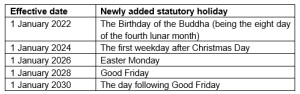
Starting this year, Easter Monday becomes a statutory holiday under s.39(1) of the Employment Ordinance (Cap. 57) (“EO”), following the phased expansion introduced by the Employment (Amendment) Ordinance 2021 (“2021 Amendment”).  This year marks the first time Easter Monday shifts from being only a “general holiday” to one that employers must treat as paid statutory leave to all employees.

Many may not be aware of Hong Kong’s dual-track holiday framework. Statutory holidays, provided under the EO, serve the purpose of safeguarding employees’ minimum labour entitlements, whereas general holidays, designated under the General Holidays Ordinance (Cap. 149), historically regulate institutional closures for all banks, educational institutions, public offices and Government departments.  Under this structure, Hong Kong has long had only 12 statutory holidays compared to 17 general holidays, (excluding Sundays).

The 2021 Amendment is slowly closing that five-day difference by progressively adding an additional statutory holiday every two years from 2022 to 2030. At that point the statutory holiday list will fully align with the 17 general holidays. The timetable is as follows:

Employers should also note that section 39(4) of the EO where a statutory holiday falls on a nominated weekly “rest day” (which is often a Sunday for many, but not for all), the employee must be granted an additional days leave on the next day that is not already a holiday.

In 2026, Ching Ming Festival (a statutory holiday) falls on Sunday, 5 April.  For most employees, this will coincide with their designated weekly rest day, which means that the statutory holiday for Ching Ming would be taken on Monday, 6 April as per section 39(4). It follows that the newly added statutory holiday for Easter Monday, originally falling on 6 April, will shift one more day forward to be taken on Tuesday, 7 April.

And with Easter Monday officially joining the list of statutory holidays this year, even the Easter Bunny is finally taking a properly mandated day off.

Russell Bennett

For more information on the above or any other enquiries, please contact:

Russell Bennett
Partner | Email

Disclaimer: This publication is general in nature and is not intended to constitute legal advice. You should seek professional advice before taking any action in relation to the matters dealt with in this publication.

Featured Articles

Insights
What Is the Right Measure of Compensation in Hong Kong Discrimination Claims?
Insights
News update: Finfluencers on the SFC regulatory radar
Insights
News update: Secondary Trading of Tokenised Authorised Investment Products Permitted in Hong Kong
Insights
News update: Hong Kong Privacy Commissioner claws back privacy protection from agentic AI tools
Insights
Enforcement action follows PCPD finding of ineffective data privacy training
Insights
What you need to know about the Protection of Critical Infrastructures (Computer Systems) Ordinance, the cybersecurity legislation in Hong Kong (Part 6)

text

Mar 05 2026


A person’s right to privacy in respect of their personal data is protected under the Personal Data (Privacy) Ordinance (“PDPO”).

In the case of Chan Long Ning Christine v Dragon Guard Security Ltd [2025] HKDC 449, Ms Chan claimed against Dragon Guard Security Ltd (“DGSL”) for compensation for, amongst other things, alleged violation of her rights of privacy.  She claimed DGSL was not allowed to keep her under surveillance whilst she was on duty, at work.

Case Summary

Ms Chan was employed by DGSL to work as the concierge supervisor at The Southside Shopping Mall (the “Mall”).  Ms Chan claimed DGSL violated her privacy by:

1. Using CCTV to monitor her performance such as standing up to serve the customers and keeping the concierge desk tidy;

2. Installing an audio recorder at the concierge desk to monitor all conversations with customers to assess her performance; and

3. Intending to take photos to record prohibited behaviours such as using smartphone on duty and failure to maintain good gestures.

The Court clarified that “there is no over-arching, all-embracing cause of action for “invasion of privacy” [45]”.  Rather, section 4 of the PDPO does not allow for any act or engagement in practice which contravenes data protection principles unless required or permitted under it.  The data protection principles relevant to Chan are as follows:

(i) Principle 1(1): Personal data shall not be collected unless the data is collected for a lawful purpose directly related to a function or activity of the data user who is to use the data.

(ii) Principle 1(2): Personal data shall be collected by means which are lawful and fair in the circumstances of the case.

(iii) Principle 1(3): Where the person from whom personal data is or is to be collected is the data subject, all practicable steps shall be taken to ensure that he is [informed].


In Chan, the Court held DGSL’s collection of personal data through surveillance was not unfair and there was no violation of Ms Chan’s privacy for the following reasons:

1. Purpose:  CCTV and audio recording were for the “lawful purpose” of monitoring her performance which directly relates to her employment.

2. Expectation of privacy: The concierge desk was in a public area of the Mall, so anyone in close proximity could see and hear her whilst she was on duty.  As such, she cannot reasonably expect for privacy when she was on duty serving the customers.


Ms Chan also complained about her lack of consent in DGSL’s surveillance measures.  However, the Court also rejected this claim for the following reasons:

1. Consent not required: Principle 1(3) only requires Ms Chan to be informed but there is no requirement for consent.  Ms Chan was in fact informed about the audio recording in advance.

2. Exemption for CCTV: Ms Chan was not informed about the CCTV recording in advance.  However, the purpose of CCTV recording falls under the legal exemption of the PDPO, such that the purpose would be prejudiced had Ms Chan been informed on or before the CCTV recording.


Guidance for the Employers

Chan reassures employers that they are allowed to reasonably monitor their employees’ performance through legal and fair means.  They do not need prior consent of the employees and will only be required to inform the employees, unless exempted to do so.

The Privacy Commissions for Personal Data (“PCPD”) confirmed the PDPO is a principle-based legislation.  PCPD issued a guideline specifically for “Monitoring and Personal Data Privacy at Work”.  It outlines the best practices for employee monitoring while respecting personal data privacy with illustrative examples.  It recommends employers consider whether monitoring is necessary and whether less intrusive options are available.  If monitoring measures need to be put in place, it should be done with transparency and with due regard to safeguarding and deletion of such data.  The guideline covers monitoring of telephone, email, internet and video, and emphasises compliance with the data protection principles.  It is a useful and elaborative guide for employers to implement monitoring measures as far as the law permits.

PCPD also issued a publication on “Physical Tracking and Monitoring Through Electronic Devices” which recognises the rise in tracking through electronic devices such as Wi-Fi transmitters and radio frequency identification tags.  Employee monitoring by tracking physical location and behaviour can constitute collection of personal data which should also comply with data protection principles.

For more details about data privacy, please refer to our article on What you need to know about personal data privacy in Hong Kong. For an update on guidance in relation to CCTV, drone, and in-vehicle camera use, please refer to our earlier article – “There’s always someone watching!”.

Russell Bennett

For more information on the above or any other enquiries, please contact:

Russell Bennett
Partner | Email

Disclaimer: This publication is general in nature and is not intended to constitute legal advice. You should seek professional advice before taking any action in relation to the matters dealt with in this publication.

Featured Articles

Insights
What Is the Right Measure of Compensation in Hong Kong Discrimination Claims?
Insights
News update: Finfluencers on the SFC regulatory radar
Insights
News update: Secondary Trading of Tokenised Authorised Investment Products Permitted in Hong Kong
Insights
News update: Hong Kong Privacy Commissioner claws back privacy protection from agentic AI tools
Insights
Enforcement action follows PCPD finding of ineffective data privacy training
Insights
What you need to know about the Protection of Critical Infrastructures (Computer Systems) Ordinance, the cybersecurity legislation in Hong Kong (Part 6)

text

Feb 27 2026

Subject to the approval of the Legislative Council, and with effect on 1 May 2026:

1.     the Statutory Minimum Wage will likely increase from HK$42.10 to HK$43.10 per hour, and

2.     the monetary cap on the requirement of employers recording the total number of hours worked by employees will be revised from HK$17,200 to HK$17,600 per month.


In light of the expected increase in Statutory Minimum Wage, employers are reminded of the following:

For more information, please refer to the guidelines issued by the Labour Department on Statutory Minimum Wage at this link, which will be updated as appropriate.

The changes in the Statutory Minimum Wage and its review mechanism were part of the 2025 Policy Address.  For other employment issues the Chief Executive intends to act on, please refer to our article, Key Employment Issues from the 2025 Policy Address.

Russell Bennett

For more information on employment matters, please contact:

Russell Bennett
Partner | Email

Disclaimer: This publication is general in nature and is not intended to constitute legal advice. You should seek professional advice before taking any action in relation to the matters dealt with in this publication.


Featured Articles

Insights
What Is the Right Measure of Compensation in Hong Kong Discrimination Claims?
Insights
News update: Finfluencers on the SFC regulatory radar
Insights
News update: Secondary Trading of Tokenised Authorised Investment Products Permitted in Hong Kong
Insights
News update: Hong Kong Privacy Commissioner claws back privacy protection from agentic AI tools
Insights
Enforcement action follows PCPD finding of ineffective data privacy training
Insights
What you need to know about the Protection of Critical Infrastructures (Computer Systems) Ordinance, the cybersecurity legislation in Hong Kong (Part 6)

text

Feb 02 2026

The Hong Kong employment law environment remained dynamic in 2025, with important developments affecting workplace policies and liability. From landmark court decisions on discrimination and sexual harassment to proposed legislative changes and updated regulatory guidance, employers face a complex array of new considerations.  This overview helps employers and employees navigate through the practical insights in understanding their rights and obligations.  We also take this opportunity to highlight our ongoing commitment to client engagement through top-tiered leadership and events on these vital issues.

Topics Article No.
Labour Rights 3, 8
Discrimination & Harassment 1, 2, 6
Other Developments 4, 5, 7, 9

1) Factors in deciding damages for “injury to feelings” in discrimination cases (3 March)

This is a review of the decision in Eddie Stobart Limited v Miss Caitlin Graham [2025] EAT 14.  Although not binding on Hong Kong courts, it offers a useful guidance on awarding “injury to feelings” based on the severity of discrimination.  Employers are also reminded the manner in which they handle discrimination complaints may be indirect evidence to affect the level of award to be made.

Go to this article.

2) Social media posts highlight workplace sexual harassment (11 March)

Nicknaming and comments of a sexual nature about an employee’s physical appearance sparked the attention of the public and specifically the Hong Kong Equal Opportunities Commission.  This article revisits the anti-sexual harassment law in Hong Kong, noting that employers, regardless of their knowledge of the harassment, can also be vicariously liable for any unlawful sexual harassment acts by its employees.

Go to this article.

3) Legal Update: Proposed reduction on threshold on working hours for “continuous contract” (9 May)

The definition of “continuous contract” is one of the key issues in employment law as it determines whether employees are given certain statutory benefits and protections.  This article outlines the reduction in what constitutes as a “continuous contract”.

Go to this article.

4) Key Employment Issues from the 2025 Policy Address (23 September)

The 2025 policy address by the Chief Executive of Hong Kong SAR referred to some upcoming changes to the local employment law. In this article we highlighted the key employment issues which employers should be aware or keep track of in the policy address.

Go to this article.

5) Legal Update – Is stress an injury: when does ‘psychiatric trauma’ amount to a workplace injury? (8 October)

Through Chan Man Sau v 風采中學 (教育評議會主辦法團校董會 [2025] HKDC 1354, we explore what constitutes as a mental injury to be considered as a workplace injury to claim for employee’s compensation.  Employers are reminded of their overall duty of care over their employees’ health and safety, as well as their obligations to report to the Commissioner for Labour in the event of an “accident” as required under the Employees’ Compensation Ordinance.

Go to this article.

6) “You’re married to him?!” Is it an issue for employers in making employment decisions? (13 October)

Discrimination against one’s “marital status” is unlawful under the Sex Discrimination Ordinance (Cap. 480).  In this article, we review the reasoning behind why being married to a specific person is not considered as discrimination against one’s “marital status” through the case of Cheuk Kit Man v FWD Life Insurance Company (Bermuda) Limited and Others [2025] HKCFI 1369 and provide practical tips to employers on how to deal with termination of employment whilst minimising the risk of any unnecessary dispute.

Go to this article.

7) Hiring Foreign Domestic Helpers in Hong Kong, Pitfalls and Misconceptions (5 November)

Foreign domestic helpers are commonly hired in Hong Kong households.  In this article, we visit the legal parameters, common misconceptions and questions about employing foreign domestic helpers.

Go to this article.

8) Working Mothers: Maternity Rights under Hong Kong Law (11 November)

Juggling between work and being a mother is never easy.  In this article, we set out maternity rights and other legal protection available for working mothers.

Go to this article.

9) “There’s always someone watching” (Ocean’s 11).  Updated Privacy Commissioner guidance on CCTV, drone and in-vehicle camera use (10 December)

Modern technology offers convenience to modern day lives but reliance upon it also creates privacy concerns.  In this article, we walk through the guidance given by the Privacy Commissions for Personal Data, the data privacy regulator in Hong Kong, on the accepted use of CCTV, drone and in-vehicle camera use (including in the employment context).

Go to this article.

TDW Past Events

In-House Community Congress 2025

Our partner, Mr Russell Bennett, delivered an engaging presentation on “Legal Lessons & Loopholes: Ten Key Employment Issues”, offering practical insights and strategic guidance to in-house counsel navigating today’s complex employment landscape.

Please see our LinkedIn post here.

The GBA Legal Compass: Navigating Employment Law Across Borders

Our partner, Mr Mark Chiu, conducted a seminar with Helena Kok of MdME and Liu Chang of Shihui Partners to explain the key characteristics in employment between different GBA areas, specifically, Hong Kong, Macau and the Mainland, in particular, the assistance of immigration policies to better integrate cooperation between GBA cities. 

Please see our LinkedIn post here.

TDW Upcoming Event

Update on Employment Law: Key Changes and Updates from 2025

We are pleased to co-host an upcoming webinar with In-House Community on key employment law developments in Hong Kong over the past 12 months, from major legislative reforms to the latest case law insights.

The webinar will be held on 5 February 2026 at 2 to 3 pm.  For more details and registration, please access this link.

Seminar with Control Risks: When Employees Go Rogue: Legal and Forensic Insights into Data Misuse

We are excited to announce we will also be hosting a seminar with Control Risks on 23 April 2026 on duty of confidentiality, from how to prevent, to detect, and to respond, with practical scenarios to help attendees better understand the law and steps they can take to protect themselves.

We will provide additional information as they become available.

Recognitions

We are proud to share our employment team has continued to earn several recognitions:


Russell Bennett and Mark Chiu


For more information on the above or any other enquiries, please contact Russell Bennett or Mark Chiu.

Russell Bennett

Partner | Email

Mark Chiu

Partner | Email

Disclaimer: This publication is general in nature and is not intended to constitute legal advice. You should seek professional advice before taking any action in relation to the matters dealt with in this publication.

Featured Articles

Insights
What Is the Right Measure of Compensation in Hong Kong Discrimination Claims?
Insights
News update: Finfluencers on the SFC regulatory radar
Insights
News update: Secondary Trading of Tokenised Authorised Investment Products Permitted in Hong Kong
Insights
News update: Hong Kong Privacy Commissioner claws back privacy protection from agentic AI tools
Insights
Enforcement action follows PCPD finding of ineffective data privacy training
Insights
What you need to know about the Protection of Critical Infrastructures (Computer Systems) Ordinance, the cybersecurity legislation in Hong Kong (Part 6)

text

Jan 23 2026

The recent case of Khan Farooq Ahmed v Delivery Hero Food Hong Kong Limited [2025] HKCFI 4030 (“Khan v Delivery Hero”) outlined an important concern in Hong Kong – what are employers’ duties when it comes to work during a Typhoon 8 or other severe weather conditions? In the article below, we consider the key takeaways for the case and other practical considerations.

Case background

The plaintiff was a food delivery worker employed by the defendant. His duties included using his self-owned motorcycle to deliver food orders to the defendant’s customers, notified to him via a mobile application on his phone. Riders employed by the defendant had all signed an “Amendment to Employment Contract” (the “Amendment”) provided by the defendant where they agreed to “deliver under black rainstorm and typhoon signal no.8,”  as well as to“continue [deliveries] under [black rainstorm and typhoon signal no.8]”.

On a regular workday in mid-August 2020, the plaintiff began his work shift in the evening. At around 9:00 pm, the defendant sent a message to all riders via Telegram, communicating that the typhoon signal No.8 was due to be issued soon; a further message was sent at around 10:45 pm confirming that the typhoon signal No.8 had been issued, and communicated “if you are delivering orders at the moment, please decide whether you can continue to complete that order based on your safety.”

Despite the above, the plaintiff took up and completed an additional 3 orders. By the time he was finished, the typhoon signal No.8 had been issued for almost 20 minutes. As the plaintiff was heading home, he injured himself in a traffic accident (that did not involve other vehicles) – he was allegedly blown off balance by a strong gust of wind, whereupon he fell onto the road and injured his back, his knee, and his hand.

In essence, the plaintiff’s case was that the defendant had operated an unsafe system of work by expecting any order accepted by employees to still be fulfilled and completed while the signal was in force, per the Amendment.

Court’s ruling

The Court found that the defendant had unlawfully exposed the plaintiff to a risk of injury when expecting and/ or requiring them to work even after the typhoon signal No.8 was issued. The defendant’s argument that the plaintiff was at liberty to not accept an order during peak hours was dismissed, as it was “in direct conflict with the terms of the Amendment” put in place by the defendant.

In making its ruling, the Court referenced the Labour Department’s Code of Practice in Times of Adverse Weather and “Extreme Conditions” (available here) (the “Code”). The key excerpts identified by the Court were:-

The Court ruled that when the defendants asked the plaintiff and other employees to sign the Amendment, it had essentially attempted to “get around the Code” and was in “clear breach” of it. It found the defendant liable for causing the accident and the resulting injuries that the plaintiff sustained.

Employer’s Duties

Khan v  Delivery Hero is a reminder to employers that, at both common law and statute via the Occupational Safety and Health Ordinance (Cap. 509), employers owe a duty to take reasonable care for their employees’ safety. In summary, employers are required to:-

Employers should also give due consideration to the provisions in the Code even though it does not have direct legal effect. Khan v Delivery Hero clearly demonstrates that the Court will take the Code into consideration when ruling on employer’s duties and liabilities in adverse weather conditions.

Practical steps for Employers

In adverse weather conditions or “extreme conditions,” employers should:-

Employers should also be sympathetic to circumstances faced by individual employees and regularly consult staff and review arrangements for adverse weather conditions. Priority consideration should be given to employees with special needs (e.g. pregnant disability, living in faraway areas or with limited public transport etc.)


Russell Bennett


For more information on the above or any other enquiries, please contact Russell Bennett or Mark Chiu.

Russell Bennett

Partner | Email

Mark Chiu

Partner | Email

Disclaimer: This publication is general in nature and is not intended to constitute legal advice. You should seek professional advice before taking any action in relation to the matters dealt with in this publication.

* ** Identified in [2025] HKCFI 4030 as pages 20 and 21 respectively; the Code has since been updated, and this article refers to the updated pages.

Featured Articles

Insights
What Is the Right Measure of Compensation in Hong Kong Discrimination Claims?
Insights
News update: Finfluencers on the SFC regulatory radar
Insights
News update: Secondary Trading of Tokenised Authorised Investment Products Permitted in Hong Kong
Insights
News update: Hong Kong Privacy Commissioner claws back privacy protection from agentic AI tools
Insights
Enforcement action follows PCPD finding of ineffective data privacy training
Insights
What you need to know about the Protection of Critical Infrastructures (Computer Systems) Ordinance, the cybersecurity legislation in Hong Kong (Part 6)

text

Jan 22 2026

The Mandatory Reporting of Child Abuse Ordinance (Cap. 650) marks a major development in Hong Kong’s child‑protection landscape. Gazetted in July 2024 and scheduled to come into force today, 20 January 2026, the Ordinance reflects the SAR Government’s commitment to strengthening early identification and intervention in cases of serious child abuse. This new legal framework is especially relevant to parents navigating divorce, care and control disputes, and broader children law matters, where the welfare of children is always the paramount consideration.

Under the Ordinance, twenty-five categories of specified professionals from the social welfare, education and healthcare sectors must report suspected serious child abuse when they have reasonable grounds to believe a child is suffering or at real risk of suffering serious harm. A child is defined as anyone under the age of eighteen. These reporting obligations create a wide and robust protective net across schools, hospitals, clinics, and social service settings, helping ensure that vulnerable children are identified more quickly and their safety secured.

The penalties for failing to make a mandatory report are significant at a Level 5 fine, currently HK$50,000, and/or up to three months’ imprisonment. This signals how seriously Hong Kong now regards the duty to report, and it also means parents should expect professionals working with their children to be more alert to potential signs of harm during medical visits, school interactions, or counselling sessions. For families dealing with separation or co‑parenting conflict, this heightened vigilance can provide reassurance that any genuine risk to children will be addressed promptly.

At the same time, the Ordinance includes important safeguards. Section 4(2) sets out circumstances in which reporting is not required, such as when the harm results solely from an accident, is self‑inflicted by the child, is caused by another child (excluding sexual conduct), or has already been reported. These exceptions help prevent unnecessary or duplicate reporting and are particularly important in the context of contentious divorce proceedings, where allegations can sometimes arise from misunderstanding, overreaction, or emotional conflict. The inclusion of these safeguards reduces the risk of the Ordinance being inadvertently or of course, intentionally, weaponised during custody disputes.

To encourage timely reporting, the law provides strong protections for specified professionals. Their identities must not be disclosed, and they are protected from civil or criminal liability merely for making a report. These protections are intended to promote a professional culture where safeguarding concerns can be raised confidently, without fear of personal repercussions.

In preparation for the commencement of the new law, the Government has invested in extensive public and professional education. This includes a city‑wide Child Protection Campaign, the publication of the official Guide for Mandated Reporters, and the creation of a dedicated electronic reporting platform developed by the Social Welfare Department in cooperation with the Hong Kong Police Force. These

systems are designed to streamline reporting, improve inter‑agency communication, and ensure frontline workers can quickly assess and escalate concerns.

Whether in the context of negotiating custody arrangements, addressing behavioural concerns, or dealing with allegations of neglect or harm, the new mandatory reporting regime will play an increasing role in how children’s welfare issues are handled in family law matters across Hong Kong. The Ordinance reinforces the principle that the best interests of the child come first, while also acknowledging the need for proportionality and fairness.

Professional advice from an experienced Hong Kong lawyer can help you navigate both the legal implications and practical steps to protect your child’s wellbeing. Further, as an employer or professional you must be ready to implement these reports. Professional advice on how to navigate these changes can also be sought. The Guide and other resources can be found here https://www.childprotectiontraining.hk/resource-corner.


Joanne Brown


If you have any questions, please contact Russell Bennett/Joanne Brown/Adrian Au

Russell Bennett

Partner | Email


Joanne Brown

Partner | Email


Adrian Au

Partner | Email


Disclaimer: This publication is general in nature and is not intended to constitute legal advice. You should seek professional advice before taking any action in relation to the matters dealt with in this publication. This article was last reviewed on 20 January 2026.


Featured Articles

Insights
What Is the Right Measure of Compensation in Hong Kong Discrimination Claims?
Insights
News update: Finfluencers on the SFC regulatory radar
Insights
News update: Secondary Trading of Tokenised Authorised Investment Products Permitted in Hong Kong
Insights
News update: Hong Kong Privacy Commissioner claws back privacy protection from agentic AI tools
Insights
Enforcement action follows PCPD finding of ineffective data privacy training
Insights
What you need to know about the Protection of Critical Infrastructures (Computer Systems) Ordinance, the cybersecurity legislation in Hong Kong (Part 6)

text

Jan 22 2026

On 19 February 2025, the Securities and Futures Commission (SFC) published ASPIRe, its regulatory roadmap for Hong Kong’s virtual asset market. It’s a fine document, and an inspired acronym. As we approach the first anniversary of its publication, Pádraig Walsh, who leads our Fintech practice, recaps on its key features and outlines the progress since its publication on the regulatory roadmap for the virtual asset market in Hong Kong.

Overview

ASPIRe is the regulatory roadmap from the SFC outlining its approach to regulating the Hong Kong virtual asset market. The SFC developed this forward-looking policy document to guide the market on its approach to balancing investor protection requirements with a safe environment for innovation and progress.

The key underlying principles are:

1.       Provide forward-looking, broad regulatory coverage to avoid uncertainty from regulatory vacuums or new innovations;

2.       Adopt and apply existing traditional finance regulation to support an integrated market;

3.       Use fit-for-purpose regulatory frameworks to align regulation with desired outcomes;

4.       Avoid unreasonable or unintended restrictions on innovation in industry processes and product offerings; and

5.       Foster open dialogue with industry stakeholders and global regulators to encourage dissemination of insights and developments.

The ASPIRe framework is built around five pillars, each with its dedicated objectives and regulatory initiatives. Let’s look at each in turn.

“A” for Access

The current regulatory framework covers existing regulated intermediaries in the securities and futures sector, and primary virtual asset trading platforms. There are obvious gaps in regulatory coverage – primarily virtual asset OTC dealers and virtual asset custodians. Pillar A for access aims to address this by expanding market accessibility, primarily through regulatory enhancement. There are three key initiatives.

1.       OTC trading, dealing, advisory and management services:

1.1     The SFC has acknowledged that virtual asset OTC trading remains important for large volume transactions, allowing buyers and sellers to execute block trades without disruptive price impact. The SFC is also aware of the critical role of OTC desks in liquidity provision and institutional participation.

1.2     The SFC will shape a specific licensing regime for virtual asset dealing services. The new licensing regime will mirror the standards applied to VATP regulation and will apply legal concepts that are familiar from the dealing in securities regulated activity currently overseen by the SFC. The SFC has stated that its approach will be to ensure the regulatory requirements are flexible and proportionate to the level of risk and complexity of the virtual asset dealing activity in question.

1.3     The SFC and the Financial Services and the Treasury Bureau (FSTB) published the consultation conclusions on a proposed virtual asset dealing regime in December 2025. Interested parties can now contact the SFC for pre-application discussions on the proposed virtual asset dealing regime.

1.4     The SFC launched a further consultation on 24 December 2025 for standalone regimes for virtual asset advisory and virtual asset management service providers. The proposed requirements are intended to be substantially equivalent to the current Type 4 and Type 9 regulated securities activities licenses respectively.

2.       Custody services:

2.1     Virtual asset custody regulation in Hong Kong has been anachronistic. The requirement for VATPs to custody client virtual assets under a wholly owned subsidiary was a sensible and practical initial solution for the time when VATP licences first became available in Hong Kong. Third party providers have used the trust or company service provider (TCSP) licence regulated by the Companies Registry; this would not be described as fit-for-purpose regulation.

2.2     The SFC will now shape a specific licensing regime for virtual asset custody services. This will allow for a two-tier market structure segregating trading and custody. The new licensing regime will mirror the standards applied to traditional financial custodians.

2.3     The SFC and FSTB published the consultation conclusions on a proposed virtual asset custodian regime in December 2025. SFC now encourages parties to contact the SFC for pre-application discussions on the proposed custodian regime.

3.       Liquidity providers:

3.1     The SFC will clarify its regulatory and financial rules expectations to facilitate the onboarding process for institutional-grade liquidity providers, market makers and proprietary trading firms. The SFC’s objective is to provide regulatory clarity to reduce barriers for liquidity providers to connect with Hong Kong VATPs.

3.2     On 3 November 2025, the SFC published a circular permitting SFC-licensed VATPs to integrate their orderbooks with qualified overseas VATPs to form a Shared Order Book. The aim is to connect Hong Kong VATPs to the deeper global liquidity, while maintaining market integrity. VATPs who wish to utilise Shared Order Book will be subject to stringent regulatory requirements. The requirements include establishing a comprehensive set of internal rules governing the operation of the Shared Order Book, fully pre-funded orders, and unified cross-platform market surveillance.

“S” for Safeguards

There are three key regulatory initiatives under this pillar.

1.       Dynamic approach to custodianship:

1.1     The SFC will aim to provide technology-neutral, outcome-based standards which will allow VASPs to adopt innovative solutions.

1.2     For instance, the SFC will aim to allow VASPs to adopt tailor made hot/cold storage strategies according to their risk profiles and operational/liquidity demands. The approach will focus on the outcome rather than specific hot/cold storage ratios.

1.3     On 15 August 2025, the SFC published a circular setting out the minimum compliance requirements for virtual asset platform operators with custody of virtual assets. These requirements foreshadow the requirements and obligations under the proposed licensing regime for virtual asset custodians. Minimum requirements include senior management obligations and mandatory cold wallet infrastructures.

2.       Insurance and compensation frameworks: VASPs will be allowed to tailor their own compensation strategies. The resulting frameworks should align with global practices.

3.       Clarify investor onboarding and product categorisation: The SFC will provide guidance to clarify investor assessment and onboarding processes adopting the tried-and-tested existing regulatory regime for investor onboarding. Product categorisation will focus on the actual activity rather than the form of VAs.

“P” for Products

Presently, licensed VATPs operate almost within a closed loop of products and liquidity pools. The SFC recognises this issue, and acknowledges that the range of VA products and services covered under Hong Kong regulations should be expanded. The SFC are pursuing four initiatives under this pillar.

1.       Framework for professional investor-exclusive tokens and VA derivative trading:

1.1     The existing framework will be expanded to enable professional investor-exclusive new tokens listing. Existing rigorous due diligence and disclosure requirements may be adopted.

1.2     Regulated VA derivatives trading will also be permitted to be introduced to professional investors. This will allow for more strategies such as hedging and leveraging, which can help mitigate volatility and allow for more sophisticated risk management strategies.

2.       VA margin financing requirements: The SFC will align established margin financing protocols in traditional securities. This will safeguard VASPs and investors from excessive risk exposure and allow traditional finance to enter the market to enhance diversified market participation.

3.       Custody and operational guide for staking and borrowing/lending services:

3.1     On 7 April 2025, the SFC published a circular setting out its regulatory approach in respect of virtual asset trading platforms offering staking as a service to its clients. Regulation of staking services will be supported by technical and custodial safeguards. Requirements will be set in place to mitigate custodial, slashing and liquidity risks.

3.2     Professional investors may be allowed to participate in borrowing/lending activities. Regulations will cover the handling of collaterals and assessing and mitigating of risks.

4.       Expansion of VATP products, distribution and custody:

4.1     On 3 November 2025, the SFC published a circular expanding the products and services that SFC-licensed VATPs may offer. For token admission, the 12-month track record requirement is removed for offerings to professional investors (including for stablecoins). This is subject to full due diligence and adequate disclosures where the track record is under 12 months. For retail investors, the 12-month track record still applies, except for stablecoins issued by an HKMA-licensed issuer.

4.2     The circular also clarifies that licensing conditions will be amended to expressly permit VATPs to distribute digital asset-related products and tokenised securities in accordance with existing SFC regulations, and to provide custody services for digital assets that have not been made available for trading via the VATP.

“I” for Infrastructure

The SFC will use new technologies and infrastructure to strengthen its oversight capabilities. There are two key initiatives under this pillar:

1.       Efficient reporting and advance surveillance: The SFC will implement means for straight-through reporting of digital asset information and data-driven surveillance tools capable of transaction monitoring, blockchain intelligence, wallet monitoring and tracing.

2.       Cross-agency and cross-border collaboration: The SFC will adopt increased collaboration and intelligence sharing with local regulators and law enforcement agencies. Holistic risk monitoring and surveillance capabilities will further promote cross-border cooperation with global regulators.

“Re” for Relationships

SFC will emphasise transparency in the policymaking process to enable constructive contributions from the industry stakeholders. There are two initiatives under this pillar.

1.       Regulation for financial influencers: The SFC recognises the influence of digital channels on investors’ perceptions and financial behaviours in respect of virtual assets. The regulatory framework will aim to encourage financial influencers to contribute constructively to educate the public and advocating the best practices. The SFC will likewise be vigilant and initiate enforcement action against reckless activity that may cause risk and harm to the public.

2.       Sustainable communication and talent network: The SFC has set up the Virtual Asset Consultative Panel to engage with market participants, industry stakeholders and global forums to obtain insights on market developments. The SFC will foster an open dialogue with industry participants to facilitate clear communication of the regulatory position and best regulatory practices.

Conclusion

We are almost at the first anniversary of when the ASPIRe framework was first published. It represented a thoughtful and strategic approach by the SFC to regulate virtual asset activities in Hong Kong. At that point in time, it was aspirational by name and nature. Since then, the SFC has made significant strides to implementing the roadmap it has outlined. We have seen positive progress on new licensing regimes for virtual asset dealing and custody services, new consultations on licences for virtual asset advisory and management activities, new guidance around staking activities, and more avenues to facilitate broadening product offerings and access to global liquidity pools.

The progress made under each pillar demonstrates the SFC’s commitment to building a robust and forward-looking regulatory environment for the virtual asset market in Hong Kong.

Pádraig Walsh 

If you want to know more about the content of this article, please contact:

Pádraig Walsh

Partner | Email

Disclaimer: This publication is general in nature and is not intended to constitute legal advice. You should seek professional advice before taking any action in relation to the matters dealt with in this publication. This article was last reviewed on 16 January 2026.

Featured Articles

Insights
What Is the Right Measure of Compensation in Hong Kong Discrimination Claims?
Insights
News update: Finfluencers on the SFC regulatory radar
Insights
News update: Secondary Trading of Tokenised Authorised Investment Products Permitted in Hong Kong
Insights
News update: Hong Kong Privacy Commissioner claws back privacy protection from agentic AI tools
Insights
Enforcement action follows PCPD finding of ineffective data privacy training
Insights
What you need to know about the Protection of Critical Infrastructures (Computer Systems) Ordinance, the cybersecurity legislation in Hong Kong (Part 6)

text

Dec 16 2025

The decision of Kan Kin Lan Kenny v Ray White (Hong Kong) Limited [2025] HKCFI 728, the Court of First Instance from early this year revisits and gives useful guidance in relation to calculating holiday pay and annual leave pay in the context of contractual commission or similar payments.

Case Summary and Key Issue

  • The Claimant, a former employee, was paid commissions as part of their remuneration.
  • The Claimant claimed against the Company for arrears of statutory holiday pay and annual leave pay based upon daily average wages.  The Company did not dispute liability but disputed quantum.
  • The key issue had to do with sections 41(6) and 41C(6) of the Employment Ordinance (Cap 57) (“EO”). These are the so called “deduction sections”. The former section relates to the computation of holiday pay, and the latter is an identical provision for purpose of computing annual leave pay.

Section 41(6) reads:

If, pursuant to the terms of his contract of employment or any other agreement or for any other reason, an employee is paid by his employer a sum of money in respect of a holiday taken by him [(the “Sum”)], the holiday pay payable to the employee in respect of that holiday is to be reduced by the sum.” (own definition and emphasis added)

This mechanism of deduction prevents an employee from being paid twice for the period to which their remuneration relates and their statutory holidays and annual leave (e.g. once as part of an employee’s monthly salary or other remuneration covering all days of the month, and once as holiday pay, on top).  

  • The Claimant’s case was that his commissions would only arise on days when he was at work.  Therefore, those commissions related only to workdays and were not paid in respect of every day of the period.  By this logic, the Claimant asserted, the Company was not entitled to take into account the commissions paid to the Claimant as part of the deductible Sum.  The Claimant should therefore have been entitled to a larger sum of holiday and annual leave pays.
  • The Claimant succeeded at the Labour Tribunal.  The Company appealed.


Appeal

The appeal was allowed.  The Claimant’s claim was dismissed.  In arriving at its decision, the Court considered the following:

  • In this case, the Claimant was paid (i) a monthly basic salary and (ii) commissions calculated and released each month.  Under section 2 of the EO, the definition of “wages” includes commission of a contractual nature.  Accordingly, the commissions formed part of the Claimant’s monthly wages.
  • Citing Cathay Pacific Airways Ltd v Kwan Siu Wa Becky (2012) 15 HKCFAR 615the Court reiterated that a monthly salary is paid for each day of the month, notwithstanding that the employee may not actually be working on certain days.  To consider that a monthly salary relates only to workdays and not leave days would fly in the face of common sense, and would render any calculations for the purpose of holiday pay and annual leave pay unusually convoluted.
  • In calculating holiday pay and annual leave pay, one needs only to work out the average of the total wages earned within the specified period.  This process should not involve considering any particular day (or “dailiness”, as coined in Cathay).
  • The Labour Tribunal’s decision that the commissions did not relate to leave days had two fundamental issues:
  • Sections 41(2) and 41C(2) provide that the daily rate of the holiday/annual leave pay is a sum equivalent to the daily average wage earned during the applicable period.  These provisions make no distinction between a workday or a leave day; and
  • The Labour Tribunal’s decision would turn any calculations for holiday and annual leave pays exceptionally complex.  This would be inconsistent with the principles expounded in Cathay that these calculations should be sensible and easy to apply.


Key Takeaways

  • In this casethe Court found it necessary to comment that in future similar cases, the Court or the Tribunal need not concern itself with the question of whether commission should be attributed to workdays only.  In a usual monthly-wage scenario, the computation of holiday and annual leave pays is not supposed to be more complex than taking the daily average of the period of the preceding 12 months or shorter. 
  • Kan Kin Lam is not the first Court decision applying sections 41(6) and 41C(6) of the EO.  This was preceded by the District Cout’s decision of Mak Wai Man & Ors v Richfield Realty Limited [2019] HKDC 358which the High Court also considered in this instance.  In Mak Wai Man, the District Court was asked whether statutory entitlements could be reduced by “team based” commission and team leader bonus.  It was held that as commissions and bonuses were received for both working days and notional working days, they fell within the definition of wages and were therefore deductible for the purpose of calculating statutory entitlements. As Kan Kin Lam is a High Court decision binding on all lower courtsit will likely stand as the authority for future cases where computation of statutory entitlements is in issue.

Russell Bennett and Mark Chiu

If you wish to discuss any matters relating to statutory holidays, annual leaves or other employment matters, please contact:

Russell Bennett

Partner | Email

Mark Chiu

Partner | Email

Disclaimer: This publication is general in nature and is not intended to constitute legal advice. You should seek professional advice before taking any action in relation to the matters dealt with in this publication. This article was last updated on 16 December 2025.

Featured Articles

Insights
What Is the Right Measure of Compensation in Hong Kong Discrimination Claims?
Insights
News update: Finfluencers on the SFC regulatory radar
Insights
News update: Secondary Trading of Tokenised Authorised Investment Products Permitted in Hong Kong
Insights
News update: Hong Kong Privacy Commissioner claws back privacy protection from agentic AI tools
Insights
Enforcement action follows PCPD finding of ineffective data privacy training
Insights
What you need to know about the Protection of Critical Infrastructures (Computer Systems) Ordinance, the cybersecurity legislation in Hong Kong (Part 6)