
content

May 13 2025

In a complex cross-border child abduction case involving multiple jurisdictions, Tanner De Witt partners Adrian Au and Joanne Brown successfully acted for the father to secure the return of his child to Mainland China. The case involved serious legal issues arising from the Court’s treatment of ‘habitual residence’. This case also highlights the distinctions between two different legal regimes governing the return of a child between Hague signatories and between a Hague signatory and a non-signatory jurisdiction.

This article highlights the Court’s different considerations between these two different legal regimes.

The Hague Abduction Convention

The goal of the Hague Convention on the Civil Aspects of International Child Abduction (“the Hague Convention”) is to ensure the swift and summary return of children who have been wrongfully removed or retained by a parent from their country of habitual residence (i.e. home country). Upon returning, the courts within the child’s home country can then determine issues of custody, care and control or other welfare issues.

If the home country is a Hague Convention signatory and the child is brought to Hong Kong, a parent can make an application to the Hong Kong Courts under the Hague Convention for the return of a child to their country of habitual residence. The Hague Convention regime provides a formulaic approach towards considering whether the child should be returned to the home country.

1) Habitual Residence

First, to engage the Hague Convention, although Hong Kong is a Hague Convention signatory, the child’s home country must also be a Hague Convention signatory.  Further, the child must be a habitual resident of their home country. Habitual residence is a factual question, to be determined by how integrated a child is into a country. The Court will consider a series of factors, including the child’s social and family environment, the duration of their stay, and their living and school conditions compared to other jurisdictions which the child may be connected to. The Court may also consider the child’s personal views and wishes. Parental intent regarding relocation can also influence this assessment, but a child does not automatically share the habitual residence of their parents.

In JEK V. LCYP | [2015] HKCFI 858 | HKLII, the wife, a Hong Kong-born Chinese, and the husband, an American from Brooklyn, married in 1997 and initially lived in New Jersey. The wife moved to Hong Kong with their two children in July 2013, and filed for divorce there in April 2014.

The Court of First Instance defined habitual residence as a factual inquiry focused on stability. It noted that the children’s habitual residence in Hong Kong was supported by the parties’ decision to purchase a property in Hong Kong in 2013 and the wife’s decision to take out a two year-lease in 2014 after discovering the husband’s affair. The children had also integrated into Hong Kong through schooling and social activities for nearly two years. Ultimately, the court concluded that their habitual residence was now in Hong Kong rather than New Jersey. The lack of joint parental intent to permanently reside in Hong Kong was not deemed decisive.

2) Infringement of Rights of Custody

Further, the removing parent must have breached the custody rights held by the other parent, as defined by the applicable laws of the child’s habitual residence.

3) Agreement and Acquiescence

The Court will also consider any agreements between the parents about where the child should live. If there is no agreement, the Court will evaluate whether one parent has implicitly accepted the other’s decision to move the child to another country. The Court does not have to order the child’s return if the parents have shown, through agreements or their actions, an intention for the child to live elsewhere.

4) Risk to child

Under the Hague Convention, the court can decide not to return the child to their habitual residence if to do so would expose them to a grave risk of physical or psychological harm or would place them in an intolerable situation. The court must assess whether the child’s home country has sufficient infrastructure, including a strong legal system, competent authorities, and sufficient public resources to ensure the child’s protection and wellbeing. This high threshold is often challenging to meet.

5) Child’s wishes

Sometimes, the Court may also hear and consider the Child’s wishes if they are of sufficient age or maturity. On such occasions, professional reports from social workers or professional experts maybe called for to obtain a child’s views and for example, to consider whether the views expressed by the child are genuinely their own.

Non-Hague Convention Cases

When a parent seeks to return the child to a non-Hague signatory, the specialised rules of the Hague Convention do not apply.

The Court can still order the child be returned to a non-Hague signatory country through Wardship proceedings commenced at the High Court. When considering these applications, the Court adopts a holistic approach with regard to the welfare of the child as the paramount consideration. It does not rely on the formulaic mechanism employed in Hague Convention cases.

Hong Kong law does not assume what is best for a child. Instead, the Court evaluates various factors individually when deciding whether to return the child. Key considerations include the child’s wishes, assessed by their maturity, and their physical, emotional, and educational needs. The Court also examines the ability of the adults responsible for the child’s care in meeting those needs.

J v Q

In the recent case of J V. Q AND ANOTHER | [2025] HKCFI 632 | HKLII, the proceedings began in Hong Kong following the mother unilaterally and wrongfully abducting the child from Shanghai to Hong Kong (i.e. between a non-Hague signatory and a Hague signatory). While in Hong Kong, the mother confirmed that she consented to the father bringing the child from Japan to Shanghai but alleged that the father unlawfully retained the child in Shanghai. She therefore claimed that she abducted the child to Hong Kong to invoke the Hong Kong Court’s Hague jurisdiction to return the child to Japan (i.e. between 2 Hague signatories). As a result, the Hong Kong Court had to grappled with Hague and non-Hague jurisdiction considerations within the same matter – arguably the first case in Hong Kong of such complexity and across multiple jurisdictions (i.e. Hong Kong, Japan, and the Mainland China)

The case was further complicated by ongoing custody proceedings in the PRC and allegations of parental alienation, which led the court to call for a report from a child psychiatrist. Expert evidence was presented on the custodial rights under both PRC and Japanese law.

The court ultimately determined that the child’s habitual residence was in Shanghai, where he had lived for the majority of his life with his sister and frequently returned during his time studying in Japan. The arrangements in Japan were deemed temporary, with both parents having agreed on the child’s eventual return to Shanghai. As a result, the Court dismissed the mother’s application under the Hague Convention.

In relation to the father’s application for non-Hague return under the wardship proceedings, applying the welfare principle, the Court found that returning to Shanghai was in the child’s best interests, given his cultural integration and familial ties there, in contrast to his primarily academic stay in Japan.

Ultimately, the father secured the child’s return to the Mainland China. Tanner De Witt partners Joanne Brown and Adrian Au acted for the father.

Concluding Remarks

The Hong Kong Court may order a child be returned to his home country if they are wrongfully removed from the home country or have been wrongfully retained in the foreign country.  Depending on whether the home country is a Hague Convention signatory, the legal basis and factors to be considered in such return applications may vary significantly. 

If it is a Hague Convention signatory, the Court will apply a statutory framework and a more formulaic approach; If it is a non-Hague Convention signatory, the Court adopts a holistic approach that focuses on assessing what is in the child’s best interests.

This distinction is crucial in practice, as it influences the speed and nature of legal proceedings. The formulaic approach of the Hague Convention can lead to quicker resolutions, while the holistic approach allows the Court to take more factors into consideration and resulting in a more nuanced evaluation based on the best interests of the child.


Joanne Brown and Adrian Au


If you would like to discuss any of the matters raised in this article, please contact:

Joanne Brown

Partner | Email


Adrian Au
Partner | E-mail

Disclaimer: This publication is general in nature and is not intended to constitute legal advice. You should seek professional advice before taking any action in relation to the matters dealt with in this publication.
Featured Articles

洞见
Must a foreign judgment be registered before being relied on as a petitioning debt? The position revisited
洞见
同一证人、不同仲裁:仲裁员曾处理同一证人作供,何时会令人质疑其公正性?
洞见
法律动态:您的竞业限制条款实际上在防范什么?关于大厦保安竞业限制条款的不寻常法院案例
新闻
𝐒𝐡𝐞𝐧𝐳𝐡𝐞𝐧–𝐇𝐨𝐧𝐠 𝐊𝐨𝐧𝐠 𝐂𝐫𝐨𝐬𝐬-𝐁𝐨𝐫𝐝𝐞𝐫 𝐋𝐞𝐠𝐚𝐥 𝐒𝐞𝐦𝐢𝐧𝐚𝐫: 𝐂𝐫𝐨𝐬𝐬-𝐁𝐨𝐫𝐝𝐞𝐫 𝐃𝐢𝐬𝐩𝐮𝐭𝐞 𝐑𝐞𝐬𝐨𝐥𝐮𝐭𝐢𝐨𝐧, 𝐖𝐞𝐚𝐥𝐭𝐡 𝐒𝐮𝐜𝐜𝐞𝐬𝐬𝐢𝐨𝐧 𝐚𝐧𝐝 𝐅𝐚𝐦𝐢𝐥𝐲 𝐌𝐚𝐭𝐭𝐞𝐫𝐬
洞见
Key Employment Issues from the 2026 Policy Address
新闻
Pamela Mak Named an ALB Asia Super 50 Dispute Lawyer 2026

content

Apr 24 2025

Nearly 25 years have passed since Hong Kong launched the Mandatory Provident Fund (“MPF”) in December 2000. As of February 2025, total assets under the MPF system in Hong Kong reached approximately HK$1.352 trillion, marking a record high since its inception and also a significant growth from the HK$1.18 trillion reported at the end of March 2024. These are in addition to the assets managed under the difference the Occupational Retirement Schemes Ordinance (“ORSO”) schemes and pension funds, details of which are not readily available.

Nevertheless, pensions, MPFs, ORSO (collectively the “retirement benefits”) can easily become a person’s significant asset upon their retirement. Even if such retirement benefits were accumulated throughout the marriage, it does not necessarily mean that the entire retirement benefit is subject to division in divorce proceedings.

There has been a trend in litigation where parties seek to exclude a portion of the retirement benefits from division, on the basis of the lack of liquidity, or because it was accumulated prior to the marriage or after parties separated.

This article explores whether the retirement benefits be treated as a marital asset? And if so, what portion of the retirement benefits balance should be included in the division of assets?

Pension as Matrimonial Assets and Types of Court Orders
In divorce proceedings, the Court may make a series of financial orders, including:
1. Periodical payments;
2. Secured periodical payments;
3. Lump sums;
4. Transfer and settlement of property;
5. Variation of settlements.

When determining the financial outcome, section 7 of the Matrimonial Proceedings and Property Ordinance (Cap. 192) (“MPPO”) is the legal basis, which sets out the matters that the Court shall have regard in deciding what orders to make. In particular, Section 7(g) of the MPPO specifically states that when determining the financial outcome in divorce proceedings, the Court should have regard to the retirement benefit that the spouse may lose as a result of the divorce. Further, the Court is also guided by the four guidelines and five steps exercise established in LKW v DD (2010) 13 HKCFAR 537.

Peculiar Nature of Retirement Benefits

The peculiar nature of retirement benefits are that: (1) they are accumulated throughout a person’s entire career span, often both before the parties’ marriage and after separation; and (2) different from other assets, retirement benefits are often illiquid and not accessible until much later. Further, retirement benefits are often paid out in various ways, as a lump sum, as an income stream or as a mixture of both.

The peculiar nature of retirement benefits is firmly recognised by the court in SSLT v SMFC [2019] HKFC 250. In that case, the parties were only able to access their pension accounts upon retirement, which was more than 20 years away. The Hong Kong Family Court recognised the illiquid nature of MPF/ pension benefits, which carries its own specific limitations and risks. On such basis, the Court ruled that it is necessary to differentiate between assets that can be readily converted into cash and those that are not easily transferable or realizable, such as retirement benefits.

Valuation of Retirement Benefits

The Court will first have to value the matrimonial asset before it can proceed to distribute the matrimonial assets. When valuing retirement benefits, Hong Kong Courts usually apply a cash equivalent value (“CEV”), estimated at the time of the trial.

Court’s Treatment of Retirement Benefits

In matrimonial cases, the Hong Kong Courts determine matrimonial finance disputes in a fair and reasonable manner. However, the Court’s determination of each case will inevitably turn on its own facts.

As part of the Matrimonial Asset: If the marriage is short, the Court maybe more reluctant to treat these retirement benefits as part of the matrimonial asset, as the parties’ prior marital / post separation accumulation may significantly outweigh those accumulated retirement benefits during the marriage. Conversely, in a long marriage, the Court is more likely to treat these benefits as part of the shared resources of the marriage. As the parties’ financials become more intertwined throughout their marriage, it becomes more challenging to identify the parties’ respective contribution towards the pension1 . In cases of long marriages (over 20 years), the Court refused to draw any distinction between pre- or post-separation pension value when determining the matrimonial assets(2).

Extent of Benefit to be Shared: Even if the Court determines that the retirement benefit should form a part of the matrimonial asset, this does not mean that the Court will include the entire retirement benefits as matrimonial asset.

In a recent Court of Appeal decision, it apportioned 80% of the Husband’s pension as part of the matrimonial asset. In some other cases, the Court has been more restrictive and only included 10% – 60% of the pension value (determined at the time of the trial), having regard to the illiquid nature of the retirement benefit and the time before parties are able to access such benefits.

Lump Sum Payment / Monthly Pension: In exercising the Court’s wide discretion, the Court may also examine the motive behind a party’s decision not to commutate part of the pension benefits with a view to achieving overall fairness between the parties(3).

After the Court has determined whether the retirement benefit should form part of the matrimonial asset, and if so, the extent to which is included, the Court will make a determination of the final outcome, having regard to all other assets and factors of the case.

In previous decided cases, the Court has provided the following mechanisms in dealing with retirement benefits:
1. A lump sum payment Order, representing the receiving party’s share in the lump sum pension received(4)
2. A periodical payment order, directing a party to pay to the other party a portion of the monthly pension received(5)
3. As opposed to sharing the actual pension, include the value of the pension as part of the party’s matrimonial assets for the purposes of financial determination(6)(7).

As illustrated above, the Hong Kong Courts’ current approach in relation to pension benefits is based on a broad, discretionary framework focused on principles of fairness and equality. There is no unified and systematic approach. Therefore, it may be worthwhile to explore how other common law jurisdictions are addressing similar challenges.

United Kingdom: Options for Flexibility and Tailored Solutions
In the United Kingdom (“UK”), the Matrimonial Causes Act 1973 provides mechanisms for dividing / sharing a person’s pension in divorce proceedings. These include pension sharing, pension offsetting, and pension earmarking:
▪ Pension sharing: this is an arrangement where a person’s existing pension is divided and transferred over to the spouse. The party receiving the pension can remain a member of the existing pension scheme; or alternatively, to transfer the pension to a new pension provider.

▪ Pension earmarking: While this is similar to pension sharing, the legal ownership is not transferred to the other party. However, when an ex-spouse is entitled to receive pension payments, part or even all of such payments maybe paid directly to the other spouse.

▪ Pension offsetting: In this arrangement, a party who decides to retain his/her ownership over the pension will have to transfer to the other spouse properties and/or assets to make up for the value the spouse would have received.

The UK Court also takes a more robust approach in dealing with pensions. In W v H (divorce financial remedies) [2020] EWFC B10, the Court acknowledges that there is no “one size fits all” approach to determining pensions. In that case, both parties were nearing retirement, defined benefit schemes are involved and that there was insufficient assets to meet the parties’ respective needs. As a result, the Court included both pre-marital and post-marital pension rights and decided that equal sharing of pension income is more appropriate than equal sharing of pension capital. Further, the Court also recognised that the lack of liquidity in pensions and pension’s post-retirement income producing qualities. The Court also acknowledged that mixing pension with mixing different categories of assets may ‘run the risk of unfairness in that valuation issues become very difficult’. Therefore, the Court said that pensions should be dealt with separately and discretely from other capital assets.

Australia: Superannuation Splitting and Balancing Interests

In Australia, the law recognises Superannuation as marital property to be divided upon the dissolution of marriage. Similar to that in the UK, the Australian law provides three options when dealing with Superannuation:

▪ Superannuation splitting: This divides the superannuation so that one party transfers his/her superannuation to the other. This creates a new interest for the non-member spouse within the same fund. The non-member’s interest can then be rolled over into a chosen compliant fund. However, these funds are not accessible until certain release conditions are met.

▪ Flagging agreement: This defers the decision to split the superannuation to a later date. This may be attractive to parties who would prefer some degree of flexibility over when to split the superannuation depending on timing and the amount of funds in the superannuation.

▪ Leave it untouched: Lastly, similar to ‘pension offsetting’ in the UK, one party may choose to retain the superannuation under his/her sole name, but instead pays off the divorcing spouse with other matrimonial assets.

Way forward for Hong Kong

When compared to the UK and Australia, Hong Kong lacks of specific statutory provisions to deal with pensions in matrimonial proceedings. Clearer guidance and principles when dealing with pensions as part of the financial relief in divorce proceedings will be very much welcomed. This could achieve consistency, predictability and with the view towards more equitable outcomes for all parties.

In the meantime, key take-aways are as follows:-

▪ There is no unified approach to what extent a party’s retirement benefits are to be treated as a matrimonial asset for purposes of division. Further, while the Court may try to navigate ‘pension sharing’ within the current legal framework, such make-shift measures do not produce the same effect as those in the UK or in Australia.

▪ Retirement benefits accumulated throughout the marriage are generally considered part of the matrimonial asset for purposes of division. But factors such as the duration of the marriage, pre / post separation accruals will impact on the extent of such benefits to be considered as part of the matrimonial asset.

▪ The Court acknowledges and has dealt with illiquidity of retirement benefits by applying a discount towards the pension value. However, such discounts vary significantly between cases.

▪ Regardless of the Court’s determination of such retirement benefits, parties must give full and frank disclose in matrimonial proceedings. This means they must fully disclose existence, the whereabouts and the extent of such benefits. This particularly applicable to Hong Kong, where parties may have worked overseas and have therefore accumulated retirement benefits in other jurisdictions.

With that in mind, the authors propose that the following measures be considered:

▪ Codifying existing principles: Enacting legislation that formalizes key principles established through case law, such as recognizing the total value of the pension as a matrimonial asset and placing emphasis on post-retirement income potential. Exploring the feasibility of orders akin to pension sharing orders in the UK, which allow for the transfer of an ex-spouse’s pension value into a new pension account, would provide couples facing divorce with greater clarity and predictability.

▪ Developing specific provisions for different types of pensions: Tailoring provisions to address the distinctive characteristics of various pension schemes, including defined benefits and defined contribution plans. This approach would ensure a more equitable division of assets and account for the specific nature of each pension scheme.

▪ Providing guidance on illiquidity discounts: Establishing clearer guidelines on applying illiquidity discounts to pensions could promote consistency and transparency in asset valuation. This guidance would help determine the appropriate adjustments to account for the restricted liquidity of pension funds.

By implementing such reforms, Hong Kong can strive towards a more unified and equitable approach to pension division in divorce cases. This will not only enhance the fairness and predictability of the legal system but also contribute to greater certainty and stability for individuals navigating the complex and often emotionally charged process of divorce.


Adrian Au and Becky So (Pantheon Chambers)


For specific advice on your situation, please contact:

Adrian Au
Partner | E-mail

Disclaimer: This publication is general in nature and is not intended to constitute legal advice. You should seek professional advice before taking any action in relation to the matters dealt with in this publication.

1. 陳對鍾 CACV 461/2022, [2023] HKCA 560
2. LCSA v AP [2019] HKFC 105
3. LOTM v CSM [2022] HKFC 64

4. 陳對鍾 CACV 461/2022, [2023] HKCA 560 and 梁對王 FCMC 14467A/2018, FCMC 14467/2018, ; [2022]
HKFC 23 (unreported 11 February 2022)
5. 陳對鍾 CACV 461/2022, [2023] HKCA 560
6. LCSA v AP FCMC 2295/2014 [2019] HKFC 105 (unreported, 18 April 2019)
7. SSLT v SMFC FCMC 11056/2017, [2019] HKFC 250 (unreported, 20 September 2019)

Featured Articles

洞见
Must a foreign judgment be registered before being relied on as a petitioning debt? The position revisited
洞见
同一证人、不同仲裁:仲裁员曾处理同一证人作供,何时会令人质疑其公正性?
洞见
法律动态:您的竞业限制条款实际上在防范什么?关于大厦保安竞业限制条款的不寻常法院案例
新闻
𝐒𝐡𝐞𝐧𝐳𝐡𝐞𝐧–𝐇𝐨𝐧𝐠 𝐊𝐨𝐧𝐠 𝐂𝐫𝐨𝐬𝐬-𝐁𝐨𝐫𝐝𝐞𝐫 𝐋𝐞𝐠𝐚𝐥 𝐒𝐞𝐦𝐢𝐧𝐚𝐫: 𝐂𝐫𝐨𝐬𝐬-𝐁𝐨𝐫𝐝𝐞𝐫 𝐃𝐢𝐬𝐩𝐮𝐭𝐞 𝐑𝐞𝐬𝐨𝐥𝐮𝐭𝐢𝐨𝐧, 𝐖𝐞𝐚𝐥𝐭𝐡 𝐒𝐮𝐜𝐜𝐞𝐬𝐬𝐢𝐨𝐧 𝐚𝐧𝐝 𝐅𝐚𝐦𝐢𝐥𝐲 𝐌𝐚𝐭𝐭𝐞𝐫𝐬
洞见
Key Employment Issues from the 2026 Policy Address
新闻
Pamela Mak Named an ALB Asia Super 50 Dispute Lawyer 2026

content

Feb 12 2025

The recent ruling in the case of WLK by MYW her next friend v. CCIW & Others [2024] HKFC 157 underscores the necessity of making reasonable provisions for a surviving spouse when drafting a will. It also affirms the Court’s discretion to award the spouse 50% of the deceased’s estate, similar to what would be granted in divorce proceedings.

Brief Background 

The deceased Husband and the Wife were married in 1953 and had 10 children during their marriage. The Husband was the family’s sole breadwinner and the wife a homemaker. 

The Husband died in around 2016, with a will bequeathing all his assets to the 10 children, leaving nothing to the Wife. The Wife was suffering from dementia at the time of the application, and was therefore acted through the grand-daughter.

The Application and the Court’s Findings

The Wife applied for financial provisions from her deceased Husband’s estate, arguing that he was financially supporting her at the time of his death. However, the executrix for the Husband’s estate opposed this request, claiming that their marriage was essentially over (“fossil marriage”), they had arranged their lives if they were no longer married, and the Wife was not financially dependent on the Husband when he passed away.

However, the Court rejected the executrix’s arguments and found that:-

(1) The marriage has not broken down / ‘fossilised’ and that there was evidence the parties lived together and even went on holidays together in the 1980’s; 

(2) Although the Wife spent a substantial portion of her time in the United States, she stayed with the Deceased whenever she was in Hong Kong;

(3) There was no evidence that the parties had completely severed their financial ties despite the executrix’s argument that there was a ‘clean break’ settlement of HK$1million.

(4) The Husband bought a plot of burial ground in anticipation to be buried together with the Wife; and

(5) The Court found that the Husband intended for the children to use their shares of the Estate to support the Wife.

The Ruling and Key Takeaways

The Court emphasised that it retains the discretion to make reasonable financial provisions for the Wife, notwithstanding that no financial provision was made under the Husband’s Will.

In particular, the Court reiterated that it must consider all relevant matters and that ‘there is no hierarchy among the matters to which the court must have regard and each of them may be of infinitely variable weight.’  Further, the Court accepts that the “notional divorce’ enquiry should be made to cross check against the surviving spouse’s reasonable financial needs. Further, the needs of the other beneficiaries should also be taken into consideration when deciding the outcome.  

In the end, the Court awarded 50% of the Estate in favour of the surviving Wife, in a similar manner as Wife would have received as if the parties had divorced prior to the Husband’s passing.

Key Takeaways from the decisions are as follows:

  • Regardless of the disposition under the Will, the surviving spouse is entitled to make a claim for financial provision from the deceased’s estate pursuant to the Inheritance (Provision for Family and Dependants) Ordinance.
  • The Court will have to consider a basket of factors when making a determination, none of these factors are determinative and necessarily carry more weight than the other factors;
  • A ‘Fossil Marriage’ is one which cohabitation ended some time before the death of the deceased, and the parties to the marriage had arranged their lives on the footing that the marriage had ended.  In that case, the Court would likely treat the surviving spouse (albeit still legally married) similar to that of a former spouse for the purposes of an IPFDO application.
  • When determining the financial provisions for the surviving spouse, the ‘notional divorce’ enquiry was conducted to cross check the reasonable financial needs of the surviving spouse.
  • If a will was in place to either include the spouse as a beneficiary or deliberately excluding the spouse for specified reasons, then the parties may have averted expensive litigation that could give an uncertain result.”  Generally, if we have more explicit statements about “excluding” any beneficiary, that would help mitigate the risk of litigation.

Eddie Look and Adrian Au

Reach out to our private client team to discuss wills preparation, probate, estate administration, financial provisions for dependents and divorce matters.

Adrian Au

Partner | [email protected]

Disclaimer: This publication is general in nature and is not intended to constitute legal advice. You should seek professional advice before taking any action in relation to the matters dealt with in this publication. This article was last reviewed on 12 February 2025.


Featured Articles

洞见
Must a foreign judgment be registered before being relied on as a petitioning debt? The position revisited
洞见
同一证人、不同仲裁:仲裁员曾处理同一证人作供,何时会令人质疑其公正性?
洞见
法律动态:您的竞业限制条款实际上在防范什么?关于大厦保安竞业限制条款的不寻常法院案例
新闻
𝐒𝐡𝐞𝐧𝐳𝐡𝐞𝐧–𝐇𝐨𝐧𝐠 𝐊𝐨𝐧𝐠 𝐂𝐫𝐨𝐬𝐬-𝐁𝐨𝐫𝐝𝐞𝐫 𝐋𝐞𝐠𝐚𝐥 𝐒𝐞𝐦𝐢𝐧𝐚𝐫: 𝐂𝐫𝐨𝐬𝐬-𝐁𝐨𝐫𝐝𝐞𝐫 𝐃𝐢𝐬𝐩𝐮𝐭𝐞 𝐑𝐞𝐬𝐨𝐥𝐮𝐭𝐢𝐨𝐧, 𝐖𝐞𝐚𝐥𝐭𝐡 𝐒𝐮𝐜𝐜𝐞𝐬𝐬𝐢𝐨𝐧 𝐚𝐧𝐝 𝐅𝐚𝐦𝐢𝐥𝐲 𝐌𝐚𝐭𝐭𝐞𝐫𝐬
洞见
Key Employment Issues from the 2026 Policy Address
新闻
Pamela Mak Named an ALB Asia Super 50 Dispute Lawyer 2026

content

Aug 28 2024

In the busy city of Hong Kong, where pet ownership is on the rise and pets are increasingly considered cherished family members, the concept of including pets in pre-nuptial agreements or eve free standing pet nuptial agreements (“Pet- Nup”) is gaining traction as a vital tool for safeguarding the well-being of beloved companions in the event of a marital dissolution. As couples opt to welcome pets into their homes instead of or alongside children, the need to address pet custody issues in a proactive manner is very sensible. 

Legal Landscape in Hong Kong 

Countries such as Portugal, Germany, France, portions of the USA, Spain, and most recently the province of British Columbia in Canada, have legislation that recognises pets as living and sentient beings and not just chattels for the purpose of welfare and ownership issues. Some jurisdictions, such as British Columbia and Israel have even considered the welfare of the animal within a divorce context and disregarded ownership as the defining feature of with whom the pet should live after divorce.  

However, despite the evolving attitudes towards pets overseas, Hong Kong’s legal framework still views family pets as chattels, i.e. property which is owned, and which is to be split as a matrimonial asset. There are no specific laws or regulations governing pet custody or access upon divorce in Hong Kong. Rather, the courts will consider elements such as the registered owner or the purchaser when deciding on which party the family pet(s) should go to.  

Including pets in nuptial agreements or creating free standing agreements will serve as a valuable exercise to set out expectations for pet ownership and to establish clear guidelines regarding the custody, care, and financial responsibilities associated with their pets, should the relationship come to an end. 

Pet-Nups in Practice: 

Pet-Nups outline detailed arrangements for pet custody, care, and financial obligations in the event of a divorce. These agreements can cover various aspects, including: 

  1. Custody and Living Arrangements: Designating primary and secondary caregivers for the pet, outlining visitation schedules, and determining where the pet will reside. 
  1. Financial Responsibilities: Clarifying who will be responsible for veterinary care, grooming, food, and other expenses related to the pet’s well-being. 
  1. Access: Establishing access rights for the non-custodial party to spend time with the pet and outlining procedures for communication regarding the pet’s welfare. 
  1. Dispute Resolution: Including mechanisms for resolving disagreements or changes in circumstances that may affect the pet’s custody arrangements. 

By proactively creating a Pet-Nup, couples can ensure that their pets are well-cared for and that potential conflicts over pet custody are minimised in the event of a divorce.  

As the legal landscape continues to evolve and society’s perception of pets as family members grows, Pet-Nups offer a practical and compassionate approach to addressing pet custody issues in divorce cases. Although Hong Kong has yet to develop its law to the same level as say New York or France, having a well written “Pet-Nup” can address various concerns such as custody arrangements, access schedules and the allocation of costs. While pets are still currently regarded as chattels under Hong Kong law, creating a personalised Pet-Nup offers the advantage of detailed customisation, aiding in averting ambiguity in case of a separation. 

Joanne Brown and Kathy Siu

If you want to know more about the content of this article, please contact:

Joanne Brown

Partner | [email protected]

Disclaimer: This publication is general in nature and is not intended to constitute legal advice. You should seek professional advice before taking any action in relation to the matters dealt with in this publication. This article was last updated on 28 August 2024.

Featured Articles

洞见
Must a foreign judgment be registered before being relied on as a petitioning debt? The position revisited
洞见
同一证人、不同仲裁:仲裁员曾处理同一证人作供,何时会令人质疑其公正性?
洞见
法律动态:您的竞业限制条款实际上在防范什么?关于大厦保安竞业限制条款的不寻常法院案例
新闻
𝐒𝐡𝐞𝐧𝐳𝐡𝐞𝐧–𝐇𝐨𝐧𝐠 𝐊𝐨𝐧𝐠 𝐂𝐫𝐨𝐬𝐬-𝐁𝐨𝐫𝐝𝐞𝐫 𝐋𝐞𝐠𝐚𝐥 𝐒𝐞𝐦𝐢𝐧𝐚𝐫: 𝐂𝐫𝐨𝐬𝐬-𝐁𝐨𝐫𝐝𝐞𝐫 𝐃𝐢𝐬𝐩𝐮𝐭𝐞 𝐑𝐞𝐬𝐨𝐥𝐮𝐭𝐢𝐨𝐧, 𝐖𝐞𝐚𝐥𝐭𝐡 𝐒𝐮𝐜𝐜𝐞𝐬𝐬𝐢𝐨𝐧 𝐚𝐧𝐝 𝐅𝐚𝐦𝐢𝐥𝐲 𝐌𝐚𝐭𝐭𝐞𝐫𝐬
洞见
Key Employment Issues from the 2026 Policy Address
新闻
Pamela Mak Named an ALB Asia Super 50 Dispute Lawyer 2026

content

Jun 28 2024

Pride Month aims to raise awareness around equality and celebrating our LGBTQIA+ people and communities and to raise awareness of issues that affect them and steer conversation and action towards positive change. Recently in celebration of Pride Month, ten LGBTQIA+ couples tied the knot in a Hong Kong Hotel, a remarkable occurrence for a city in which same-sex marriage is not legalised. In order to achieve legal recognition for the marriage, the ten couples legally married registering their marriages online through a process recognised by the United States.

Marriage equality, or the lack thereof, is often under the spotlight in Hong Kong and for good reason. In Hong Kong the Constitutional right to marry is enshrined in Article 37 of the Basic Law, which states that “the freedom of marriage of Hong Kong residents shall be protected by law”. However, in the case  MK v Government of HKSAR [2019] HKCFI 2518, the court upheld the HKSAR Government’s policy such that same sex couples do not have a constitutional right to marry under the Basic Law and denied the recognition of their relationships with the provision of an alternative legal framework in Hong Kong.

Despite that there is still no legal recognition for same-sex couples in Hong Kong, there has been significant strides towards marriage equality in the recent years.

1. Progress So Far

In 2023, the Hong Kong Court of Final Appeal (“CFA”) handed down its judgment in Sham Tsz Kit v Secretary for Justice [2023] HKCFA 28. This judgment was widely regarded as a partial victory for LGBTQI+ rights in Hong Kong. While the CFA still declined to recognise same-sex marriages, it acknowledged the necessity of establishing an alternative legal framework to address the basic social requirements of same-sex partnerships.

Effectively, the CFA ordered the HKSAR Government to establish a legal framework that would recognise same-sex partnerships and address crucial rights such as access to hospitals, inheritance, and tax benefits. This development signifies a positive step forward in ensuring equal treatment and protection for same-sex couples in Hong Kong.

Furthermore, noteworthy progress was made as the majority of the CFA declared that the absence of an alternative legal framework for the recognition of same-sex partnerships constitutes a violation of the HKSAR Government’s positive duty under Article 14 of the Hong Kong Bill of Rights. 

2. What’s Next?

While progress is encouraging, there’s more work to be done. Hong Kong Marriage Equality, an NGO group, considers that the path to achieving marriage for same sex couples in Hong Kong to be three-pronged: –

  • Legislative Empowerment Advocate for legal reforms and empower legislators and policymakers to prioritise enacting change. Marriage equality should be placed high on their agenda to ensure that the rights and recognition of LGBTQIA+  individuals are fully protected under the law. This includes efforts to amend existing legislation and enact new laws that support equal rights for all couples, regardless of their sexual orientation.
  • Community Engagement: Mobilise the LGBTQIA+ community and allies to create a strong and unified voice. Encourage open dialogues and discussions across different districts and communities in Hong Kong to foster understanding and empathy. It is essential to engage with stakeholders who may have previously considered the topic of marriage equality as taboo or unfamiliar. By educating and raising awareness, we can challenge misconceptions and promote inclusivity.
  • Broaden Support: Build a coalition of key constituencies within society to amplify the call for marriage equality. Voices from various sectors such as business, education, healthcare, and beyond can play a vital role in advocating for equal rights. Engaging these stakeholders, including influential individuals and organizations, will help create a broader support network that can effectively push for legislative changes and societal acceptance.

According to the latest poll by the Chinese University of Hong Kong, 49% of the respondents supported marriage equality. While this is an improvement and a step forward for LGBTQIA+  communities, it takes everyone in society to pay more attention and to do much more work in order to create a fully inclusive and equal rights platform for the LGBTQIA+ community.

3. Celebrating Pride

We have witnessed remarkable progress in both legal reforms and shifts in social attitudes towards LGBTQIA+  people in Hong Kong. However, it is evident that legislation and protections still lag behind global norms for the LGBTQIA+ community. While the recent positive developments in legal cases are encouraging, the specific legal protections for same-sex partnerships remain uncertain.

Moving forward, it is crucial to focus on raising legal awareness about the LGBTQIA+  community and advocating for legal reforms. By fostering understanding and promoting inclusivity, we can strive towards a more equitable society that provides equal rights and protections to all individuals, regardless of their sexual or gender orientation. Continued efforts and advocacy are essential to ensure that Hong Kong progresses towards a future where LGBTQIA+  individuals enjoy the same rights and opportunities as their heterosexual counterparts.

Joanne Brown and Kathy Siu

If you want to know more about the content of this article, please contact:

Joanne Brown

Partner | Email

Disclaimer: This publication is general in nature and is not intended to constitute legal advice. You should seek professional advice before taking any action in relation to the matters dealt with in this publication. This article was last updated on 28 June 2024.


Featured Articles

洞见
Must a foreign judgment be registered before being relied on as a petitioning debt? The position revisited
洞见
同一证人、不同仲裁:仲裁员曾处理同一证人作供,何时会令人质疑其公正性?
洞见
法律动态:您的竞业限制条款实际上在防范什么?关于大厦保安竞业限制条款的不寻常法院案例
新闻
𝐒𝐡𝐞𝐧𝐳𝐡𝐞𝐧–𝐇𝐨𝐧𝐠 𝐊𝐨𝐧𝐠 𝐂𝐫𝐨𝐬𝐬-𝐁𝐨𝐫𝐝𝐞𝐫 𝐋𝐞𝐠𝐚𝐥 𝐒𝐞𝐦𝐢𝐧𝐚𝐫: 𝐂𝐫𝐨𝐬𝐬-𝐁𝐨𝐫𝐝𝐞𝐫 𝐃𝐢𝐬𝐩𝐮𝐭𝐞 𝐑𝐞𝐬𝐨𝐥𝐮𝐭𝐢𝐨𝐧, 𝐖𝐞𝐚𝐥𝐭𝐡 𝐒𝐮𝐜𝐜𝐞𝐬𝐬𝐢𝐨𝐧 𝐚𝐧𝐝 𝐅𝐚𝐦𝐢𝐥𝐲 𝐌𝐚𝐭𝐭𝐞𝐫𝐬
洞见
Key Employment Issues from the 2026 Policy Address
新闻
Pamela Mak Named an ALB Asia Super 50 Dispute Lawyer 2026

content

Jun 07 2024

The decision in the case of Standish v Standish, Court of Appeal, England & Wales, concerns a high-profile divorce settlement and primarily concerns pre-marital contributions to the asset pool. In an unprecedented move, the Court of Appeal reduced the award to the Wife by GBP20 million because the Court of First Instance had not adequately reflected the pre-marital contributions of the Husband.  The decision sheds light on the intricacies of asset division and the significance of pre-marital wealth in high-net-worth divorce cases.  

Background

The was the Appellant’s (“Wife”) appeal and the Respondent’s (“Husband”) cross-appeal from a financial remedy order (“the Order”) made on 27 October 2022 (ARQ v YAQ[2022] EWFC 128, [2022] 4 WLR 112).

The Husband and Wife began their relationship in 2003 and married in 2005. The marriage ended in 2020. When the parties married, the Husband had accumulated significant (pre-marital) wealth through financial rewards from his employment in the form of investments and properties before retiring in 2007.

The Wife’s resources at the start of the marriage comprised a property, some funds in bank accounts and an inheritance amount. Compared to the Husband’s pre-marital wealth scale, the Wife’s assets were modest.

This decision relates most specifically to two financial events in 2017 that were part of tax reduction schemes. The first involved a transfer from the Husband’s sole name into the Wife’s sole name of investment funds worth approximately £77 million (“the 2017 Assets”). The second involved the Wife being issued shares in a farming business, namely Ardenside Angus.

The Judge, at First Instance, found that the total wealth of the couple was £132 million, of which he determined that £112 million was matrimonial property, including the 2017 Assets and Ardenside Angus. As a result of these transactions, the Order states that these assets had been matrimonialised and were, accordingly, subject to the sharing principle.

The Judge decided there should be an unequal division of the matrimonial property because the 2017 Assets had only been matrimonialised towards the end of the marriage. Accordingly, the Judge awarded the Husband £87 million (66%) and the Wife £45 million (34%) of the parties’ total wealth.

The appeals concern the appropriate application of the sharing principle and how the court identifies assets to which it applies.

Grounds of Appeal     

For different reasons, both parties contended that the effect of the division by the Judge failed to apply the sharing principle correctly.

The Wife advanced two grounds of appeal. According to the Wife, the Judge had been wrong to decide that the 2017 Assets had been matrimonialised. Title was the critical factor and the Judge should have decided that the 2017 Assets (and the Wife’s shares in Ardenside Angus) were her separate or non-marital property. They were not, therefore, subject to the sharing principle save for the Wife conceding that they, with the balance of the marital property, should be divided equally between parties because this was a ‘partnership marriage’. The Court of Appeal disregarded the latter argument.

The Husband, by cross-appeal, also contended that the Judge should not have applied the sharing principle to the 2017 Assets or to the Ardenside Angus. This was because they were not matrimonial property, but both before and after the transfers into the Wife’s name, they represented the Husband’s pre-marital wealth.

The majority of the parties’ wealth, according to the Husband, including the 2017 Assets, continued to be the product of the Husband’s pre-martial endeavour rather than the product of the marital endeavour and therefore was not subject to the sharing principle, which applies only to the latter.

Findings

The Court of Appeal (“CA”) concluded that the source of an asset is the critical factor and not the title. The sharing principle is founded or based on each party, in accordance with the objectives of fairness, equality and non-discrimination, being entitled to an equal share of their matrimonial property.

With regards to the sharing principle, the CA referred to Miller v Miller [2006] UKHL 24, which indicated the importance of the difference of source between “(1) property acquired during the marriage otherwise than by inheritance or gift (matrimonial property) and (2) other property. The former is the financial product of the parties’ common endeavour; the latter is not”. Lady Hale noted at [148], however, that the “importance of the source of the assets will diminish over time” (also followed in K v L (Ancillary Relief: Inherited Wealth) [2011] EWCA Civ 550.

When counsel for the Wife was asked to explain the relationship between the source of an asset and ownership for the application of the sharing principle, they failed to provide a clear answer. They argued that a balance must be struck but submitted that ownership is ‘determinative’ because this indicates the source of the asset. The CA rejected the submission that the 2017 Assets and Arendenside Angus became the Wife’s non-marital property as discriminatory and unfair. The CA concluded that the source reflects when and how an asset was generated and not the title. The Wife’s title, therefore, did not prevent the CA from classifying those assets as pre-marital wealth.

The CA quoted a passage from Hart v Hart [2017] EWCA Civ 1306 that provides a distinction between matrimonial and non-matrimonial property:

“Non-matrimonial property can, therefore, be broadly defined in the negative, namely as being assets (or that part of the value of an asset) which are not the financial product of or generated by the parties’ endeavours during the marriage. Examples usually given are assets owned by one spouse before the marriage and assets which have been inherited or otherwise given to a spouse from, typically, a relative of theirs during the marriage.”

Both parties raised the issue of the applicability of matrimonialisation. The CA stated that it should only be narrowly applied to prevent parties from misusing it in a manner that undermines the sharing of property generated by parties’ endeavours during the marriage. It would be incorrect to state, however, that property which has a non-marital source can never be subject to the sharing principle, as there may be situations when fairness justifies this. This also reflects Lady Hale’s statement in Miller that “the importance of the non-marital source of the assets will diminish over time”.  Referring to Hart, when a clear dividing line between matrimonial and non-matrimonial property is absent, the court’s discretionary powers become applicable.

The Wife’s appeal was dismissed, and the Husband’s appeal was allowed. The Judge’s application of the sharing principle was flawed and had resulted in an “unjustified division of the family’s wealth in the Wife’s favour.”

The CA considered a careful analysis of the various assets and concluded that the martial property was £50.48 million. It went on to finally concluded that a fair application of the sharing principle would have therefore resulted in the Wife receiving wealth of approximately £25 million in place of the Judge’s award of £45 million.

The CA concluded that the matter be remitted for reconsideration. The Judge below did not undertake the needs assessment as it was clear that the Wife “can live very well on a sum of £45 million” (ARQ v YAQat [85]). As to whether the Wife will proceed with a cross-check against her needs assessment, this remains to be seen.

The case highlights the complexities of determining the appropriate award in high-net-worth divorces and the importance of properly accounting for pre-marital wealth. The judgment can be found here Anna Catherine Standish v Clive Thomas Standish – Find case law – The National Archives

Joanne Brown

If you want to know more about the content of this article, please contact:

Joanne Brown

Partner | Email

Disclaimer: This publication is general in nature and is not intended to constitute legal advice. You should seek professional advice before taking any action in relation to the matters dealt with in this publication. This article was last updated on 07 June 2024.

Featured Articles

洞见
Must a foreign judgment be registered before being relied on as a petitioning debt? The position revisited
洞见
同一证人、不同仲裁:仲裁员曾处理同一证人作供,何时会令人质疑其公正性?
洞见
法律动态:您的竞业限制条款实际上在防范什么?关于大厦保安竞业限制条款的不寻常法院案例
新闻
𝐒𝐡𝐞𝐧𝐳𝐡𝐞𝐧–𝐇𝐨𝐧𝐠 𝐊𝐨𝐧𝐠 𝐂𝐫𝐨𝐬𝐬-𝐁𝐨𝐫𝐝𝐞𝐫 𝐋𝐞𝐠𝐚𝐥 𝐒𝐞𝐦𝐢𝐧𝐚𝐫: 𝐂𝐫𝐨𝐬𝐬-𝐁𝐨𝐫𝐝𝐞𝐫 𝐃𝐢𝐬𝐩𝐮𝐭𝐞 𝐑𝐞𝐬𝐨𝐥𝐮𝐭𝐢𝐨𝐧, 𝐖𝐞𝐚𝐥𝐭𝐡 𝐒𝐮𝐜𝐜𝐞𝐬𝐬𝐢𝐨𝐧 𝐚𝐧𝐝 𝐅𝐚𝐦𝐢𝐥𝐲 𝐌𝐚𝐭𝐭𝐞𝐫𝐬
洞见
Key Employment Issues from the 2026 Policy Address
新闻
Pamela Mak Named an ALB Asia Super 50 Dispute Lawyer 2026

content

Apr 26 2024

Introduction

An occurrence of international child abduction evokes negative emotions and strong condemnation. The unauthorised removal of a child from the loving care of a parent across international lines is obviously unacceptable. Equally so, is the retention of a child abroad without mutual parental consent. 

In 1980, the Convention on the Civil Aspects of International Child Abduction (the ‘1980 Hague Child Abduction Convention’) was first introduced and unanimously approved by all contracting states present at the 14th Session of the Hague Conference on Private International Law on 24 October 1980 . As of 2022, there are 103 contracting parties, including Hong Kong.  The 1980 Hague Child Abduction Convention’s purpose is to provide a mechanism “desiring to protect children internationally from the harmful effects of their wrongful removal or retention ”[1]. by providing a prompt procedure to secure their return and / or to secure rights of access. Such wrongful removals or retentions are generally known as ‘Hague abductions’.

By nature, Hague abduction cases are highly emotional and stressful for parents – especially for the left behind parent.  For a child, regardless of whether they are aware of the specific legal circumstances or consequences, their removal or retention by a parent will undoubtedly cause confusion and instability. Some cases can create long-term damaging effects including psychological trauma and distress, loss of contact with a left behind parent , loss of social, family and education systems and support systems, and even the potential jeopardy of one’s identity.

The 1980 Hague Child Abduction Convention has served its purpose well since its inception and provided a reliable framework for relevant contracting parties to implement return applications via their central authorities, which, once accepted, are then referred to a judicial authority for a determination. Time is of the essence and under the1980 Hague Child Abduction Convention, the application and hearings are required to be conducted expeditiously and completed within 6 weeks. The defences to an application for return are limited.  It is not an opportunity for parents to be heard on other factors or arrangements in relation to the child, as these matters are more appropriately dealt with by the domestic court.

For more information on 1980 Hague Child Abduction Convention and child abduction cases in Hong Kong, please see our article.

State of Play in 2021  

Recent statistics from a global report dated September 2023 (available at this link)on international child abduction make for interesting reading[2].  

A brief summary:-

  • In 2021, at least 2,771 children were involved in 2,180 return applications globally.
  • Of this number 88% of the taking persons were a ‘primary carer” or ‘joint primary carer’.
  • Mothers were the largest group of parents who took children, followed by fathers.
  • 38% of return applications were ultimately decided by a court.
  • 16% resulted in voluntary returns.
  • The total number of days taken to resolve the applications had increased from 164 days in 2015 to 207 days in 2021.
  • Crucially, 22% of the applications received were resolved by agreement[3].

Mediation

Many parents, when seeking legal advice, either to bring a case of child abduction or defend one, can’t possibly fathom how a case can be resolved without a judicial determination of right and wrong. Usually, unpleasant and damaging allegations are made about the left behind parent or the domestic jurisdiction. Matters become acrimonious. However, that does not always have to be the case. Dispute resolution methods, such as mediation can be successful in resolving the dispute.

The 1980 Hague Child Abduction Convention itself provided for the prospect of mediation by Article 7, which requires central authorities not only to secure voluntary return but to also “to bring about an amicable resolution of the case.” In 2012, the advisory Guide to Good Practice Child Abduction Convention: Part V – Mediation (available at this link) was produced in multiple languages aiming to promote the use of agreements and a good practice guide in the use of mediation in cross border disputes. Other options are of course available, however, for the purposes of this article we focus on mediation.

Benefits of mediation in Hague Abduction Cases

The Family Team at Tanner De Witt are firm believers in constructive and practical approaches to resolution which often include mediation.  Mediation offers a plethora of benefits, including:-

  • Flexibility and tailored solutions: Mediation empowers the parties to take ownership of the process and outcomes and generate options which work for them and their specific situation. 
  • Broader Scope: Mediation is not limited to issues within the court’s jurisdiction, whereas abduction proceedings is inherently limited. It allows parents to address a broader range of topics related to the child’s interests, including for example custody and care and control for the child, their separation and/or divorce arrangements, as well as anything else they wish to discuss. This is especially helpful in resolving long-standing family disputes and preventing further disputes in the domestic jurisdiction.
  • Preserving the co-parental relationship: It may seem contradictory to suggest that there is a co-parental relationship to be salvaged after a Hague abduction. However, the reality is that in most cases there will remain a co-parenting relationship despite this difficult situation. Mediation gives parents the opportunity to work together to come to mutually agreed solutions, thereby eliminating the notion of a ‘winner’ versus a ‘loser’ and placing the child at the very centre of discussions.
  • Cost-effectiveness: Generally, mediation tends to be more cost-effective than court proceedings, which can include multiple court attendance by legal representatives and costs incurred to draft legal documents and evidence.

Even if an immediate agreement is not reached through mediation, there can still be substantial benefits for the parents and for the child(ren).  Mediation can help parents manage short-term issues such as access or financial arrangements pending a determination. Parents may also propose and/or agree protective measures in the state of habitual residence should return be ordered. Parents may also learn the essential skills of active listening and effective dialogue, enabling them to engage in constructive conversations. With these skills, parents can navigate future disagreements more effectively, hopefully leading to a greater understanding of each other’s perspectives.

Two recent case studies

  • United States / England

American singer Joe Jonas and British actress Sophie Turner hit headlines across the globe when their private affairs turned public in late September in 2023.  Their separation, followed swiftly by divorce proceedings initiated by Jonas in the United States and Hague abduction proceedings issued by Turner for wrongful retention of their children in the USA, was covered by celebrity glossies and international news organisations alike.

Jonas and Turner agreed to a 4-day mediation which, thankfully, led to an interim and private custody agreement in relation to the children’s arrangements – preventing further scrutiny and speculation by the press and an ugly trial. 

(2) Hong Kong/Japan: Hong Kong case of OM v WX [2023] HKCFI 2688

Our family team, instructing Barrister Joshua Baker, successfully assisted a father to return to his home country with his son, who had been retained in Hong Kong by his mother following a trip to the city.  Through mediation, the father and the mother came to agreements on inter alia (i) the child’s return to Japan and (ii) access and visitation for the mother who wished to stay in Hong Kong.

The use of mediation allowed the parties to explore their stated concerns and create a solution which worked for each of them individually, without arguing the facts before the Court. The Decision reflecting the agreement can be found at this link.

Mediator Perspectives

We spoke to experienced Hague mediators Sala Sihombing and Kay Chan for their perspectives on the use of mediation in Hague abduction cases.

  • Is mediating a Hague abduction case different to a ‘standard’ children’s arrangements case?

The first principle is to always keep the focus on children’s best interests, regardless of Hague or not. However, we speak in mediation about the parties negotiating in the shadow of the law.  In Hague cases, the legal aspects of the case can seem like a living, breathing presence in the room.  Whilst the child focus is the same, there is often a multiplicity of legal and even criminal cases surrounding the Hague case itself which can make it difficult for parents to focus on their children. #SalaSihombing

  •  How do you approach a Hague Abduction case as a mediator?

I usually first try to understand the background of the family including the country of origin, how they communicate with each other and their views on the child’s upbringing. I always want to have intake sessions on a separate day before the joint session so parents would get some time between the intake and joint session to think and better formulate their concerns and do necessary preparations, like research, for the joint session. #KayChan

  • What should parents consider before mediating a Hague abduction case?

I think the timing for mediation can be critical.  I have worked with parents who had so many outstanding cases that finding a through-line was extremely difficult. I would ask any parent to consider the impact on their children of a court battle. Regardless of the parents’ perceptions and beliefs, children typically wish to maintain a relationship with each of their parents.  Helping children to weather this storm can be difficult when it seems like everything has fallen apart. Generally, abduction has resulted from a crisis of some kind between the parents. When working with parents they need to work to step out of crisis mode and shift to decision-making in the interests of their children. #SalaSihombing

  • Would you encourage parents to consider mediation for a Hague abduction case?

Mediation is highly recommended for Hague abduction cases because it really allows parents to move past the past bad feelings and focus on the future upbringing of the children. The communication done through the mediator can also take some of the negative emotions out of the exchanges between the parents which can in turn facilitate more productive communications. #KayChan

  • Do you have any interesting experiences in particular with mediating Hague abduction cases?

I have worked on cases where the acrimony from the court-resolved Hague cases has destroyed the ability of the parents to interact in a constructive manner.  However, I will never forget working with parents where the children had been returned to Hong Kong and the parents were mediating their divorce. This was the first time they had seen each other and without any warning, the parent who abducted the children apologised.  It was an emotional apology which demonstrated an understanding of the exact nature of the betrayal given this family’s situation. Spontaneous apologies can happen, however what happened next shocked me. The left behind parent apologised and acknowledged that their behaviour had contributed to the crisis and the abduction. We sat in the mediation in silence for some time as the parents processed what each had said to the other. #SalaSihombing

Conclusion

Ultimately, mediation can be explored in most cases arising out of alleged removal or retention of children. An amicable resolution, with the child’s interests considered, serves all parties involved and prevents acrimonious, drawn out and potentially expensive proceedings.

Joanne Brown and Phoebe Chan

The above is not intended to be relied on as legal advice and specific legal advice should be sought at all times in relation to the above.

For more information on the 1980 Hague Child Abduction Convention and its effects on you or your family, please contact:

Joanne Brown
Partner | [email protected]

Disclaimer: This publication is general in nature and is not intended to constitute legal advice. You should seek professional advice before taking any action in relation to the matters dealt with in this publication.

[1] Preamble to the 1980 Hague Child Abduction Convention

[2] Global Report – Statistical study of application in 2021 under the 1980 Child Abduction Convention Prel. Doc No 19A of September 2023

[3] These figures applied largely to common law jurisdictions and thus the overall number may be higher. The study does not indicate how agreement was reached. Nevertheless, it is safe to say that approximately a quarter of these cases were ultimately resolved by the parents without a court’s assistance. Point being, alternate dispute resolution is possible in even the most difficult of cases and can lead to resolution.

Featured Articles

洞见
Must a foreign judgment be registered before being relied on as a petitioning debt? The position revisited
洞见
同一证人、不同仲裁:仲裁员曾处理同一证人作供,何时会令人质疑其公正性?
洞见
法律动态:您的竞业限制条款实际上在防范什么?关于大厦保安竞业限制条款的不寻常法院案例
新闻
𝐒𝐡𝐞𝐧𝐳𝐡𝐞𝐧–𝐇𝐨𝐧𝐠 𝐊𝐨𝐧𝐠 𝐂𝐫𝐨𝐬𝐬-𝐁𝐨𝐫𝐝𝐞𝐫 𝐋𝐞𝐠𝐚𝐥 𝐒𝐞𝐦𝐢𝐧𝐚𝐫: 𝐂𝐫𝐨𝐬𝐬-𝐁𝐨𝐫𝐝𝐞𝐫 𝐃𝐢𝐬𝐩𝐮𝐭𝐞 𝐑𝐞𝐬𝐨𝐥𝐮𝐭𝐢𝐨𝐧, 𝐖𝐞𝐚𝐥𝐭𝐡 𝐒𝐮𝐜𝐜𝐞𝐬𝐬𝐢𝐨𝐧 𝐚𝐧𝐝 𝐅𝐚𝐦𝐢𝐥𝐲 𝐌𝐚𝐭𝐭𝐞𝐫𝐬
洞见
Key Employment Issues from the 2026 Policy Address
新闻
Pamela Mak Named an ALB Asia Super 50 Dispute Lawyer 2026

content

Apr 08 2024

In Hong Kong, the right to family life is enshrined in Article 19 of the Bill of Rights Ordinance (Cap. 383), which recognises family as “the natural and fundamental group unit of society”. Further, Article 14 protects one’s rights from arbitrary or unlawful interference with family or home. Article 37 of the Basic Law protects our rights to “raise a family freely”. In the context of adoption, a child’s parental relationship can be a central point of discussion – which is reflected in the legal framework, for instance, both parents’ consent is required before an adoption order can be made. Significance attached to sibling relationships, despite strong research that they are in fact, the most enduring relationships in most people’s lives – is rarely extensively considered by Hong Kong courts – until now. In Director of Social Welfare v LPK [2024] HKCFI 421, the Court had to grapple with a rather unusual case involving 7 children born to the same mother.

In LPK, the Director of Social Welfare applied for an order to declare two infants, respectively the 6th and 7th child born to two non-married parents with a history of drug use, free for adoption and to dispense with the consent of the Defendant mother. The mother and the putative father have 7 children together but none of them are under parents’ care. The first five have been freed for adoption.

While the Honourable Justice Au-Yeung was satisfied that all statutory requirements were met, Her Ladyship was mindful that the Court should not merely “rubber stamp” freeing applications, and expressed her concerns as to the human rights of the two siblings. In fact, in her Decision in two earlier cases relating to older siblings born to the same parents, Her Ladyship surmised that the right to family life may be engaged, as, despite being abandoned or neglected by their parents, the children may very well be willing and able to build their own families. The Court restated similar concerns here as to “whether children born of the same mother have had access to their siblings, at least before adoption was carried out, and their rights to a family that society should protect.”

Her Ladyship went on to direct that these issues must be considered before the Court can decide whether to make a freeing order. In this regard, the Official Solicitor was required to file a report to address questions relating to human rights of the children and possible minimum measures to safeguard such rights.

It is an established principle in child protection practice that siblings should, ideally, be kept together. The Guidelines for the Alternative Care of Children released by the United Nations in 2010 state that:

“Siblings with existing bonds should be in principle not be separated by placements in alternative care unless there is a clear risk of abuse or other justification in the best interests of the child.”

The importance of sibling relationships was considered by the UK Court of Appeal in Re B (a Child) (Sibling Relationship: Placement for Adoption) [2018] EWCA Civ 20. The proceedings related to a little girl, B, who was born in the spring of 2016. B had an elder full brother, H, who was born in 2015 and was adopted in 2016. The essential issue was whether B should be placed with H’s adoptive parents or with her father’s cousin. In favoring the former, one of the most important factors that the trial judge took into account was that B could be brought up with a full sibling, meaning that “she would never be alone, she would have the shared experiences of being brought up in the same household, which will promote identity and self-esteem.” The Court of Appeal considered the trial judge’s conclusion that B’s future relationship with H “tipped the balance and was determinative of the outcome”, and was “securely founded in the evidence.”

The LPK Decision is a welcome development to bring into the forefront the crucial human rights considerations involved within adoption and alternative care solutions.

Joanne Brown and Phoebe Chan

If you want to know more about the content of this article, please contact:

Joanne Brown

Partner | [email protected]

Disclaimer: This publication is general in nature and is not intended to constitute legal advice. You should seek professional advice before taking any action in relation to the matters dealt with in this publication. This article was last updated on 08 April 2024.

Featured Articles

洞见
Must a foreign judgment be registered before being relied on as a petitioning debt? The position revisited
洞见
同一证人、不同仲裁:仲裁员曾处理同一证人作供,何时会令人质疑其公正性?
洞见
法律动态:您的竞业限制条款实际上在防范什么?关于大厦保安竞业限制条款的不寻常法院案例
新闻
𝐒𝐡𝐞𝐧𝐳𝐡𝐞𝐧–𝐇𝐨𝐧𝐠 𝐊𝐨𝐧𝐠 𝐂𝐫𝐨𝐬𝐬-𝐁𝐨𝐫𝐝𝐞𝐫 𝐋𝐞𝐠𝐚𝐥 𝐒𝐞𝐦𝐢𝐧𝐚𝐫: 𝐂𝐫𝐨𝐬𝐬-𝐁𝐨𝐫𝐝𝐞𝐫 𝐃𝐢𝐬𝐩𝐮𝐭𝐞 𝐑𝐞𝐬𝐨𝐥𝐮𝐭𝐢𝐨𝐧, 𝐖𝐞𝐚𝐥𝐭𝐡 𝐒𝐮𝐜𝐜𝐞𝐬𝐬𝐢𝐨𝐧 𝐚𝐧𝐝 𝐅𝐚𝐦𝐢𝐥𝐲 𝐌𝐚𝐭𝐭𝐞𝐫𝐬
洞见
Key Employment Issues from the 2026 Policy Address
新闻
Pamela Mak Named an ALB Asia Super 50 Dispute Lawyer 2026

content

Jan 22 2024

At the start of a New Year, parents may be looking to enjoy overseas travel with their children, especially during their long school holidays. It is important to plan ahead and seek agreement with your co-parent to prevent any travel disappointments, delays, or cancellation costs. As a general principle, parents should co-operate with one another and agree overseas trips for their children. If there is agreement to travel, there should be provision of contact information and arrangements for contact with the non-travelling parent, and an itinerary which usually includes travel information and where the children will be staying. 

The Hong Kong Family Court has jurisdiction over issues of custody and access until the child turns 18 when parties are going through a divorce and proceedings have been commenced. This includes arrangements relating to holiday travel if parents are not agreed.  

Upon dealing with matters of custody and access, the Court customarily issues a standard direction at an early stage that the children not be removed from Hong Kong without leave of the Court until the children reach 18 years of age, but if either parent gives a general undertaking to the Court to return the children, and the other parent’s written consent is obtained, that parent may remove the children from Hong Kong for the agreed period of time.  

Sometimes, in cases where there is concern a child may be removed without permission, this order will be provided to the Hong Kong Immigration Department and a ‘stop order’ is issued to prevent travel without a court order.  

Even if there are no Court proceedings or order prohibiting removal of the children, it is necessary to obtain the other parent’s written consent before taking the children on holiday. Not doing so may attract criticism from the Court and may even result in an application made by the non-travelling parent to return the children to Hong Kong, or even allegations of abduction. 

If parties cannot agree on arrangement for overseas travel, then the travelling parent will need to take out an application with the Court. This is known as a Temporary Removal application. 

Court application 

When deciding whether to grant leave for a Temporary Removal application, the Court will consider the best interests of the children through a basket of factors. This includes inter alia the travel period, travel destination, reason for travel, the travelling parent’s Hong Kong ties and the risk of non-return of the child/children to Hong Kong. The Court will weigh the benefits of travel to the children and the risk of non-return.  

VDR, BA and TOY FCMP 171 / 2020 [2022] HKFC 260   

In this case, handled by the Tanner De Witt team, the Father wished to take the two children on holiday to visit family in Europe. The Mother resisted the application and cited concerns around the Father’s credibility, employment status and his links and ties to Hong Kong i.e. that he would not return with the children to Hong Kong. She also made complaints about loans allegedly made to the Father and citing a failure to fail monthly allowance. She required these sums to be paid before she would agree to the Father’s travel plans. She allegedly feared that the Father would not return to Hong Kong and required several undertakings to be filed by the Father. He was able to produce further evidence in reply to eliminate concerns around return to Hong Kong.  

In his Judgement, His Honour Judge G. Own restates the general principle that the first and paramount consideration in all matters related to children is that their interests are to be secured and well served. His Honour examined the Father’s ties to Hong Kong and stated that a major factor to be considered in such cases is whether the country to which the children will travel is a Hague Convention contracting state. This will ensure the parties have an avenue to expeditiously deal with any failures or delay in returning the children post removal. The Court also considered previous commendable behaviour and compliance with court orders, his employment status and other ties to Hong Kong including tenancy and MPF documents. The Court refused to consider the financial concerns and deemed this objection ‘a non-starter’. When considering the Children’s best interests, His Honour found that the children should not be deprived of an opportunity to see family members which was their right, not the parties’. The Father was permitted leave to remove the children.  

Plan early and try to reach agreement 

In the absence of a court order regulating holiday access, it is prudent to begin discussions up to 6 months in advance of the intended travel. As a Court application for Temporary Removal can take considerable time, sometimes 4-6 months, best practice is to consider and discuss holiday plans with the other parent well in advance to see whether the matter can be resolved without going to Court.  If agreement cannot be reached, parents may consider seeking legal advice and / or mediation to reach agreement on appropriate terms. Failing which an application to Court can be made.  

Joanne Brown and Jamie Choy

For specific advice on your situation, please contact:

Joanne Brown
Partner | Email

Disclaimer: This publication is general in nature and is not intended to constitute legal advice. You should seek professional advice before taking any action in relation to the matters dealt with in this publication.

Featured Articles

洞见
Must a foreign judgment be registered before being relied on as a petitioning debt? The position revisited
洞见
同一证人、不同仲裁:仲裁员曾处理同一证人作供,何时会令人质疑其公正性?
洞见
法律动态:您的竞业限制条款实际上在防范什么?关于大厦保安竞业限制条款的不寻常法院案例
新闻
𝐒𝐡𝐞𝐧𝐳𝐡𝐞𝐧–𝐇𝐨𝐧𝐠 𝐊𝐨𝐧𝐠 𝐂𝐫𝐨𝐬𝐬-𝐁𝐨𝐫𝐝𝐞𝐫 𝐋𝐞𝐠𝐚𝐥 𝐒𝐞𝐦𝐢𝐧𝐚𝐫: 𝐂𝐫𝐨𝐬𝐬-𝐁𝐨𝐫𝐝𝐞𝐫 𝐃𝐢𝐬𝐩𝐮𝐭𝐞 𝐑𝐞𝐬𝐨𝐥𝐮𝐭𝐢𝐨𝐧, 𝐖𝐞𝐚𝐥𝐭𝐡 𝐒𝐮𝐜𝐜𝐞𝐬𝐬𝐢𝐨𝐧 𝐚𝐧𝐝 𝐅𝐚𝐦𝐢𝐥𝐲 𝐌𝐚𝐭𝐭𝐞𝐫𝐬
洞见
Key Employment Issues from the 2026 Policy Address
新闻
Pamela Mak Named an ALB Asia Super 50 Dispute Lawyer 2026

content

Jan 18 2024
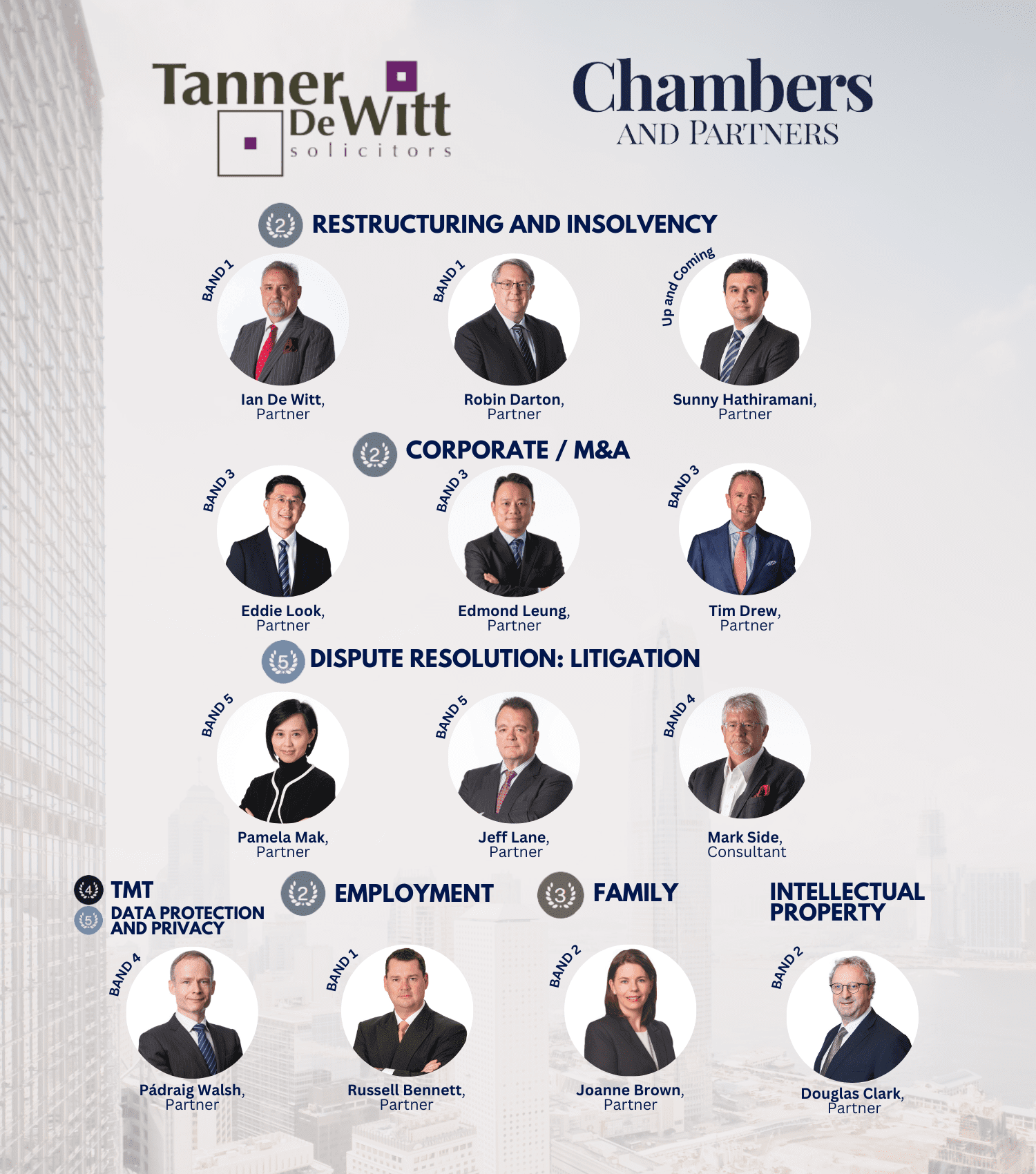
Tanner De Witt is delighted that our law firm has achieved consistent recognition in Chambers and Partners Greater China Region Guide 2024. We are honoured to have maintained top-notch rankings for an impressive 14-year stretch. Big congratulations to our exceptional team for earning this well-deserved recognition.

Restructuring & Insolvency: 14 years and 3 lawyers ranked
Corporate/M&A: Independent Hong Kong Firms: 12 years and 3 lawyers ranked
Dispute Resolution: Litigation: 10 years and 3 lawyers ranked
Family & Matrimonial: 6 years and 1 lawyer ranked
Employment: 3 years and 1 lawyer ranked
TMT: 2 years and 1 lawyer ranked
Data Protection & Privacy: 1 year and 1 lawyer ranked

“

Featured Articles

洞见
Must a foreign judgment be registered before being relied on as a petitioning debt? The position revisited
洞见
同一证人、不同仲裁:仲裁员曾处理同一证人作供,何时会令人质疑其公正性?
洞见
法律动态:您的竞业限制条款实际上在防范什么?关于大厦保安竞业限制条款的不寻常法院案例
新闻
𝐒𝐡𝐞𝐧𝐳𝐡𝐞𝐧–𝐇𝐨𝐧𝐠 𝐊𝐨𝐧𝐠 𝐂𝐫𝐨𝐬𝐬-𝐁𝐨𝐫𝐝𝐞𝐫 𝐋𝐞𝐠𝐚𝐥 𝐒𝐞𝐦𝐢𝐧𝐚𝐫: 𝐂𝐫𝐨𝐬𝐬-𝐁𝐨𝐫𝐝𝐞𝐫 𝐃𝐢𝐬𝐩𝐮𝐭𝐞 𝐑𝐞𝐬𝐨𝐥𝐮𝐭𝐢𝐨𝐧, 𝐖𝐞𝐚𝐥𝐭𝐡 𝐒𝐮𝐜𝐜𝐞𝐬𝐬𝐢𝐨𝐧 𝐚𝐧𝐝 𝐅𝐚𝐦𝐢𝐥𝐲 𝐌𝐚𝐭𝐭𝐞𝐫𝐬
洞见
Key Employment Issues from the 2026 Policy Address
新闻
Pamela Mak Named an ALB Asia Super 50 Dispute Lawyer 2026