content

Sep 28 2026

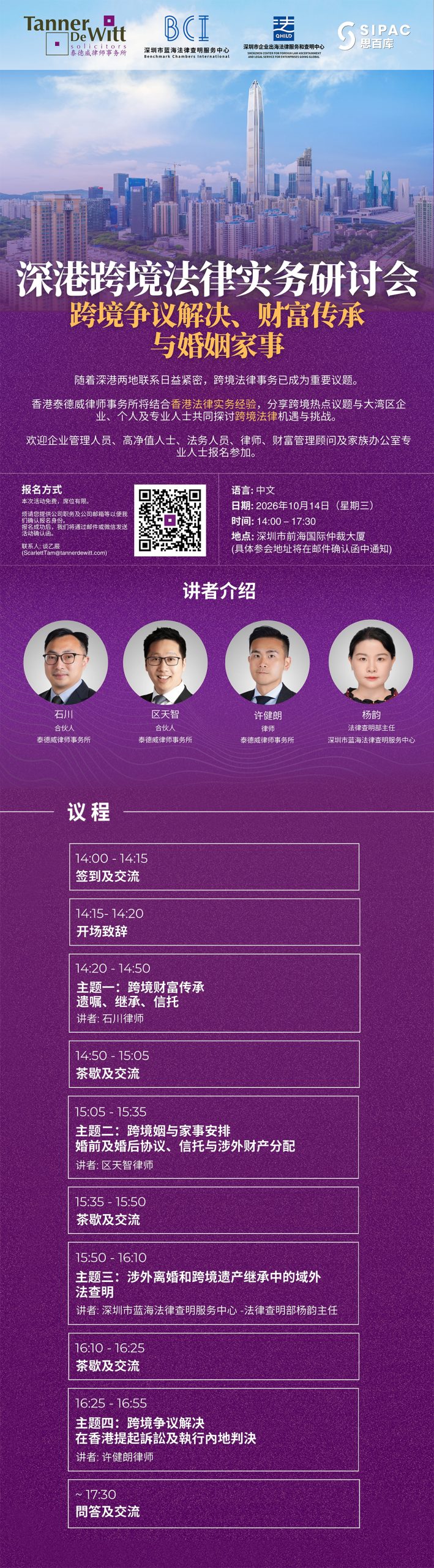
As cross-border movement of people, business and wealth between Hong Kong and Mainland China continues to grow, legal issues relating to dispute resolution, wealth succession and family matters have become increasingly important.
 
We are pleased to announce Tanner De Witt’s first event in Mainland China, taking place in 𝗦𝗵𝗲𝗻𝘇𝗵𝗲𝗻 𝗼𝗻 𝟭𝟰 𝗢𝗰𝘁𝗼𝗯𝗲𝗿 𝟮𝟬𝟮𝟲, 𝗶𝗻 𝗰𝗼𝗹𝗹𝗮𝗯𝗼𝗿𝗮𝘁𝗶𝗼𝗻 𝘄𝗶𝘁𝗵 𝗕𝗖𝗜 (𝗕𝗲𝗻𝗰𝗵𝗺𝗮𝗿𝗸 𝗖𝗵𝗮𝗺𝗯𝗲𝗿𝘀 𝗜𝗻𝘁𝗲𝗿𝗻𝗮𝘁𝗶𝗼𝗻𝗮𝗹) 𝗮𝗻𝗱 Sino International Professional Advisory Council (SIPAC).
 
Drawing on extensive experience in Hong Kong and cross-border matters, our Partners Chuan Shi and Adrian Au, together with Associate Adam Hoi will explore some of the most common legal issues affecting businesses, families and individuals with Hong Kong and Mainland China connections:
▪️ Wealth succession, inheritance and trusts
▪️ Family and matrimonial arrangements
▪️ Cross-border disputes and enforcement
 
Join us and register now: https://lnkd.in/g4w_wGBy

随着香港与内地之间人员、商业活动及财富流动日益频繁,涉及跨境争议解决、财富传承及婚姻家事的法律问题愈发受到广泛关注。
 
我们很高兴宣布,香港泰德威律师事务所将于 2026年10月14日在深圳举办本所在中国内地的首场活动,并荣幸邀请深圳市蓝海法律查明和商事调解中心及 Sino International Professional Advisory Council (SIPAC) 担任本次活动合作方。
 
凭借丰富的香港法律实务经验及跨境项目经验,泰德威合伙人 Chuan Shi 和 Adrian Au 及律师 Adam Hoi 将围绕企业、家庭及个人在香港与内地之间最常遇到的法律问题,分享实务经验与处理思路,包括:
▪️ 财富传承、继承及信托安排
▪️ 婚姻家事及财富规划安排
▪️ 跨境争议、诉讼及判决执行
 
欢迎报名参加: https://lnkd.in/g4w_wGBy

Featured Articles

洞见
Must a foreign judgment be registered before being relied on as a petitioning debt? The position revisited
洞见
同一证人、不同仲裁:仲裁员曾处理同一证人作供,何时会令人质疑其公正性?
洞见
法律动态:您的竞业限制条款实际上在防范什么?关于大厦保安竞业限制条款的不寻常法院案例
新闻
𝐒𝐡𝐞𝐧𝐳𝐡𝐞𝐧–𝐇𝐨𝐧𝐠 𝐊𝐨𝐧𝐠 𝐂𝐫𝐨𝐬𝐬-𝐁𝐨𝐫𝐝𝐞𝐫 𝐋𝐞𝐠𝐚𝐥 𝐒𝐞𝐦𝐢𝐧𝐚𝐫: 𝐂𝐫𝐨𝐬𝐬-𝐁𝐨𝐫𝐝𝐞𝐫 𝐃𝐢𝐬𝐩𝐮𝐭𝐞 𝐑𝐞𝐬𝐨𝐥𝐮𝐭𝐢𝐨𝐧, 𝐖𝐞𝐚𝐥𝐭𝐡 𝐒𝐮𝐜𝐜𝐞𝐬𝐬𝐢𝐨𝐧 𝐚𝐧𝐝 𝐅𝐚𝐦𝐢𝐥𝐲 𝐌𝐚𝐭𝐭𝐞𝐫𝐬
洞见
Key Employment Issues from the 2026 Policy Address
新闻
Pamela Mak Named an ALB Asia Super 50 Dispute Lawyer 2026

content

Jul 27 2026

We are delighted to share that Tanner De Witt, together with partners Pamela Mak and Joanne Brown, have been recognised in the Chambers High Net Worth Guide 2026.

𝗣𝗿𝗶𝘃𝗮𝘁𝗲 𝗪𝗲𝗮𝗹𝘁𝗵 𝗗𝗶𝘀𝗽𝘂𝘁𝗲𝘀
• Pamela Mak, Partner, Head of Dispute Resolution, is once again individually ranked
• Tanner De Witt maintains its firm ranking

𝗙𝗮𝗺𝗶𝗹𝘆/𝗠𝗮𝘁𝗿𝗶𝗺𝗼𝗻𝗶𝗮𝗹
• Joanne Brown, Partner, Head of Family, achieves her first individual ranking
• Tanner De Witt is newly ranked as a firm in this category

These rankings are based on extensive independent research and client feedback. We are grateful to our clients, referees and peers for their continued trust and support.

Congratulations to Pamela, Joanne and all members of our Dispute Resolution and Family teams on this achievement.


Featured Articles

洞见
Must a foreign judgment be registered before being relied on as a petitioning debt? The position revisited
洞见
同一证人、不同仲裁:仲裁员曾处理同一证人作供,何时会令人质疑其公正性?
洞见
法律动态:您的竞业限制条款实际上在防范什么?关于大厦保安竞业限制条款的不寻常法院案例
新闻
𝐒𝐡𝐞𝐧𝐳𝐡𝐞𝐧–𝐇𝐨𝐧𝐠 𝐊𝐨𝐧𝐠 𝐂𝐫𝐨𝐬𝐬-𝐁𝐨𝐫𝐝𝐞𝐫 𝐋𝐞𝐠𝐚𝐥 𝐒𝐞𝐦𝐢𝐧𝐚𝐫: 𝐂𝐫𝐨𝐬𝐬-𝐁𝐨𝐫𝐝𝐞𝐫 𝐃𝐢𝐬𝐩𝐮𝐭𝐞 𝐑𝐞𝐬𝐨𝐥𝐮𝐭𝐢𝐨𝐧, 𝐖𝐞𝐚𝐥𝐭𝐡 𝐒𝐮𝐜𝐜𝐞𝐬𝐬𝐢𝐨𝐧 𝐚𝐧𝐝 𝐅𝐚𝐦𝐢𝐥𝐲 𝐌𝐚𝐭𝐭𝐞𝐫𝐬
洞见
Key Employment Issues from the 2026 Policy Address
新闻
Pamela Mak Named an ALB Asia Super 50 Dispute Lawyer 2026

content

Jul 09 2026

The decision of His Honour Judge I Wong in M, DA & M, VD, KSH ([2026] HKFC 37) concerns the Hong Kong court’s approach to applications for legal costs provision in matrimonial proceedings, particularly in cases involving complex asset structures and high-net-worth individuals. It is a useful reminder that full and frank financial disclosure is not a technical exercise, but central to the court’s ability to do justice.

The parties were married for around twenty-five years. The Wife had largely been out of the workforce, while the Husband was a successful businessman operating through a network of private companies across multiple jurisdictions. Divorce proceedings followed, with ancillary relief still pending. The Wife sought maintenance pending suit and provision for legal costs to fund the litigation. While maintenance was agreed, the issue of legal costs proceeded to judgment.

The governing principles are well established. Legal costs provision is treated as a form of maintenance pending suit, guided by Currey v Currey (No 2) and applied in Hong Kong in HJFG v KCY. The question is whether the applicant can reasonably secure representation by other means. This includes considering the availability of assets, borrowing, or litigation funding, and whether public funding is available. Even where need is established, the court retains a broad discretion, including consideration of proportionality and the parties’ conduct.

In this case, the outcome turned on the Husband’s financial disclosure, and in particular the contrast between his first and updated Forms E. In his original disclosure, prepared with professional assistance, the Husband identified substantial worldwide assets and a net worth exceeding HK$50 million. He was also maintaining the Wife and children at a significant level, and had previously indicated an ability to make meaningful capital provision in his Petition for divorce.

By the time of the updated Form E, however, the position had shifted markedly. Company values were said to be “to be determined”, personal bank balances had reduced sharply, and corporate liabilities, including contingent liabilities supported by personal guarantees, were brought into the calculation of personal net worth. The overall presentation was of significantly reduced means.

The Court was not persuaded that this revised picture provided a clearer or more reliable account of the Husband’s true financial position. While acknowledging the complexity of his affairs, His Honour Judge I Wong expressed concern that the manner of disclosure made it difficult to understand the underlying reality. The effect was not to assist the Court, but to obscure it.

This was not simply a case of imperfect disclosure. The inconsistencies between the earlier and updated Forms E, coupled with the absence of coherent explanation, gave rise to a proper basis for adverse inference in financial remedy proceedings. Where a party has the means and opportunity to provide full and frank disclosure, but advances a presentation that is incomplete, shifting, or opaque, the Court is entitled to treat that evidence with caution. Importantly, it may infer that a clearer and more candid picture would not have assisted that party’s case.

The Court recalled the well-known caveat given by Lam J (as he then was) at [197]–[200] of L v L [2006] HKFLR 121 that financial disclosure is not a “game of hide and seek” and that a court should not hesitate to draw an adverse inference where a litigant has failed in the duty of full and frank disclosure.

His Honour Judge I Wong therefore adopted that approach in a practical way. Faced with a presentation that could not readily be tested or reconciled, the Court was prepared to rely on earlier, more reliable material and to draw adverse inferences as to the Husband’s ability to pay. The exercise was not punitive. It was necessary to ensure that the litigation could proceed on a fair footing.

This case demonstrates that the risk for litigants is real. In Hong Kong divorce and ancillary relief proceedings, where disclosure is presented in a way that obscures rather than clarifies, the Court is not bound to accept it at face value. It is entitled to stand back and draw inferences that reflect the likely reality of the undisclosed position.

Against that backdrop, and given the complexity of the proceedings, including multiple companies, cross-border assets, and likely valuation disputes, the Court concluded that an order for legal costs provision of HK$50,000 per month for eighteen months was reasonable and proportionate.

The decision is a reminder that legal costs provision is not only about need. It is also about fairness in the litigation process. In high-value Hong Kong family law cases, parties are expected to present their financial affairs in a clear, consistent, and intelligible way. Where they do not, the Court may adopt a pragmatic approach, rely on more reliable material, and draw adverse inferences to ensure that both parties are able to participate on an equal footing.

Joanne Brown

Partner | Email


Featured Articles

洞见
Must a foreign judgment be registered before being relied on as a petitioning debt? The position revisited
洞见
同一证人、不同仲裁:仲裁员曾处理同一证人作供,何时会令人质疑其公正性?
洞见
法律动态:您的竞业限制条款实际上在防范什么?关于大厦保安竞业限制条款的不寻常法院案例
新闻
𝐒𝐡𝐞𝐧𝐳𝐡𝐞𝐧–𝐇𝐨𝐧𝐠 𝐊𝐨𝐧𝐠 𝐂𝐫𝐨𝐬𝐬-𝐁𝐨𝐫𝐝𝐞𝐫 𝐋𝐞𝐠𝐚𝐥 𝐒𝐞𝐦𝐢𝐧𝐚𝐫: 𝐂𝐫𝐨𝐬𝐬-𝐁𝐨𝐫𝐝𝐞𝐫 𝐃𝐢𝐬𝐩𝐮𝐭𝐞 𝐑𝐞𝐬𝐨𝐥𝐮𝐭𝐢𝐨𝐧, 𝐖𝐞𝐚𝐥𝐭𝐡 𝐒𝐮𝐜𝐜𝐞𝐬𝐬𝐢𝐨𝐧 𝐚𝐧𝐝 𝐅𝐚𝐦𝐢𝐥𝐲 𝐌𝐚𝐭𝐭𝐞𝐫𝐬
洞见
Key Employment Issues from the 2026 Policy Address
新闻
Pamela Mak Named an ALB Asia Super 50 Dispute Lawyer 2026

content

Feb 25 2026

Recently, Adrian Au discussed the use of Judgment Summons – Examination and Committal Applications in Hong Kong family proceedings, highlighting that committal is a real enforcement mechanism, not a theoretical threat.

A new decision handed down on 4 February 2026 reinforces that message clearly: Wong v Mak [2026] HKFC 26 — a case concerning the activation of a suspended committal sentence.


Round One – 3 Months’ Imprisonment, Suspended for 24 Months

In May 2025, the Wife was found guilty of civil contempt for repeated breaches of a long‑standing non‑molestation order. Her conduct involved over 100 defamatory, degrading, and abusive messages and social‑media posts targeting the Husband and his family.

The Court imposed 3 months’ imprisonment, but suspended it for 24 months, conditional on strict compliance with her non‑molestation undertaking.


While imprisonment in contempt cases is often treated as a last resort, Hong Kong courts may suspend sentences to secure future compliance with injunctions and protective orders


Round Two – Immediate Imprisonment + HK$1Mn Cost

Despite the suspended sentence, evidence showed the Wife continued to post more than 114 new offending posts from her social‑media accounts. She denied responsibility and alleged hacking, but provided no evidence of unauthorised access to her social media account.


She further argued she had been “reverse discriminated” against for being a Hong Kong solicitor. The Court found this argument irrelevant, self‑contradictory, and unviable.


The Court’s Key Findings (Balance of Probabilities Standard):

  • The volume, content, and tone of the posts were consistent with her prior conduct.
  • She offered no credible evidence of hacking, password compromise, or outsider involvement.
  • As a solicitor, she was expected to understand the seriousness of undertakings and Court orders.
  • Her conduct reflected wilful and unremorseful continuation of contempt shortly after sentencing.


The Outcome: The Court activated the original 3‑month imprisonment and ordered her to pay HK$964,754 in indemnity costs


Key Takeaways for Hong Kong Family Law and Enforcement

This new case reinforces the core themes of last week’s article:

  1. Committal orders are real tools of enforcement — They may be imposed, and suspended. But they are not symbolic. Non‑compliance carries real consequences.
  2. Suspended sentences come with conditions — breach them, and activation follows.
  3. Costs exposure is significant and often indemnity‑based – In this case, a HK$1M legal bill.

Adrian Au

If you have any questions, please contact:

Adrian Au
Partner | Email

Disclaimer: This publication is general in nature and is not intended to constitute legal advice. You should seek professional advice before taking any action in relation to the matters dealt with in this publication.

Featured Articles

洞见
Must a foreign judgment be registered before being relied on as a petitioning debt? The position revisited
洞见
同一证人、不同仲裁:仲裁员曾处理同一证人作供,何时会令人质疑其公正性?
洞见
法律动态:您的竞业限制条款实际上在防范什么?关于大厦保安竞业限制条款的不寻常法院案例
新闻
𝐒𝐡𝐞𝐧𝐳𝐡𝐞𝐧–𝐇𝐨𝐧𝐠 𝐊𝐨𝐧𝐠 𝐂𝐫𝐨𝐬𝐬-𝐁𝐨𝐫𝐝𝐞𝐫 𝐋𝐞𝐠𝐚𝐥 𝐒𝐞𝐦𝐢𝐧𝐚𝐫: 𝐂𝐫𝐨𝐬𝐬-𝐁𝐨𝐫𝐝𝐞𝐫 𝐃𝐢𝐬𝐩𝐮𝐭𝐞 𝐑𝐞𝐬𝐨𝐥𝐮𝐭𝐢𝐨𝐧, 𝐖𝐞𝐚𝐥𝐭𝐡 𝐒𝐮𝐜𝐜𝐞𝐬𝐬𝐢𝐨𝐧 𝐚𝐧𝐝 𝐅𝐚𝐦𝐢𝐥𝐲 𝐌𝐚𝐭𝐭𝐞𝐫𝐬
洞见
Key Employment Issues from the 2026 Policy Address
新闻
Pamela Mak Named an ALB Asia Super 50 Dispute Lawyer 2026

content

Feb 12 2026

Introduction

Legal recognition of same-sex parenthood is a still developing area in Hong Kong. Same-sex couples and their children face significant challenges and discrimination in Hong Kong under the application of outdated laws that fail to account for the reality of modern family structures. This leaves children of non-traditional families in positions of vulnerability and legal uncertainty. However, a number of recent landmark decisions give hope that the tide is starting to turn towards affording protection to all families and their children in Hong Kong.

Legal Parenthood and the law

Under Hong Kong law, by default a child’s gestational carrier is considered to be their mother, and if the mother is married, her husband is considered to be their father.

However, it is well-established in both Hong Kong and UK case law that the notion of parenthood is not limited to genetic or gestational connections. Parenthood also fundamentally encompasses both social and psychological bonds. The notion of a “psychological parent” as a form of natural parent, as distinct from but equal to genetic and gestational parents, was notably addressed by Baroness Hale in Re G (Residence: Same-sex Partner) [2006] 1 WLR 2305, at §§35-37:

37. “… there are also parents who are neither genetic nor gestational, but who have become the psychological parents of the child and thus have an important contribution to make to their welfare. Adoptive parents are the most obvious example, but there are many others.”

Regardless of how it is recognised, legal parenthood confers vital rights, responsibilities, and protections, the primary focus of which should always be the child’s best interests. However, the lack of application of these rights to modern family structures, including those formed by same-sex couples, have necessitated numerous applications for parental orders and legal challenges.

Same-sex Adoption

Under the Adoption Ordinance (Cap. 290) (“the AO”), adoption in Hong Kong is open to single individuals or joint applicants who are spouses. Adoptions in Hong Kong are overseen by the Social Welfare Department (“SWD”) and three accredited NGOs. The AO does not define the word “spouse.” However, it has been the ongoing practice of the Director of Social Welfare to limit its interpretation to opposite-sex spouses and to exclude same-sex married couples from joint adoption rights. Under this interpretation, parties to a same-sex overseas marriage are also unable to adopt their spouse’s child in a second parent adoption under the AO. For same-sex couples in Hong Kong, this leaves only the option of one party to the marriage applying to adopt as a sole applicant.

The decision in B v B & another [2024] HKCFI 3356 saw the High Court approve the adoption of a child by a married gay man as a sole applicant. After the Family Court Judge transferred the case to the Court of First Instance, Justice Au-Yeung affirmed that the child’s best interests override concerns about the parent’s sexual orientation. It is worth noting that nothing in the AO suggests that a sole applicant’s sexual orientation can or should impact their eligibility for adoption.

The Director’s interpretation of the AO and the resulting differential treatment of same-sex and opposite-sex spouses leaves the non-applicant spouse and the adopted child in the position of legal strangers. This is despite whatever the factual reality of their parent-child relationship may be. The adoptive parent and child are left lacking enforceable parental rights, including orders for maintenance for the child against the non-applicant spouse. This leaves the child and the family in a vulnerable position. Alternative legal protections such as guardianship or wardship, both of which are revocable and cease once the child attains majority, cannot permanently cure the denial of legal recognition of the parent-child relationship.

Surrogacy for Same-sex Couples

Hong Kong’s legal framework for surrogacy is governed by the Human Reproductive Technology Ordinance (Cap. 561) (“the HRTO”). Hong Kong law heavily restricts surrogacy arrangements. Commercial surrogacy is prohibited entirely with the elements of the related offences set out in section 17 of the HRTO. Altruistic surrogacy, while permissible, lacks a clear legal framework and is available only to married opposite-sex couples. Altruistic surrogacy arrangements are also unenforceable in Hong Kong, with the gestational mother considered to be the child’s legal mother until a parental order is made in favour of the commissioning parents.

As a result of these restrictions under the HRTO, many same-sex couples turn to surrogacy arrangements overseas. However, the prohibitions on commercial surrogacy arrangements in the HRTO have extraterritorial effect. This means that an offence is considered to have been committed in Hong Kong regardless of where the surrogacy arrangement is initiated or carried out.

Once back in Hong Kong, same-sex commissioning parents have limited and challenging options available to them to secure legal recognition of their relationship with their child.

The Court has no statutory power to grant a parental order in surrogacy except under section 12 of the Parent and Child Ordinance (Cap. 429) (“the PCO”) which expressly excludes same-sex couples.

The options that remain to same-sex couples or commissioning parents who are otherwise excluded from applying under s12 of the PCO are:

  1. obtaining an adoption order in the country in which the child was born to the surrogate mother; or
  2. applying to the Hong Kong Court for approval to pursue a private adoption of the child, that is, out with the normal adoption process conducted by SWD. However, only one commissioning parent can adopt and be legally recognised as the child’s parent.

Both are expensive and time-consuming processes, and legal advice should be taken in Hong Kong and any other relevant jurisdiction for a comprehensive understanding of the procedures and risks before a path is chosen.

Reciprocal IVF (“RIVF”) and Parental Rights

RIVF is a procedure by which one woman carries their partner’s egg in pregnancy, fostering biological parenthood of a child for both partners in a female same-sex couple. However, with Hong Kong law only recognising the gestational mother and her husband, if any, as the child’s legal parents, the partner who is the genetic mother of the child is not recognised in legal parenthood. Like with surrogacy, the paths available to legal parenthood are limited. Adoption is not an option, unless to the exclusion of the gestational parent’s legal rights, and for the reasons above, same-sex couples are excluded from applying for parental orders under section 12 of the PCO.

The exclusion from birth registration of genetic parents in same-sex couples who have children by RIVF was recently successfully challenged in K (an infant) by his next friend, R v The Secretary for Justice [2025] HKCFI 1974 (“the K decision”). Justice Coleman found the differential treatment of children born through RIVF to lesbian couples to be unconstitutional and that it failed to recognise the existence of same-sex families and the use of RIVF to have children. The Court deferred the question of form of relief for further argument.

The couple had previously applied for a declaration under the PCO that both parents should be legally recognised as the child’s parents. In the decision, the court granted recognition of the non-gestational parent in  as a “parent at common law,” reflecting the evolving understanding of family but still without conferral of full legal rights and benefits. The Court did however observe that it “…should be astute to the changing world where people build families in different manners other than through a married or heterosexual relationship.”

Conclusion

Comprehensive reform of child protection laws in Hong Kong and their application to children of modern family structures is long overdue. Until then, same-sex couples in Hong Kong must navigate a complex and often inequitable legal landscape, relying on costly litigation and uncertain outcomes to secure recognition of their parental rights and more to the point, the rights of their children.

While recent decisions have made some progress towards aligning the law with now well-established diverse family forms, significant gaps remain, especially concerning joint adoption rights for same-sex couples and clear parentage recognition in surrogacy arrangements. This leaves children born into such families in vulnerable positions. Justice Coleman astutely observed in the K decision that:

193. “…For sure, heterosexual parents have no monopoly on good parenting, and it is as a matter of generality difficult to understand why same-sex parents should somehow prove that their parenting is in the best interests of the child, when the vast majority of heterosexual parents do not have to jump any such hurdle.”

For now, court applications will continue to be necessary and as Hong Kong family lawyers, we are committed to our clients and to continue our work for them towards equal protection and legal certainty for themselves and their children.


Joanne Brown & Elizabeth Seymour-Jones


If you have any questions, please contact Joanne Brown:

Joanne Brown

Partner | Email


Disclaimer: This publication is general in nature and is not intended to constitute legal advice. You should seek professional advice before taking any action in relation to the matters dealt with in this publication.

Featured Articles

洞见
Must a foreign judgment be registered before being relied on as a petitioning debt? The position revisited
洞见
同一证人、不同仲裁:仲裁员曾处理同一证人作供,何时会令人质疑其公正性?
洞见
法律动态:您的竞业限制条款实际上在防范什么?关于大厦保安竞业限制条款的不寻常法院案例
新闻
𝐒𝐡𝐞𝐧𝐳𝐡𝐞𝐧–𝐇𝐨𝐧𝐠 𝐊𝐨𝐧𝐠 𝐂𝐫𝐨𝐬𝐬-𝐁𝐨𝐫𝐝𝐞𝐫 𝐋𝐞𝐠𝐚𝐥 𝐒𝐞𝐦𝐢𝐧𝐚𝐫: 𝐂𝐫𝐨𝐬𝐬-𝐁𝐨𝐫𝐝𝐞𝐫 𝐃𝐢𝐬𝐩𝐮𝐭𝐞 𝐑𝐞𝐬𝐨𝐥𝐮𝐭𝐢𝐨𝐧, 𝐖𝐞𝐚𝐥𝐭𝐡 𝐒𝐮𝐜𝐜𝐞𝐬𝐬𝐢𝐨𝐧 𝐚𝐧𝐝 𝐅𝐚𝐦𝐢𝐥𝐲 𝐌𝐚𝐭𝐭𝐞𝐫𝐬
洞见
Key Employment Issues from the 2026 Policy Address
新闻
Pamela Mak Named an ALB Asia Super 50 Dispute Lawyer 2026

content

Feb 04 2026

Enforcement, Penalties, and the Real Risk of Imprisonment

Many divorce settlements involve one time payments or ongoing financial commitments, such as monthly maintenance, school fees, or staged lump-sum payments. These arrangements often work well at the outset, but real life has a habit of intervening.

When payments fall behind, this will have a knock-on effect on the financially dependent party. Some assume the court will be sympathetic. Others assume enforcement is slow and cost inefficient. Both assumptions can be costly.

One of the strongest enforcement tools available to the Family Court is the Judgment Summons. This article explains what it is, how it operates in Hong Kong today, and what can happen if court-ordered payments are ignored — as well as what parties should do early if they genuinely cannot pay.

This article forms part of a broader series on the enforcement of financial orders in Hong Kong divorce proceedings.

1. What Is a Judgment Summons?

A judgment summons is a court procedure used to enforce a financial obligation ordered by the court.

In divorce cases, this most commonly involves:

It is important to be clear from the outset:

A judgment summons is not simply the court asking why payment has not been made. In serious cases, it can lead to penal consequences, including loss of liberty.

In the past, judgment summons proceedings were sometimes described as a single “show cause” hearing. That description is no longer accurate.

2. How Judgment Summons Work in Hong Kong Today

Two Separate Procedures — Not a Step-by-Step Process

Under current law, the term “judgment summons” is used as a shorthand for two distinct court procedures, each serving a different purpose.

(a) Examination Summons — Investigating Financial Means

An examination summons allows the creditor to obtain information about the payer’s financial position. It may be used to:

The payer may be questioned under oath and must give full and honest answers.

An examination summons does not, by itself, result in imprisonment.

However, incomplete or evasive answers may lead the court to draw adverse conclusions, which can later become critical if committal proceedings are pursued.

(b) Committal Summons — Penal Proceedings

A committal summons is fundamentally different.

It is a penal process in which the court is asked to punish a party for deliberately failing to comply with a court order.

To succeed, the applicant must beyond reasonable doubt that:

Clarifying some common conceptions:

3. What Penalties Can the Court Impose?

If the court is satisfied that a party has deliberately failed to comply with a financial order, it has a range of enforcement powers.

(a) Fine

The court may impose a financial penalty, either on its own or together with other enforcement orders.

(b) Imprisonment

This is the most serious sanction.

Imprisonment is not mandatory and is considered as a last resort, however this is becoming more common.

Custodial sentences are typically considered where:

(c) Suspended Sentence

In many cases, the court may impose a prison sentence but suspend it on strict conditions — for example:

A suspended sentence is not a warning. It is usually the court’s final opportunity for compliance. If the conditions are breached, imprisonment may follow swiftly.

(d) Surcharge on Arrears

In maintenance cases, the court may also impose a surcharge on outstanding arrears.

This is an additional financial penalty for repeated non-payment without reasonable excuse.

4. “I Genuinely Can’t Pay” — What Should Be Done?

Financial hardship is real. The Family Court recognises that circumstances can change.

But there is a right way and a wrong way to deal with that reality.

(a) Apply for a Variation — Early and Properly

If a party can no longer afford to comply with a financial order, the proper response is to apply for a variation. In appropriate cases, the court may also be asked to suspend payments while the variation is being considered.

A variation application must show:

What the court will not accept is stopping payment unilaterally and hoping the issue resolves itself.

(b) Does Applying for a Variation Automatically Stop Judgment Summons Application?

No, it does not. While courts have indicated that variation applications are often dealt with before enforcement, this is not guaranteed.

If the court finds that:

then enforcement — including committal — may still proceed.

A late variation application is rarely a shield against serious enforcement action.

5. Enforcing Maintenance Arrears Over 12 Months

If maintenance arrears are more than 12 months old, the court’s permission is required before enforcement.

Delay alone does not prevent enforcement. The court will consider:

Importantly, patience or accommodation does not amount to forfeiting the right to enforce later.

6. Practical Takeaways

If You Are Enforcing a Court Order

Consider:

A clear enforcement strategy can materially affect outcomes.

If You Are Struggling to Pay

Be proactive and realistic:

Waiting too long usually worsens the position.

Final Thoughts

If you are struggling to comply with a financial order, do not wait until enforcement proceedings are issued. Early advice and a timely variation application can prevent matters from escalating.

If you are owed money under a court order, do not assume enforcement is ineffective or slow. The Family Court has robust powers, and in appropriate cases it will use them.

Judgment summons proceedings are not procedural formalities. They carry real consequences, including imprisonment, and should be taken seriously by both sides.


Adrian Au


If you have any questions, please contact Adrian Au:

Adrian Au

Partner | Email


Disclaimer: This publication is general in nature and is not intended to constitute legal advice. You should seek professional advice before taking any action in relation to the matters dealt with in this publication.
Featured Articles

洞见
Must a foreign judgment be registered before being relied on as a petitioning debt? The position revisited
洞见
同一证人、不同仲裁:仲裁员曾处理同一证人作供,何时会令人质疑其公正性?
洞见
法律动态:您的竞业限制条款实际上在防范什么?关于大厦保安竞业限制条款的不寻常法院案例
新闻
𝐒𝐡𝐞𝐧𝐳𝐡𝐞𝐧–𝐇𝐨𝐧𝐠 𝐊𝐨𝐧𝐠 𝐂𝐫𝐨𝐬𝐬-𝐁𝐨𝐫𝐝𝐞𝐫 𝐋𝐞𝐠𝐚𝐥 𝐒𝐞𝐦𝐢𝐧𝐚𝐫: 𝐂𝐫𝐨𝐬𝐬-𝐁𝐨𝐫𝐝𝐞𝐫 𝐃𝐢𝐬𝐩𝐮𝐭𝐞 𝐑𝐞𝐬𝐨𝐥𝐮𝐭𝐢𝐨𝐧, 𝐖𝐞𝐚𝐥𝐭𝐡 𝐒𝐮𝐜𝐜𝐞𝐬𝐬𝐢𝐨𝐧 𝐚𝐧𝐝 𝐅𝐚𝐦𝐢𝐥𝐲 𝐌𝐚𝐭𝐭𝐞𝐫𝐬
洞见
Key Employment Issues from the 2026 Policy Address
新闻
Pamela Mak Named an ALB Asia Super 50 Dispute Lawyer 2026

content

Jan 27 2026

The recent case of Leung Kar Hin Ross v Ma Lai Fong [1] (“Leung v Ma”) case link has provided important reminders for families dealing with the passing away of loved ones, particularly around who has the legal right to make funeral arrangements and control the disposition or burial of a deceased person’s remains. This topic frequently arises in probate disputes and family conflicts, and understanding the law can help avoid deeply emotional disagreements.

Leung v Ma

The Hong Kong Court was required to resolve a difficult and sad dispute between Leung (the son) and Ma (his mother). The dispute concerned who should be given the right to dispose of the remains of the deceased husband and father (the “Deceased”), as well as control of the funeral arrangements.

During an illness before his death, the Deceased, while separated physically from Ma by their children, executed various documents including an Enduring Power of Attorney, a Will and a Notice of Severance (to sever property rights of the family home with Ma). It was also alleged by Ma that the Deceased had removed funds totalling over HKD7.5million in the months before his death and that Leung has refused to account for the missing funds. Ma questioned testamentary capacity and made various other allegations to form the basis of her cross-application. There were clear and ongoing disputes between Leung and his siblings which formed an important background to this case.

The Deceased had named Leung as executor in his Will, and as such, Leung claimed to be entitled to, possession of the remains, to dispose of the remains and to control funeral arrangements. However, Ma challenged Leung’s suitability to do so. In particular, she pointed to Leung’s “lack of genuine commitment acting contrary to [the Deceased’s] religious wishes,” his systematic isolation of Ma and other relatives from the Deceased in the days before his passing, and her concerns that she might not be informed of relevant funeral services due to the lack of trust between them.

The Court ruled that, although the “starting point” for such disputes was that the executor under a will shall be entitled to possession of the remains and be responsible for burial and funeral arrangements, Ma’s concerns were valid and real and that her points were sufficient to constitute “overwhelming circumstances to depart from the starting point”. The Court conveyed Ma both possession of the Deceased’s remains and the right to arrange for the relevant funeral services, to “achieve proper respect and decency” for the Deceased, as well as to prevent “irreparable”deprivation on the part of Ma and other relatives were they to miss any funeral services.

In ruling the above, the Court delivered a powerful and crucial reminder that appointment of an executor is not final, and the Courts retain discretion to redirect the right to possession of a deceased person’s remains and to control their funeral arrangements.

Sadly, it appears clear that there are many questions to be resolved around the circumstances of various documents executed before the Deceased passed, meaning the Will may be challenged, and litigation may continue.

Common law

There are both moral and practical reasons for the laws governing disposition of a person’s remains. Courts in Hong Kong still rely heavily on long-established common law principles as noted by Baroness Hale in Kerr v Department for Social Development (Northern Ireland) [2], “…we all have an interest in securing the decent burial of a dead body. It is disrespectful, as well as a hazard to public health, if this is not done in a prompt and seemly manner. Hence there is a common law obligation, “in the nature of a public duty, to arrange for [proper burial arrangements].”

The seminal case in this area of law is Haynes’ case [3], where it was established that a corpse is not capable of property ownership. In this case, when the Court considered the Defendant Haynes’ taking of several sheets off the bodies of some corpses, it ruled that Haynes was liable in theft to the executor of the deceased persons, as opposed to the deceased persons/corpses. This was because the corpses could not be the owner of the any property, such as the sheets. The sheets in question were ultimately held to be owned by the corpses’ executor.

Hong Kong law

The Haynes’ case principle still holds in Hong Kong. In Re Estate of Lu Han Lung [4], the Hong Kong Court set out what are now known as the “Lu Han Lung Principles” governing who should be entitled to the remains of a deceased and its burial. In Leung v Ma, the Court summarised the essentials of these principles as stated below (by way of citing Zhao Shaoyuan v Chan Mee Lin [5] then adding further observations):-

Courts favour executors

The Hong Kong courts generally give priority to deceased’s personal representative and executor or administrator the right to arrange burial. In Sum Siu Mui v Ho Sui Chun [5], upon a dispute between the de facto wife Plaintiff and executor Defendant (on the location of the grave and choice of contractor to hire to arrange the burial), the Court ruled in favour of the Defendant, stating that, as executor, the Defendant had both the right to bury and the rights over the grave.

Similarly, in Cheung Hong Mui, the personal representative of the Estate of Lam Kwan Hung, Deceased v Lam Mo Sze [6], the Defendant was the intestate deceased’s daughter. The Defendant had handled many of the deceased’s intestate affairs (e.g. death certificate, funeral and burial). However, it was the Plaintiff – the deceased’s wife – who was formally appointed administrator years afterwards. In the following years, the Defendant attempted to arrange for the deceased’s remains. The Plaintiff objected and applied for a court order to grant her permission to deal with them instead. The Court ruled in the Plaintiff’s favour. Citing the Lu Han Lung Principles, the Court noted how the Plaintiff had been granted the Letters of Administration in respect of the deceased’s estate, which would make her the “proper person entitled” on the burial arrangements, despite the Defendant’s daughter’s previous contributions.

However, as we can see from the Lu Han Lung Principles (as set out above by Leung v Ma’scitation of Zhao Shaoyuan v Chan Mee Lin), although the “starting point” is for the courts to favour executors, this can be overturned depending on the circumstances of the case. For families where estrangement, second marriages, blended families are involved or questions of testamentary capacity exist, arrangements can be particularly vulnerable to dispute.

Same-sex spouse rights

In the Court of Final Appeal case Ng Hon Lam Edgar v Secretary for Justice and Li Yik Ho and Secretary for Justice) [7], the Court considered inheritance rights of same-sex couples obiter, the case also considered that Li had not been permitted to identify his partner Mr. Ng’s corpse at the public mortuary.

Whilst the case was settled, the Court took the chance to restate Hong Kong government’s declared position on corpse identification:-

Notably, the Court stated that there is no distinction between same-sex and opposite-sex spouses for the term ‘spouse’ under schedule 2(1) of the Coroner’s Ordinance (Cap. 504). Following this, and pending any framework change from the Hong Kong government, the intestacy and family provision statutes must be read so that a surviving same‑sex spouse lawfully married overseas is treated in the same way as an opposite‑sex spouse for the purposes of inheritance and dependency provision. This is significant for same‑sex couples in Hong Kong planning their estate arrangements.

Alternative disposition

For those so inclined, Hong Kong’s Medical (Therapy, Education and Research) Ordinance(Cap. 278)allows for a person’s remains – or individual body parts – to be subject to donation for regulated uses of deceased muscle tissue. Several medical schools in Hong Kong have ‘whole body donation’ programmes where donated cadavers are used for dissection, medical education, and preparation of permanent specimens. The remains are either returned to the family after 2 years, cremated at the school’s expense and scattered in a memorial garden, or retained as a permanent specimen. These remains receive the utmost care and dignified respect as per their contribution to science and the training of Hong Kong’s next generation of medical talent. This alternative can be part of a broader estate and end‑of‑life planning strategy.

Conclusion

Couples and families, whether married, or unmarried should consider making clear, early arrangements for the disposition of remains and funeral wishes. Doing so helps minimise family disputes. However, Leung v Ma serves as a reminder that even well drafted wills may not be the final word on who controls funeral arrangements. Courts retain discretion to reassign those rights where fairness and respect require it.

Joanne Brown

For advice on family law, probate disputes, will challenges, or disposition arrangements, please contact:

Joanne Brown

Partner | Email

Adrian Au

Partner | Email

Eddie Look

Partner | Email

Disclaimer: This publication is general in nature and is not intended to constitute legal advice. You should seek professional advice before taking any action in relation to the matters dealt with in this publication.
[1] [2026] HKCFI 383

[2] [2004] UKHL 23, [2004] 1 WLR 1372

[3] (1614)

[4] [2010] 3 HKLRD 651

[5] [2018] HKCFI 1724

[6] [2021] HKCFI 1585

[7] [2011] HKCU 1142

[8] [2024] HKCFA 30

Featured Articles

洞见
Must a foreign judgment be registered before being relied on as a petitioning debt? The position revisited
洞见
同一证人、不同仲裁:仲裁员曾处理同一证人作供,何时会令人质疑其公正性?
洞见
法律动态:您的竞业限制条款实际上在防范什么?关于大厦保安竞业限制条款的不寻常法院案例
新闻
𝐒𝐡𝐞𝐧𝐳𝐡𝐞𝐧–𝐇𝐨𝐧𝐠 𝐊𝐨𝐧𝐠 𝐂𝐫𝐨𝐬𝐬-𝐁𝐨𝐫𝐝𝐞𝐫 𝐋𝐞𝐠𝐚𝐥 𝐒𝐞𝐦𝐢𝐧𝐚𝐫: 𝐂𝐫𝐨𝐬𝐬-𝐁𝐨𝐫𝐝𝐞𝐫 𝐃𝐢𝐬𝐩𝐮𝐭𝐞 𝐑𝐞𝐬𝐨𝐥𝐮𝐭𝐢𝐨𝐧, 𝐖𝐞𝐚𝐥𝐭𝐡 𝐒𝐮𝐜𝐜𝐞𝐬𝐬𝐢𝐨𝐧 𝐚𝐧𝐝 𝐅𝐚𝐦𝐢𝐥𝐲 𝐌𝐚𝐭𝐭𝐞𝐫𝐬
洞见
Key Employment Issues from the 2026 Policy Address
新闻
Pamela Mak Named an ALB Asia Super 50 Dispute Lawyer 2026

content

Nov 14 2025

Cohabitation is on the rise in Hong Kong, as more couples choose to live together before, or instead of, getting married. Yet despite these changing social norms, the law in Hong Kong continues to draw sharp distinctions between married and unmarried couples. Understanding how cohabitation fits within Hong Kong legal frameworks, and the impact this has on everything from separation and property to children, and inheritance, is essential for anyone considering cohabitation or currently in a long-term relationship outside of marriage.​

Unmarried couples, no matter how long they have lived together, are not recognised under Hong Kong law as having the same rights as married couples or even distinct rights a cohabitants. The myth of “common law marriage” simply does not exist here. Married couples enjoy a comprehensive package of legal protections and financial benefits, including public housing, tax relief, medical coverage, and access to pensions. Unmarried couples, including those who have cohabited for decades or who share children, do not get these automatic benefits. The following are several examples of where the rights and obligations diverge:-

Divorce and Trust Law Differences

Only married individuals may make claims under the Matrimonial Causes Ordinance when a relationship breaks down. This Ordinance governs everything from division of assets, transfer and sale of property to children and spousal maintenance. For cohabiting but unmarried partners, there is no right to claim financial support or property division soley as a result of the relationship ending. Instead, any claims about property ownership come down to trust law, which requires proof of direct contributions or agreements, often leading to complex, stressful disputes.

Unmarried stay-at-home partners are particularly vulnerable, sometimes left without any legal recourse to share in property acquired during the relationship.​ Unmarried parents are not entitled to claim spousal maintenance but may claim a carer’s allowance under the Guardianship of Minors Ordinance. These may differ in terms of quantum and duration. The latter being drawn from the mutual obligations of the marriage and the spouses’ needs, whereas the carer’s allowance is a child focused measure intended to indirectly benefit the child.

Children and Parental Rights

For married parents, both the mother and father automatically hold parental rights and responsibilities for their children by law. This means both parents have the right to make the big decision for their children. Unmarried parents, however, face a very different reality. Unless a father’s name appears on the birth certificate, or unless he obtains a declaration from the court, he will have no automatic or inherent parental rights. This can cause significant issues regarding custodial decision-making, and even the ability to prevent a child from being taken or retained overseas. The law’s emphasis remains on the mother, with unmarried fathers required to take active steps to secure legal recognition.​

Probate, Inheritance and Financial Claims

The imbalance between married and unmarried couples is also unhelpful when it comes to inheritance and probate. Where a married partner dies without a will (intestate in legalese), the surviving spouse is entitled to inherit by default under Hong Kong probate law. However, for unmarried cohabitants, there is no such entitlement unless the deceased expressly provided for them in a will. Even couples who have shared a home and their lives together for decades can find that the law provides no safety net, potentially leaving the surviving partner without support or a claim on family assets.​

Action Steps for Unmarried Couples

Given these realities, there are practical, proactive steps that unmarried couples and unmarried parents can take to protect themselves and their children in Hong Kong. A cohabitation agreement is a good place to start. It can address responsibilities of each partner during the relationship, provide for ownership of property and other assets and provide clarity for what is to happen in the event of a separation. Insurance policies, pension beneficiary designations, and other written agreements on major assets can provide added layers of security. Unmarried fathers can apply for legal parental status early, ideally at the child’s birth. Finally, drafting a will is critical for ensuring loved ones are provided for in the event of a death.

While, these actions do not create comprehensive marriage-equivalent rights, they significantly reduce risk and legal uncertainty and help close the gap that Hong Kong’s law currently leaves.​ This can prevent years of stressful legal action and costs.

Joanne Brown

If you have any questions, please contact Joanne Brown.

Joanne Brown

Partner | Email

Disclaimer: This publication is general in nature and is not intended to constitute legal advice. You should seek professional advice before taking any action in relation to the matters dealt with in this publication.

Featured Articles

洞见
Must a foreign judgment be registered before being relied on as a petitioning debt? The position revisited
洞见
同一证人、不同仲裁:仲裁员曾处理同一证人作供,何时会令人质疑其公正性?
洞见
法律动态:您的竞业限制条款实际上在防范什么?关于大厦保安竞业限制条款的不寻常法院案例
新闻
𝐒𝐡𝐞𝐧𝐳𝐡𝐞𝐧–𝐇𝐨𝐧𝐠 𝐊𝐨𝐧𝐠 𝐂𝐫𝐨𝐬𝐬-𝐁𝐨𝐫𝐝𝐞𝐫 𝐋𝐞𝐠𝐚𝐥 𝐒𝐞𝐦𝐢𝐧𝐚𝐫: 𝐂𝐫𝐨𝐬𝐬-𝐁𝐨𝐫𝐝𝐞𝐫 𝐃𝐢𝐬𝐩𝐮𝐭𝐞 𝐑𝐞𝐬𝐨𝐥𝐮𝐭𝐢𝐨𝐧, 𝐖𝐞𝐚𝐥𝐭𝐡 𝐒𝐮𝐜𝐜𝐞𝐬𝐬𝐢𝐨𝐧 𝐚𝐧𝐝 𝐅𝐚𝐦𝐢𝐥𝐲 𝐌𝐚𝐭𝐭𝐞𝐫𝐬
洞见
Key Employment Issues from the 2026 Policy Address
新闻
Pamela Mak Named an ALB Asia Super 50 Dispute Lawyer 2026

content

Aug 22 2025

Adrian Au, partner from our family practice breaks down the most frequently asked questions, offering clarity, guidance, and practical insights for those navigating this complex process. 

The full Q&A is set out below. A downloadable version is available at the end. 

Question 1:

What do I need to know about divorcing in Hong Kong? 

Answer:

In Hong Kong, divorce proceedings follow a 3-pronged process: dissolving the marriage, handling child care arrangements, and sorting out finances.

Initially, all three steps happen simultaneously. If the main suit is not contested and if the Court is satisfied with the paperwork, the Court will issue a Decree Nisi. However, the marriage is not formally dissolved at this point, and after the Court is satisfied with the financial and care arrangements for the children, it will then issue a Decree Absolute, formally dissolving the marriage.

As described above, the divorce proceedings is a 3-pronged process. It is therefore not uncommon that the financial proceedings between the spouses are still ongoing even after the Court formally dissolves the marriage.

Question 2:

Does Hong Kong recognise our overseas marriage? Do we have to register our overseas marriage in Hong Kong? 

Answer:

Hong Kong Courts recognise overseas marriages provided that the marriage was lawful under the local jurisdiction where it occurred, and that there was mutual consent from both parties. 

There is no requirement to register an overseas marriage in Hong Kong for recognition by the judicial system. Nonetheless, should you desire to update your marital status with the Immigration Department, you may do this by completing and submitting Form ROP 18 which is available at https://www.immd.gov.hk/eng/forms/forms/rop18.html 

Question 3: 

If we are legally married overseas or in Mainland China, can I get divorced in Hong Kong? Would the outcome be different if we had married in Hong Kong? 

Answers: 

So long as parties were legally married, the place where the parties were married is not a factor which the Hong Kong court will take into account when deciding with whether it has jurisdiction to deal with the divorce petition. 

Under the laws of Hong Kong, the Hong Kong Courts will have jurisdiction to deal with a divorce petition if either party: 

The above jurisdiction requirement applies regardless of whether the parties were married in Hong Kong / Mainland China or elsewhere in the world. 

Question 4: 

We were married in Hong Kong, but have since lived in the Mainland China. Can we file for divorce in Hong Kong? 

Answer: 

The Hong Kong Courts may have jurisdiction over a divorce petition if either party is domiciled in Hong Kong; has habitually resided in Hong Kong in the past 3 years, or has a substantial connection with Hong Kong at the time of the petition. The Courts will assess the facts of each case individually at the time of the petition, and no single factor will be definitive in determining jurisdiction. 

Question 5: 

I am a Hong Kong Permanent Resident (HKPR). Can I file for divorce in Hong Kong? 

Answer: 

Being a HKPR does not necessarily mean they are domiciled in Hong Kong. A person is considered domiciled in Hong Kong if they are present in Hong Kong and intend to make it their home for the foreseeable future. 

However, if this is not satisfied, they can try to satisfy one of the other jurisdictional requirements. 

Question 6: 

If both parties consent, can we become formally divorced by registering our agreement with the relevant authorities in Hong Kong? 

Answer:

In Hong Kong, only the Court may formally dissolve a marriage. Parties must therefore either petition for a divorce or jointly apply for a divorce. 

However, the Hong Kong Court encourages parties to reach an amicable settlement over both children and financial arrangements prior to commencing divorce proceedings. Donig so may sometimes shorten the time needed for the Court to consider and formally dissolve the marriage. 

Question 7: 

Is there a “cooling-off” period in Hong Kong? Will the Court reject our petition in the first instance?

Answer:

The only “cooling-off” period is a 42 day gap between the pronouncement of Decree Nisi and application for Decree Absolute, so that the Petitioner can “wait and think” before formally applying to dissolve the marriage. If the parties eventually reconcile their differences, they may apply to withdraw the divorce petition any time before the Court formally dissolves the marriage. 

Once the Court is satisfied that it has jurisdiction over the divorce proceedings and that the marriage has broken down irretrievably for the reasons stated in the divorce petition, it will proceed to dissolve the marriage, regardless of whether this is the parties’ first time petitioning for divorce. 

Question 8: 

If I can petition for divorce in both Hong Kong and the Mainland China, what are my considerations? 

Answer: 

Choosing the forum and applicable law for determining child and financial arrangements may significantly impact the outcome of the proceedings. 

In our experience, clients often ask about the duration of proceedings, the children’s residence, the location of family assets, the asset division, and parental rights. Parties must carefully consider the benefits and drawbacks of each jurisdiction before filing. 

Question 9: 

On what basis can I petition for divorce in Hong Kong? 

Answer:

The only ground for divorce in Hong Kong shall be that the marriage has broken down irretrievably. In the divorce petition, the petitioner will have to prove and satisfy the Court with 1 of the 5 facts, which are commonly known as: 

(i) Adultery;

(ii) Unreasonable behaviour;

(iii) One year separation with consent; 

(iv) Two year separation; and 

(v) One year desertion 

Question 10:

What are the implications if an adulterous petition is established?

Answer: 

In the English Judgement G v G [2002] 2 FLR 1143, Coleridge J famously commented that:

“the parties are not assisted to achieve compromise when they are encouraged by the law to indulge in a detailed and lengthy retrospective involving a general rummage through the attic of the marriage to discover relics from the past to enhance their role or diminish their spouses” 

Hong Kong Courts will unlikely consider the reasons for the breakdown of the marriage when determining child arrangements or finances. 

Adrian Au

Partner | Email


View Fullscreen
Skip to PDF content

Featured Articles

洞见
Must a foreign judgment be registered before being relied on as a petitioning debt? The position revisited
洞见
同一证人、不同仲裁:仲裁员曾处理同一证人作供,何时会令人质疑其公正性?
洞见
法律动态:您的竞业限制条款实际上在防范什么?关于大厦保安竞业限制条款的不寻常法院案例
新闻
𝐒𝐡𝐞𝐧𝐳𝐡𝐞𝐧–𝐇𝐨𝐧𝐠 𝐊𝐨𝐧𝐠 𝐂𝐫𝐨𝐬𝐬-𝐁𝐨𝐫𝐝𝐞𝐫 𝐋𝐞𝐠𝐚𝐥 𝐒𝐞𝐦𝐢𝐧𝐚𝐫: 𝐂𝐫𝐨𝐬𝐬-𝐁𝐨𝐫𝐝𝐞𝐫 𝐃𝐢𝐬𝐩𝐮𝐭𝐞 𝐑𝐞𝐬𝐨𝐥𝐮𝐭𝐢𝐨𝐧, 𝐖𝐞𝐚𝐥𝐭𝐡 𝐒𝐮𝐜𝐜𝐞𝐬𝐬𝐢𝐨𝐧 𝐚𝐧𝐝 𝐅𝐚𝐦𝐢𝐥𝐲 𝐌𝐚𝐭𝐭𝐞𝐫𝐬
洞见
Key Employment Issues from the 2026 Policy Address
新闻
Pamela Mak Named an ALB Asia Super 50 Dispute Lawyer 2026

content

Jun 03 2025

Earlier this month, we published an article on Hague and non-Hague principles applicable to the Court’s determining whether to return a child to his home country.

On 9 May 2025, the Hong Kong court awarded costs to the Father, diverging from the usual practice of no order as to costs for children proceedings. This article examines the legal principles applied and the key factors driving this exceptional ruling, offering insights for legal practitioners and parties involved in similar cases.

Legal Principles Governing Costs in Children’s Proceedings

Children’s proceedings, such as those concerning custody or Hague Convention matters, adopt a distinct approach to costs. Typically, the court follows a practice of “no order as to costs,” where each party covers their own legal expenses. This stems from the inquisitorial nature of these cases, which prioritise the child’s welfare over adversarial outcomes. The policy ensures that parents or guardians with a genuine interest in the welfare of the child are not deterred from participating or advocating for the child in fear of potential cost penalties.

However, this general principle is not a rigid rule. The court retains discretion under section 52A(1) of the High Court Ordinance and Order 62, rule 5 of the Rules of the High Court to award costs in exceptional cases. This discretion hinges on factors like the parties’ conduct (both conduct before and during the proceedings)[1]. When a party’s behaviour is deemed unreasonable or reprehensible, the court may depart from the norm and impose a costs order.

The Exceptional Case: Factors Leading to the Costs Award

In this case, the court found the mother’s actions sufficiently egregious to warrant a costs award in the father’s favour. The decisive factors included:

  1. Unilateral Removal of the Child: On 25 November 2024, the mother took the child from Shanghai to Hong Kong without notifying the father, violating an interim access agreement from Shanghai proceedings she had initiated. Further, the mother abducted the child to Hong Kong after she lost at first instance and during her appeal of a ruling favouring the father. This highlighted her disregard for legal obligations. 

  1. Non-Compliance with Court Directions: The mother disregarded the Court’s direction to explain, via affidavit, her application for a replacement HKSAR passport for the child. The non-compliance with the court’s direction was unreasonable.

  1. Contradictory and Unsupported Factual Case: The mother’s claims about the child’s intended residence were internally contradictory and directly contradicted by evidence produced during the proceedings. Her persistence with this flawed narrative till the very end was deemed unreasonable.

  1. Inconsistent Stances in Legal Proceedings: She presented diametrically opposed and contradictory evidence to the Shanghai and the Hong Kong courts. She was either lying the Shanghai Court or to the Hong Kong Court. This was held reprehensible conduct.

The court should only make a cost order which is no more than necessary to reflect the exceptional circumstance. The pervasive nature of the mother’s conduct led the court to order her to bear all of the father’s costs in the Wardship and Hague proceedings, assessed on a party and party basis if not agreed.

Conclusion

This judgment illustrates that while costs orders are still unusual in most children’s proceedings, they serve as a critical tool to address egregious conduct. Parties must act with integrity and respect legal processes, as deviations can lead to significant financial consequences.

Tanner De Witt acted for the Father in these proceedings. Judgment for return of child to Shanghai is published here and for cost is published here.


Adrian Au and Joanne Brown

For enquiries, please approach our partners

Adrian Au

Partner | Email

Joanne Brown

Partner | Email


Disclaimer: This publication is general in nature and is not intended to constitute legal advice. You should seek professional advice before taking any action in relation to the matters dealt with in this publication. This article was last reviewed on 03 June 2025.

[1] Court of Appeal in TPL v WYY [2015] HKFLR 75

Featured Articles

洞见
Must a foreign judgment be registered before being relied on as a petitioning debt? The position revisited
洞见
同一证人、不同仲裁:仲裁员曾处理同一证人作供,何时会令人质疑其公正性?
洞见
法律动态:您的竞业限制条款实际上在防范什么?关于大厦保安竞业限制条款的不寻常法院案例
新闻
𝐒𝐡𝐞𝐧𝐳𝐡𝐞𝐧–𝐇𝐨𝐧𝐠 𝐊𝐨𝐧𝐠 𝐂𝐫𝐨𝐬𝐬-𝐁𝐨𝐫𝐝𝐞𝐫 𝐋𝐞𝐠𝐚𝐥 𝐒𝐞𝐦𝐢𝐧𝐚𝐫: 𝐂𝐫𝐨𝐬𝐬-𝐁𝐨𝐫𝐝𝐞𝐫 𝐃𝐢𝐬𝐩𝐮𝐭𝐞 𝐑𝐞𝐬𝐨𝐥𝐮𝐭𝐢𝐨𝐧, 𝐖𝐞𝐚𝐥𝐭𝐡 𝐒𝐮𝐜𝐜𝐞𝐬𝐬𝐢𝐨𝐧 𝐚𝐧𝐝 𝐅𝐚𝐦𝐢𝐥𝐲 𝐌𝐚𝐭𝐭𝐞𝐫𝐬
洞见
Key Employment Issues from the 2026 Policy Address
新闻
Pamela Mak Named an ALB Asia Super 50 Dispute Lawyer 2026