HKCHC Blocks With Title

Apr 14 2025

Background

In litigation proceedings, parties may understandably be concerned about the disclosure of confidential documents.  This concern is more pronounced in intellectual property proceedings involving valuable and commercially sensitive patents and trade secrets, especially where the opposing party is a business competitor.

A party receiving discovery documents is bound by an implied undertaking not to use the documents for any purposes other than those of the proceedings in question.  However, the receiving party is released from this implied undertaking once a document is read or referred to in open court (usually during trial)[1].  The implied undertaking may therefore not offer sufficient comfort to a party required to disclose highly confidential information, e.g. pricing information and manufacturing processes.

Judicial efforts to preserve the confidentiality of documents in litigation have led to the creation of “confidentiality clubs” imposing undertakings on the receiving parties not to disclose the information to be received.  Without a confidentiality club, documents referred to in open court become public. 

Confidentiality clubs in Hong Kong

We have occasionally seen the setting up of confidentiality clubs in Hong Kong.  A prominent example is Diagcor Bioscience Incorporated Ltd v Chan Wai Hon Billy & Ors [2015] 6 HKC 474.  The plaintiff, a biotechnology company, developed a test that can identify the gender of a foetus (the “Test”).  The defendants include former employees of the plaintiff who had acquired confidential information from the plaintiff.  Shortly after their departure from the plaintiff, they set up companies in Hong Kong that developed a test similar to the Test.  Hence, the plaintiff claimed against the defendants for inter alia infringement of copyright in misusing confidential information in relation to the Test.[2]

The plaintiff claimed that certain data relating to the Test is confidential information, and sought an undertaking from the defendants as to confidentiality before the plaintiff would give them discovery.  The plaintiff also agreed to reciprocate in respect of confidential materials to be disclosed by the defendants.[3]  Hon Au-Yeung J took these matters into account and ordered the formation of a confidentiality club to protect the confidential nature of the parties’ disclosure. [4]

The members of the confidentiality club were the parties’ representatives, solicitors and barristers.[5]  Each of the members was required to give an undertaking both as to (i) confidentiality (i.e. not to divulge the confidential information to anybody except authorised persons such as named legal advisers, or to use the confidential information except for the purpose of the action); and (ii) damages (i.e. to indemnify the disclosing party against damages in case of unlawful disclosure by the receiving party).[6]  Any member that is not willing to give the undertaking will be denied access to confidential documents.[7]

Thus, access to confidential information is restricted mainly to the receiving party’s legal advisers.  Given the undertaking given by the confidentiality club members, this should hopefully ease the disclosing party’s concerns that the receiving party might improperly use the confidential information to gain an unfair commercial advantage.

Future development

The formation of confidentiality clubs is not (yet) common in Hong Kong.  Since Diagcor in 2015, there have only been a handful of decisions where the setting up of confidentiality clubs was explored.  However, most recently in Hwang Joon Sang & Anor v Golden Electronics Inc & Ors [2021] HKCFI 1973, being a case involving alleged breaches of fiduciary duties, the Court gave the parties time to discuss the possibility of creating a confidentiality club to permit disclosure to the plaintiff’s legal representatives only (and not to the plaintiff himself).[8]  This is an interesting proposition, which is on the face of it contradictory to the duty of a solicitor to pass on to his client and use all information which is material to the subject matter of the retainer regardless of the source of the information.  Exemptions to this duty do not refer to situations like the confidentiality clubs.[9] 

Different types of information may require different degrees of protection, according to their value and potential for misuse.[10]  Nevertheless, a confidentiality club where only external legal representatives (i.e. excluding any officer or employee of the receiving party) are granted access to the documents is exceptional even in the United Kingdom.[11] 

In the context of competition law, the Competition Tribunal has power to impose a “confidentiality ring” (equivalent to a confidentiality club).  Again, it would be exceptional to prevent a party from having access to information which would play a substantial part in a case.  When a confidentiality ring is deemed necessary, the Competition Tribunal will adopt a two-stage approach.  The first stage involves the lawyers (who were exclusively granted access to the documents) identifying the relevant issues after inspecting the documents.  In the second stage, the lawyers should form a view on whether any officer or employee of the receiving party will also need to see any of the documents, and apply to the Court for disclosure accordingly.[12]  

The setting up of confidentiality clubs can hopefully encourage parties to be more forthcoming with disclosure of confidential information that is relevant to the action.  Given their benefits, we would welcome more widespread application, which may well extend beyond intellectual property and competition law proceedings to any cases involving commercially sensitive information.  


Pamela Mak and Daniel Li


Our team is experienced in handling complex legal issues in commercial litigation and arbitration matters. Please contact our partner Pamela Mak if you are interested to learn more about how we can assist you.

Pamela Mak

Partner | Email


Disclaimer: This publication is general in nature and is not intended to constitute legal advice. You should seek professional advice before taking any action in relation to the matters dealt with in this publication. This article was last reviewed on 14 April 2025.


[1] Order 24, rule 14A of the Rules of the High Court (Cap. 4A).

[2] Paragraph 2 to 5 of Diagcor.

[3] Paragraphs 1B, 25, 66 and 68 of Diagcor.

[4] Paragraph 75 of Diagcor.

[5] Paragraphs 75 to 77 and 85(3) of Diagcor.

[6] Paragraphs 78, 79, 85(4) and Annex A of Diagcor.

[7] Paragraphs 81 and 85(4) of Diagcor.

[8] Paragraph 56 of Hwang Joon Sang.

[9] Section 8.03 of The Hong Kong Solicitors’ Guide to Professional Conduct. 

[10] Subparagraph 39(vi) of Oneplus Technology (Shenzhen) Co Ltd & Ors v Mitsubishi Electric Corp & Anor [2020] EWCA Civ 1562 (19 November 2020).

[11] Subparagraphs 39(ii) and (iv) of Oneplus

[12] Paragraph 13 of Competition Commission v Atal Building Services Engineering Ltd & Ors [2022] HKCT 4, summarising the principles in Taching Petroleum Company Ltd V Meyer Aluminum Ltd; Shell Hong Kong Ltd V Meyer Aluminium Ltd [2019] 6 HKC 553

Featured Articles

Insights
What Is the Right Measure of Compensation in Hong Kong Discrimination Claims?
Insights
News update: Finfluencers on the SFC regulatory radar
Insights
News update: Secondary Trading of Tokenised Authorised Investment Products Permitted in Hong Kong
Insights
News update: Hong Kong Privacy Commissioner claws back privacy protection from agentic AI tools
Insights
Enforcement action follows PCPD finding of ineffective data privacy training
Insights
What you need to know about the Protection of Critical Infrastructures (Computer Systems) Ordinance, the cybersecurity legislation in Hong Kong (Part 6)

HKCHC Blocks With Title

Mar 20 2025

Hong Kong has the lowest home ownership rate in the world, and the average home in the city costs as much as the average family earns in 16.7 years.  Unsurprisingly, this concerning situation has led to a substantial number of disputes over landed properties.

One of the most common arguments to claim ownership of landed property is the common intention constructive trust.

Presumption of gift/advancement

Property disputes usually arise in a situation where one party has paid for all or part of the purchase price of a property, but for various reasons, the property is registered under another person’s name.  In such cases, equity imposes a presumption of resulting trust, meaning that the party who paid for the purchase price is presumed to hold the beneficial interest in the property.

However, this presumption is not absolute and can be rebutted or negated either by evidence of actual intention of the parties or by other presumptions.  In cases involving property transfers between certain family members (such as transfers from husband to wife or from parents to children), the law presumes that the transfer was intended to be a gift to the recipient.  Although this presumption of gift/advancement has been abolished or declined in some common law jurisdictions, it remains applicable in Hong Kong and is commonly relied on in family disputes on landed properties.

That said, the strength of the presumption of gift/advancement should not be overstated.  As the Court of Final Appeal emphasized in Cheung Pui Yuen v Worldcup Investments Inc (2009) 12 HKCFAR 31: “The presumption of advancement is nothing more than an evidential tool; its weight varies with the circumstances of the case”.  Similarly, the Court of Appeal in Suen Shu Tai v Tam Fung Tai CACV 187/2013 also noted that “the presumption of advancement is rather a weak concept these days which can be rebutted on comparatively slight evidence”.

In addition to family disputes, property disputes also arise between parties who are not related by blood.  In such cases, the legal argument often centres on the concept of common intention constructive trust.

An oral promise or conduct can create an interest in a property

A common intention constructive trust arises when two parties (often in a relationship) have had a mutual intention of sharing the ownership of a property, even if that intention is not formally documented.

A recent case Leung Yiu Man v Chu Kuen [2024] HKCFI 2753 is yet another typical scenario where common intention constructive trust was considered by the Court:

The Plaintiff (Leung) and the Defendant (Chu) had an affair in the past, though they have never married.  Leung claimed that he had a half interest in a flat registered solely in Chu’s name, as he paid part of the purchase price for investment purpose and both parties had a common intention to share equal ownership of the flat at the time of purchase.  Chu, on the other hand, denied the alleged common intention and asserted that Leung’s financial contributions were mere gifts made out of love and affection.

The principles of common intention constructive trust are well-established.  In the judgment, Deputy High Court Judge Kenneth Wong adopted the helpful summary by Coleman J in Lam Ka Kui v Choi Yuen Ling [2020] HKCFI 2647:

  • Where a common intention constructive trust has arisen, ownership in the property is split into legal ownership and beneficial ownership. The trustee holds the legal title on trust for the beneficiary.
  • Where a constructive trust is alleged to arise on the basis of the parties’ common intention, it is the intention commonly held by the property owner and the plaintiff regarding their shared beneficial interests in the property that matters. The trust is constituted by the three elements of (i) the common intention, (ii) the plaintiff’s detrimental reliance on their common intention, and (iii) the unconscionability of the property owner departing from it.
  • The burden of proving each element of common intention, detrimental reliance and unconscionability is on the person seeking to show that the beneficial ownership is different from the legal ownership. The focus is on the intention of the parties at the time of acquisition of the asset. Contemporaneous conduct is inherently more likely to be a reliable indicator of intention, to be given greater weight, than are words and conduct after the event.
  • Common intention can be expressed or implied. It can be deduced or inferred objectively from the parties’ conduct. As a matter of common sense, it is easier to infer such an intention prior to the acquisition of property which results in an obvious change in legal ownership (rather than after such an acquisition where there is no change in legal ownership and a change in beneficial ownership is not otherwise apparent).
  • In Primecredit Ltd v Yeung Chun Pang Barry [2017] 4 HKLRD 327, §§2.3-2.4, Cheung JA identified two situations where a common intention constructive trust may arise.
  • The first is where at any time prior to acquisition, or exceptionally at some later date, there is an agreement, arrangement or understanding reached between the parties on how the property is to be held beneficially. The finding of such an agreement or arrangement can only be based on evidence of express discussions between the partners, however imperfectly remembered and however imprecise their terms may have been.
  • The second situation is where there is no evidence to support a finding of an agreement or arrangement on the beneficial ownership of the property, and the court must rely entirely on the conduct of the parties both as the basis from which to infer a common intention on the beneficial ownership of the property and as the conduct relied on to give rise to a constructive trust. In this situation, direct contributions to the purchase price by the party who is not the legal owner, whether initially or by mortgage instalment payments, will readily justify the inference necessary to the creation of a constructive trust.”

In brief, the party who alleges a common intention constructive trust has the burden to prove that:

  • There is a common intention between the parties that he/she shall have a beneficial interest in the property.  The common intention can be express or inferred objectively from the parties’ conduct.  
  • There has been detrimental reliance (such as contribution to the purchase price or mortgage payment of the property) based on the common intention; and
  • It is unconscionable for the other party to depart from the common intention.

It is also stated in the judgment that in assessing the common intention of the parties, the modern approach is that the Court would adopt a holistic approach having regard to the context of the case.

Leung’s claim eventually failed as he failed to discharge his burden of proving the existence of his alleged common intention.  Based on the parties’ testimony and the circumstantial evidence, the Judge preferred Chu’s account of the events and concluded that the money advanced by Leung to Chu for the purchase of the flat was given out of love and affection.

How can we help?

Cases involve common intention constructive trust are fact sensitive and the Court will consider all relevant evidence, including the parties’ testimony and other contemporaneous evidence. 

Our Dispute Resolution Team is experienced and well-equipped in handling complex property disputes.  Please contact us if you need practical advice in disputes over ownership of landed properties.

Pamela Mak and Adam Hoi

If you want to know more about the content of this article, please contact:

Pamela Mak

Partner | Email


Disclaimer: This publication is general in nature and is not intended to constitute legal advice. You should seek professional advice before taking any action in relation to the matters dealt with in this publication. This article was last reviewed on 20 March 2025.

Featured Articles

Insights
What Is the Right Measure of Compensation in Hong Kong Discrimination Claims?
Insights
News update: Finfluencers on the SFC regulatory radar
Insights
News update: Secondary Trading of Tokenised Authorised Investment Products Permitted in Hong Kong
Insights
News update: Hong Kong Privacy Commissioner claws back privacy protection from agentic AI tools
Insights
Enforcement action follows PCPD finding of ineffective data privacy training
Insights
What you need to know about the Protection of Critical Infrastructures (Computer Systems) Ordinance, the cybersecurity legislation in Hong Kong (Part 6)

HKCHC Blocks With Title

Jun 14 2024

In a significant white-collar criminal trial of Hong Kong, Tanner De Witt secured the acquittal of Mr. Leslie Harry Swann. The case revolved around the activities of a concrete compression test lab operated by a multinational company, where Mr. Swann served as a project director. This lab was responsible for testing materials used in public works projects, including the Hong Kong–Zhuhai–Macau Bridge, the world’s longest sea crossing and open-sea fixed link.

The crux of the matter lay in the lab technicians’ actions: a substantial number of them manipulated test results by falsifying the timing of tests and substituting concrete cubes with other materials. These technicians faced conviction in a separate trial.

Mr. Swann and his co-defendant, another senior member of the company, faced charges related to conspiracy to defraud the Civil Engineering and Development Department (“CEDD”) and statutory fraud under the Theft Ordinance (Cap. 159). Their alleged offence was failing to disclose the falsification of concrete compression test results carried out by the lab technicians.

While the first defendant was found guilty of fraud, Mr. Swann—the second defendant—was acquitted after a 20-day trial. The judge accepted our team’s argument that this case transcended mere concrete testing; it centered on honesty, integrity, and adherence to contractual obligations. The judge recognised that Mr. Swann and the project team were not involved in the company’s internal investigation to avoid conflicts of interest. Importantly, evidence revealed that the lab technicians’ fraudulent actions were discovered during an independent investigation but were not communicated to the project team. Mr. Swann, having no knowledge of the fraud, had honestly signed the reports submitted to the CEDD. Tanner De Witt’s Mark Side and Kritika Sethia headed by Pamela Mak acted for Mr Swann. The Counsel team included John Reading SC of Pacific Chambers, Benson Tsoi SC of Parkside Chambers and  Henry Chung of Pacific Chambers.

Read the Reasons for Verdict here.

Pamela Mak and Kritika Sethia

If you would like to discuss any of the matters raised in this article, please contact:

Pamela Mak
Partner | E-mail

The above is not intended to be relied on as legal advice and specific legal advice should be sought at all times in relation to the above.

Featured Articles

Insights
What Is the Right Measure of Compensation in Hong Kong Discrimination Claims?
Insights
News update: Finfluencers on the SFC regulatory radar
Insights
News update: Secondary Trading of Tokenised Authorised Investment Products Permitted in Hong Kong
Insights
News update: Hong Kong Privacy Commissioner claws back privacy protection from agentic AI tools
Insights
Enforcement action follows PCPD finding of ineffective data privacy training
Insights
What you need to know about the Protection of Critical Infrastructures (Computer Systems) Ordinance, the cybersecurity legislation in Hong Kong (Part 6)

HKCHC Blocks With Title

Jan 18 2024
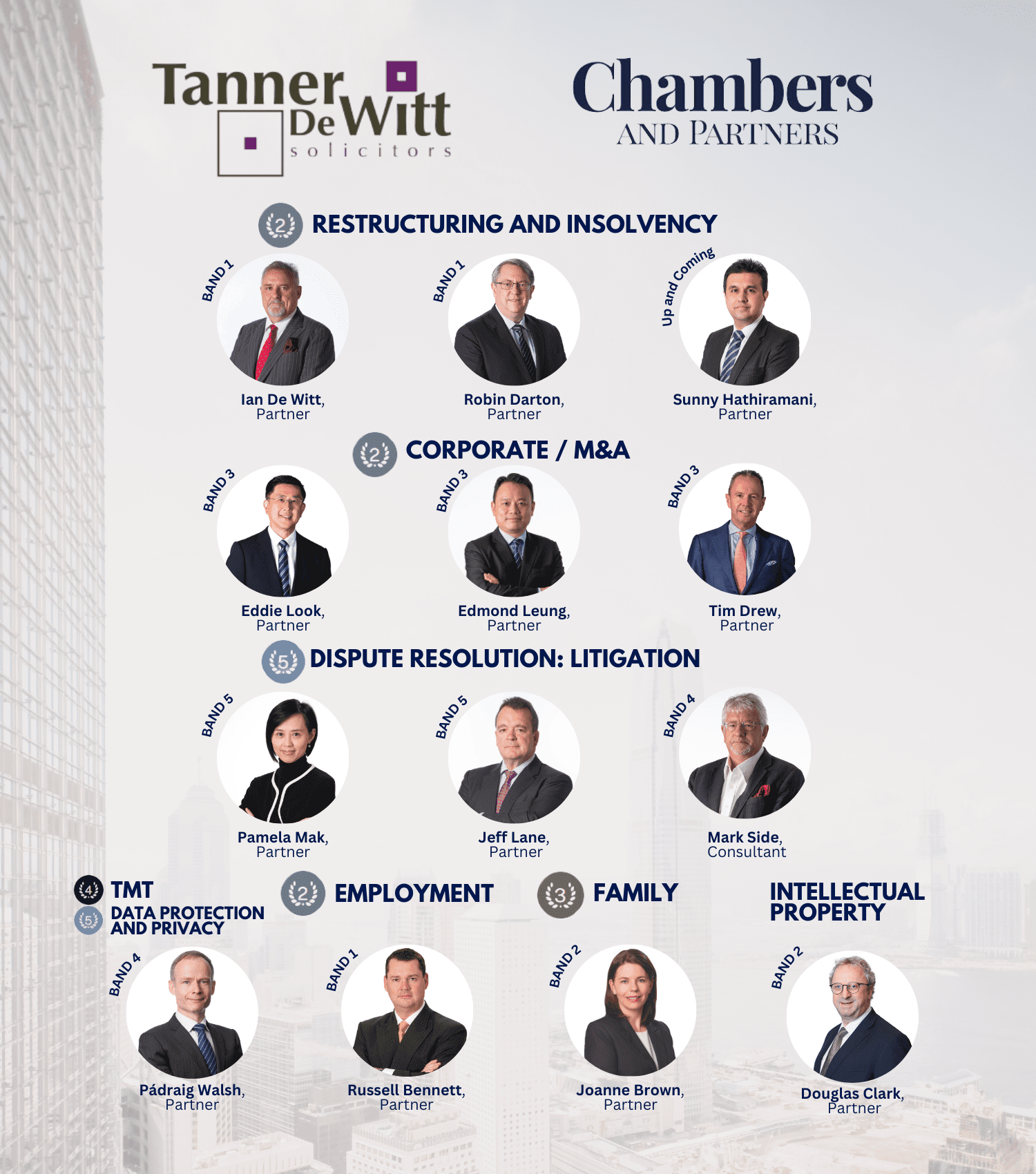
Tanner De Witt is delighted that our law firm has achieved consistent recognition in Chambers and Partners Greater China Region Guide 2024. We are honoured to have maintained top-notch rankings for an impressive 14-year stretch. Big congratulations to our exceptional team for earning this well-deserved recognition.

Restructuring & Insolvency: 14 years and 3 lawyers ranked
Corporate/M&A: Independent Hong Kong Firms: 12 years and 3 lawyers ranked
Dispute Resolution: Litigation: 10 years and 3 lawyers ranked
Family & Matrimonial: 6 years and 1 lawyer ranked
Employment: 3 years and 1 lawyer ranked
TMT: 2 years and 1 lawyer ranked
Data Protection & Privacy: 1 year and 1 lawyer ranked

Featured Articles

Insights
What Is the Right Measure of Compensation in Hong Kong Discrimination Claims?
Insights
News update: Finfluencers on the SFC regulatory radar
Insights
News update: Secondary Trading of Tokenised Authorised Investment Products Permitted in Hong Kong
Insights
News update: Hong Kong Privacy Commissioner claws back privacy protection from agentic AI tools
Insights
Enforcement action follows PCPD finding of ineffective data privacy training
Insights
What you need to know about the Protection of Critical Infrastructures (Computer Systems) Ordinance, the cybersecurity legislation in Hong Kong (Part 6)

HKCHC Blocks With Title

Jan 17 2024
Happy to share that Pamela Mak, the Head of our Dispute Resolution Department has been named in The A List 2023-2024: Growth Drivers by the China Business Law Journal that identifies elite lawyers in Hong Kong and other cities in the PRC.

Featured Articles

Insights
What Is the Right Measure of Compensation in Hong Kong Discrimination Claims?
Insights
News update: Finfluencers on the SFC regulatory radar
Insights
News update: Secondary Trading of Tokenised Authorised Investment Products Permitted in Hong Kong
Insights
News update: Hong Kong Privacy Commissioner claws back privacy protection from agentic AI tools
Insights
Enforcement action follows PCPD finding of ineffective data privacy training
Insights
What you need to know about the Protection of Critical Infrastructures (Computer Systems) Ordinance, the cybersecurity legislation in Hong Kong (Part 6)

HKCHC Blocks With Title

Oct 31 2023

Tanner De Witt secures victory for a foreign plaintiff against defendant’s intended appeal to Court of Appeal, following defeating a claim for security for costs

In the decision handed down by The Honourable Mr Justice Wilson Chan on 20 October 2023 in XY, LLC v Jesse Zhu (also known as Jia-Bei Zhu and Jessie Jia-Bei Zhu) and Grand Network Technology Limited [2023] HKCFI 2686, the Hong Kong Court dismissed the defendant’s application for leave to appeal to the Court of Appeal against the Court of First Instance’s judgment which affirmed the dismissal of the defendant’s application for security for costs against the foreign plaintiff with no assets or presence in Hong Kong.  Tanner De Witt’s Dispute Resolution team represented the plaintiff – XY, LLC (“XY”) – in this case.

The 2nd Defendant (“GNT”)’s application against XY for security for costs (for over HK$4 million) was first heard and dismissed by a Master in the First Instance, followed by a dismissal of its appeal against the Master’s decision.  Details of XY’s successful resistance against GNT’s appeal of the Master’s decision were reported in our previous post.  The dismissal was primarily based on the ground that XY has a “high probability of success” in the action. 

Notwithstanding the dismissal, GNT sought leave to appeal the First Instance Judge’s decision to the Court of Appeal.  In dismissing GNT’s application for leave to appeal, the Court had the following key rulings:

  1. The Court confirmed that the threshold for the purpose of the security for costs is “high probability of success”, which is a higher threshold than “good arguable case”.  Contrary to GNT’s arguments, the Court did not “conflate” the two different thresholds.  In determining that XY has a “high probability of success” in the present action, the Court replied on the “findings and evidence” concerning the merits of XY’s claims by the Court of Appeal and the Leave Committee of the Court of Final Appeal in related litigation proceedings.  The determination was not simply based on the “conclusion” previously reached by those Courts.
  2. When exercising its discretion in deciding whether to order security for costs, the Court is entitled to have regard to all the circumstances of the case, including the fact that there are substantial outstanding costs orders granted in favour of XY against GNT in related proceedings in Hong Kong. 

Comments

The decision reaffirms the Hong Kong Courts’ position that security for costs is not an arbitrary weapon to be wielded against foreign plaintiffs.  The Court does not order security from a plaintiff simply because it is a foreign entity.  Instead, the Court retains a discretion to decide whether it is just to order such security, having considered all the circumstances of the case.  A major consideration is the likelihood of the plaintiff succeeding.  

Pamela Mak and Ling Meng

For further information and enquiry, please contact our Pamela Mak.

Pamela Mak

Partner | Email

Disclaimer: This publication is general in nature and is not intended to constitute legal advice. You should seek professional advice before taking any action in relation to the matters dealt with in this publication.

Featured Articles

Insights
What Is the Right Measure of Compensation in Hong Kong Discrimination Claims?
Insights
News update: Finfluencers on the SFC regulatory radar
Insights
News update: Secondary Trading of Tokenised Authorised Investment Products Permitted in Hong Kong
Insights
News update: Hong Kong Privacy Commissioner claws back privacy protection from agentic AI tools
Insights
Enforcement action follows PCPD finding of ineffective data privacy training
Insights
What you need to know about the Protection of Critical Infrastructures (Computer Systems) Ordinance, the cybersecurity legislation in Hong Kong (Part 6)

HKCHC Blocks With Title

Oct 26 2023

The Hong Kong Court of First Instance (Court) recently decided due process issues arising from the fairness of remote hearings in not one, but two, judgments. In Sky Power Construction Engineering Ltd v Iraero Airlines JSC [2023] HKCFI 1558 (Sky Power), the respondent argued that the tribunal’s decision to order a fully virtual hearing prejudiced its ability to properly assess the testifying witness’s demeanour. The Court rejected the respondent’s arguments. In Song LiHua v Lee Chee Hon [2023] HKCFI 2540 (Song), the Court held that an arbitrator’s “obvious” failure to concentrate during the remote hearing violated due process.

Despite the opposite outcomes (where one award was enforced and the other was not), there are common takeaways from both judgments. These are especially important given remote hearings are here to stay. For example, the Hong Kong International Arbitration Centre (HKIAC) reported in October 2023 that most of its hearings this year (to date) have involved some virtual element.

Key Takeaways 

First, the Court clarified that fully virtual hearings may be procedurally acceptable if a tribunal has appropriately considered the reasons for it. In Sky Power, the Court found the arbitrator had duly considered the “difficulties and delay caused by the global pandemic, the need for a speedy resolution of the Arbitration without further postponements in the face of the changing situation and the evolving health regulations and travel restrictions, when she decided on the timing and format of the hearing”. Neither party had voiced any concerns during the remote hearing as regards any interference or difficulties encountered.

However, it should not be considered a blanket endorsement by the Hong Kong courts for virtual hearings in every case, especially if a party objects. Ultimately, the Court’s decision will turn on specific facts of the case. The shift here was not from a fully in-person to a fully virtual hearing, which might have presented more complex challenges and considerations.

Second, the International Council for Commercial Arbitration’s (ICCA)Task Force 2022 Report on the legal, conceptual and practical implications of remote hearings in international arbitration provides a broader context to the Hong Kong courts’ decisions. Following a survey of 82 New York Convention jurisdictions, the report’s authors conclude that the risk of an award being set aside due only to a remote hearing is minimal. However, any such decision will be fact-specific, dependent on various factors, including the law of the seat of arbitration, the rules chosen by the parties, and the tribunal’s handling of the issue.

The authors observe that based on existing case law, for a challenge to an award to be successful, there needs to be a factor that makes the remote hearing egregiously unfair. These factors could prevent a party from presenting its case or result in unequal treatment. The authors remarked that the courts have generally given little weight to logistical challenges that might arise in remote hearings, such as technological glitches, time zone differences or arguments based on the need to “eyeball” a witness.  

Third, Song provides an example of an “egregiously unfair” situation. In a video-recorded excerpt from a remote hearing lasting about two and a half hours, it was observed (among other things) that, during the presentation of legal and evidentiary submissions:

  • The arbitrator had “scarcely been stationary for more than 1 minute”, apart from when he was sitting in his car. He moved between rooms, “at times talking to and/or gesturing to others in the room”.
  • He disconnected from the hearing at various times, with no or little explanation for his absence.
  • It appears that the arbitrator did not use any headphones or earpiece and was instead relying on the speaker of his mobile telephone or other handheld advice. When asked at two points whether he was online or could hear the proceedings, he did not respond verbally or by gesture.

The Court found that these (and other) factors gave rise to a breach of natural justice and the parties’ right to be heard. In these circumstances, an objective observer would have reasonable doubts. First, as to whether the arbitrator had already made up his mind on the dispute before hearing the parties. And second, whether his decision in the case could be supported by the evidence (given he had no properly focused on it). The Court concluded that there was “no apparent justice and fairness, when a member of the decision-making tribunal was not hearing and focused on hearing the parties in the course of the trial”.

The Court refused to enforce the award even though the Respondent’s lawyers had not raised any objections to the arbitrator’s conduct during the hearing (and even affirmed that they had no objection).

Finally, parties should take practical steps to protect their interests if there is a remote hearing:

  • Raise contemporaneous procedural objections if you have concerns about the conduct of proceedings, as it may assist if it is necessary to challenge an award later. While parties may not want to raise objections for seemingly minor issues, in some circumstances, an objection will be warranted, even if it leads to a delay in resolving the proceedings. It will be necessary to safeguard the award from potential enforcement challenges.  
  • Consider how a remote hearing can be conducted as effectively as possible for your client (for example, mitigating the distortions that can arise from remote examination of a witness). 

Pamela Mak and Elizabeth Chan

If you would like to discuss any of the matters raised in this article, please contact:

Pamela Mak

Partner | [email protected][email protected][email protected]

Disclaimer: This publication is general in nature and is not intended to constitute legal advice. You should seek professional advice before taking any action in relation to the matters dealt with in this publication. 

Featured Articles

Insights
What Is the Right Measure of Compensation in Hong Kong Discrimination Claims?
Insights
News update: Finfluencers on the SFC regulatory radar
Insights
News update: Secondary Trading of Tokenised Authorised Investment Products Permitted in Hong Kong
Insights
News update: Hong Kong Privacy Commissioner claws back privacy protection from agentic AI tools
Insights
Enforcement action follows PCPD finding of ineffective data privacy training
Insights
What you need to know about the Protection of Critical Infrastructures (Computer Systems) Ordinance, the cybersecurity legislation in Hong Kong (Part 6)

HKCHC Blocks With Title

Sep 18 2023

This article was initially published by The Global Legal Post.

1 . What is the structure and organisation of local courts dealing with commercial claims? What are the main procedural rules governing commercial litigation?

The Basic Law of Hong Kong (HKBL) is the constitutional document upon which the Special Administrative Region is founded. Section 4 of the HKBL expressly provides that Hong Kong will have an independent judiciary, which will exercise judicial powers free from any interference.[1] The Hong Kong legal system is thus separate from the legal system of the People’s Republic of China (PRC).

The court system in Hong Kong is bilingual and proceedings can be conducted in either or both Chinese and English.[2] Pursuant to Article 81 of the HKBL, the courts in Hong Kong comprise of: 

Major commercial disputes are usually brought before the CFI as it has unlimited civil jurisdiction. The District Court has jurisdiction over smaller commercial disputes (of values over HKD 75,000 and up to HKD 3 million). Claims below HKD 75,000 are dealt with by the Small Claims Tribunal. 

In addition, the CFI reserves jurisdiction in certain types of disputes, in particular the:

Procedures in civil proceedings in Hong Kong are set out in the Rules of the High Court (Cap 4A) (RHC) and the Rules of the District Court (Cap 336H) (which is very similar to the RHC). Practice Directions are also published to provide further practical guidance to civil and criminal procedures in the Hong Kong Courts.

[1] Article 85, HKBL.

[2] Article 9, HKBL.

[3] Article 82, HKBL

[4] Practice Direction 6.1.

[5] Practice Direction 22.1.

[6] Practice Direction 26.1 and SL3.

[7] Practice Direction SL1.1.

2 . What pre-action considerations apply?

There are no specific rules on pre-action conduct but it is customary (though not necessary) for actions to be preceded by letter(s) before action. This is because the court has wide discretion in dealing with the matter of costs (see Question 7 below) and the court may take into account parties’ pre-action conduct in determining costs issues.[8] As such, parties should ensure that they act reasonably before, as well as during, the proceedings. 

It may also be relevant to consider the matter of limitation periods in Hong Kong, which are set out in the Limitation Ordinance (Cap. 347).

[8] Order 62, rule 5(1)(e) and (2)(d), RHC.

3 . What are the main alternative dispute resolution (ADR) methods used to settle large commercial disputes?

The most common ADR methods in Hong Kong are mediation and arbitration.

Mediation

Mediation involves the appointment of a neutral third party to help facilitate settlement discussions. Since Hong Kong’s implementation of the Civil Justice Reform (CJR) in 2009, solicitors are required to file mediation certificates confirming that they have advised their client on the mediation process and indicating whether their clients are willing to participate in mediation. There is also a Practice Direction providing a practical framework for incorporating mediation into the court process. 

Arbitration

Arbitration is an ADR method which is particularly popular with parties involved in high-value and complex international commercial disputes. Arbitration is favourable to the parties in these disputes due to its relative procedural flexibility (compared to court proceedings) and its confidential nature. Arbitral awards are generally final and binding (see Question 11 below) and can be enforced through the Hong Kong courts (as well as in foreign courts).

4 . How long, on average, do court proceedings take to reach trial?

Relatively straightforward civil matters commenced by writ of summons could be ready for trial two to three years from the commencement of proceedings. However, more complex matters where the timeline is delayed by multiple interlocutory applications could take many years before they are ready to be set down for trial. In addition, the date of the actual trial would depend on the number of days required (to be directed by the court, having consulted with the parties) and the court’s diary.

In certain circumstances, a plaintiff may obtain judgment without a full trial. These circumstances are discussed further in Question 8 below. 

5 . What disclosure obligations apply? Are parties required to disclose unhelpful documents as well as those on which they rely?

There are two main types of discovery: automatic discovery and specific discovery.

Automatic discovery

Pursuant to Order 24, rule 1, RHC, parties are required to provide discovery of documents “which are or have been in their possession, custody or power relating to matters in question in the action”. These include documents that are not favourable to the parties’ own cases and may include any paper documents and any electronic data contained in any tapes, discs or other electronic means. Order 24 rule 2(1), RHC requires discovery to take place within 14 days after the close of pleadings (where matters are commenced by writ).

‘Relevance’ in this context has typically been given a wide meaning, and would cover, for example, documents that would assist a party in proving or disproving a matter. However, in the interest of wider case management, the court has express powers under Order 24, rule 15A, RHC to limit the discovery of documents.

Where a party is concerned that some of the documents are privileged, the claim for privilege must be set out in the list of documents[9] and the relevant documents must still be identified. It can then refuse to allow the other party to inspect the documents. 

Specific discovery

Where, after the completion of automatic discovery, a party is of the view that the other party has failed to disclose documents in accordance with the above procedure, it can apply to the court for an order compelling the other party to disclose those documents.[10]

[9] Order 24, rule 5(2), RHC.

[10] Order 24, rule 3, RHC.

6 . Can witnesses be required to attend trial and face cross-examination?

As a general rule, Order 38, rule 1, RHC provides that “any fact required to be proved at the trial of any action begun by writ by the evidence of witnesses shall be proved by the examination of the witnesses orally and in open court”.

Where parties have prepared and filed witness statements, they must ensure that their witnesses are available to attend trial. Where a party is unsure whether its witness will attend the trial, it can consider issuing a writ of subpoena to compel the witness to attend.[11]

[11] Order 38, rule 14, RHC.

7 . What discretion do the courts have in making costs orders?

Generally, costs will follow the event and the unsuccessful party will be ordered to pay the successful party’s costs. However, the court has discretion to make any costs orders it considers appropriate,[12] having regard to matters such as the parties’ respective conduct in the proceedings, whether settlement offers have been made, or the level of success (i.e., whether the successful party had only been partially successful). In rare situations, the court also has the discretion to order costs against a legal representative.[13]

Unless the parties can reach an agreement on the amount of costs to be paid, the amount claimed by the receiving party will have to be assessed (or taxed) by the court, whereby a taxing master will consider the case and the papers and assess the costs claimed by the receiving party.[14]

The receiving party is generally also entitled to interest on any costs from the date of the costs order. However, if the taxing master considers that there has been undue delay in commencing taxation proceedings or in proceeding with the taxation, they may exercise their discretion to disallow interest or reduce the rate of interest or period during which it is payable.[15]

[12] Order 62, rule 3, RHC.

[13] Order 62, rules 8 to 8E, RHC.

[14] Order 62, rule 12, RHC.

[15] Order 62, rule 22(5)(c), RHC.

8 . What are the main types of interim remedies available?

The procedural rules provide for a number of different applications for interim remedies. What is appropriate in each case will be different as each case will develop according to the manner in which the case is defended. 

Default judgment 

A plaintiff can apply for default judgment where the defendant:

A defendant may also apply to the court to have an action dismissed if the plaintiff fails to serve a statement of claim within the prescribed time limit.[18]

Summary judgment

Where the defendant serves a defence but the plaintiff considers that the defendant has put forward no arguable defence against its claim, the plaintiff can apply to the court for summary judgment.[19] This application is made by way of summons supported by affidavit setting out the plaintiff’s belief that “there is no defence to that claim or part, […] or no defence except as to the amount of any damages claimed”.[20] To avoid summary judgment being entered against it, the defendant would need to show, primarily, that there is an issue in dispute that ought to be tried.[21] However, summary judgment is not available for certain causes of action.[22]

Security for costs

Plaintiffs based overseas may be subject to an application by the defendant for security for costs. A defendant (or a plaintiff who is a defendant in a counterclaim) can apply for an order for security for costs to be paid by the plaintiff on a number of grounds:

If one of the above grounds are satisfied, then the court may exercise its discretion to grant security of costs. In exercising this discretion, the court will have regard to all the circumstances of the case, including the merits of the claims.[28]

Other interim measures, such as injunctions, are available to preserve assets and assist with the enforcement of judgments. These are discussed at Question 16 below.

[16] Order 13, rules 1 to 6, RHC.

[17] Order 19, rules 2 to 6, RHC.

[18] Order 19, rule 1, RHC.

[19] Order 14, rule 1, RHC.

[20] Order 14, rule 2(1), RHC.

[21] Order 14, rule 3(1), RHC.

[22] Order 14, rule 1(2), RHC.

[23] Order 23, rule 1(1)(a), RHC.

[24] Order 23, rule 1(1)(b), RHC.

[25] Order 23, rules 1(1)(c) and (2), RHC.

[26] Order 23, rule 1(1)(d), RHC.

[27] Section 905, Companies Ordinance (Cap. 622).

[28] Order 23, rule 1, RHC; See also §23/3/3 of Hong Kong Civil Procedure 2023.

9 . What approach do the local courts adopt with respect to arbitration? What arbitration law applies and is it based on the UNCITRAL Model Law?

Arbitration in Hong Kong is governed by the Arbitration Ordinance (Cap 609) (AO), which came into force in June 2011. The AO is largely based on the UNCITRAL Model Law, with each article of the UNCITRAL Model Law forming a section in the AO, supplemented by details of any modifications which have been included to fit the local context.

Parties cannot unilaterally force the other to arbitrate and therefore there must be a valid arbitration agreement. In most cases, the arbitration agreement is incorporated as part of the contract from which the dispute arose. However, if there is no arbitration agreement in the contract, there can still be a separate arbitration agreement between the parties providing for the dispute to be referred to arbitration.

If one party commences legal proceedings in the court, notwithstanding that such party had previously agreed to arbitration, the other party may apply to court for the proceedings to be stayed in favour of arbitration. The party requesting the stay must show prima facie that there is a binding arbitration agreement.[29] Then, the court will only refuse to stay the proceedings in limited situations, for example:[30]

Section 12 of the AO provides that the court cannot intervene in arbitration proceedings, except where court intervention is specifically provided for in the AO.

[29] Tommy CP Sze v. Li & Fung (Trading) Ltd [2003] 1 HKC 418; see also L v. M N & Anor [2021] HKCFI 2829.

[30] Section 20(1), AO.

10 . Can arbitrators grant interim relief?

The arbitral tribunal is empowered by section 35 of the AO to grant interim measures pending the determination of the matter, which include injunctions as well as other interim measures and procedural orders such as provision of security and disclosure of documents. 

Section 45 of the AO also specifically allows parties to go to court to seek interim relief in relation to any arbitral proceedings which have been or are to be commenced in or outside Hong Kong. This is particularly valuable for urgent situations because, notwithstanding sections 22A and 22B of the AO which provides for emergency relief, it would be much quicker to make an urgent application to the court.

11 . On what grounds can an arbitration award be appealed?

An arbitrator’s award is final and binding.[31] There is no automatic right to appeal unless the parties have expressly opted for certain provisions. Where the award cannot be appealed, the only other available recourse is an application to the court for the award to be set aside on the grounds set out in section 81 of the AO.

Courts in Hong Kong are generally careful to not be seen to be interfering with arbitration proceedings. The grounds set out above are applied narrowly and the threshold that must be met before an arbitration award can be set aside is high.[32]

[31] Section 73, AO.

[32] LY v. HW [2022] HKCFI 2267.

12 . What international conventions and agreements on enforcement of judgments or arbitral awards is your jurisdiction a party to?

Hong Kong is a party to the 1958 New York Convention on the Recognition and Enforcement of Foreign Arbitral AwardsHong Kong is otherwise not a party to any international conventions and agreements dealing with the enforcement of foreign judgments. For a foreign judgment to be enforceable in Hong Kong, it must either be registrable under the limited statutory regime that exists, or recognised under the common law by way of bringing separate proceedings on the judgment. 

13 . What types of judgments in commercial matters are enforceable and what types are excluded?

Domestic judgment 

Generally speaking, all types of domestic judgments can be enforced. Even where a judgment is in the process of being appealed, it is still enforceable unless the defendant applies for a stay of execution.

Foreign judgment

The process of the enforcement of foreign judgments will be discussed below in Question 14 and, generally speaking, only final money judgments can be enforced. Where a judgment is to be registered under the Mainland Judgments (Reciprocal Enforcement) Ordinance (Cap 597) (MJREO), only final money judgments in relation to a commercial contract can be enforced.

Other foreign judgments, such as interlocutory judgments and judgments for non-monetary relief (e.g., specific performance) cannot be enforced in Hong Kong. 

14 . What is the process for registration of foreign judgments and arbitral awards?

In Hong Kong, foreign judgments can either be: 

The statutory regime applies in the first instance and where a foreign judgment falls within the scope of the statutory regime it must be registered under it. The common law can only be used when statutory registration is not possible.

Statutory registration

Foreign judgments

Pursuant to the Foreign Judgments (Reciprocal Enforcement) Ordinance (Cap. 319) (FJREO), an application can be made to the CFI to register a foreign judgment. This judgment must satisfy the following requirements:

The application is made ex parte to the CFI but the court may direct the matter to be determined inter partes. If the judgment is registered, notice of registration should be served on the judgment debtor and the foreign judgment can be enforced in the same way as a Hong Kong judgment. 

Mainland Chinese judgment

To enforce a judgment granted by a court in any part of China other than Hong Kong, Macau and Taiwan (Mainland Judgment) in Hong Kong, it must be registrable under the MJREO and must satisfy the same requirements under the FJREO with the following modifications:

The procedure for an application under the MJREO is similar to an application made under the FJREO and is also made ex parte to the CFI. 

Common Law recognition

Other judgments that cannot be registered will have to be recognised at common law. The foreign judgment or award will form the basis of a cause of action and the judgment will be treated as a debt between the parties. 

For a judgment to be enforceable at common law, the following requirements must be met:[40]

The practice under the common law is that the judgment creditor will issue proceedings by way of a writ of summons, endorsed with a short statement of claim referring to the foreign judgment. Then, if the judgment debtor acknowledges service of the proceedings, the judgment creditor will make an application for summary judgment. The court will then determine whether the judgment debtor has any bona fide defence (see Question 8 above on summary judgment in general).

Arbitral awards

Section 84, AO states that, with the court’s leave, an arbitration award, whether made in or outside Hong Kong, may be enforced in the same manner as a judgment of the High Court provided there is no pending request to the court to challenge the award.[41]

Leave is obtained by way of ex parte application with an affidavit in support but the court may direct that the application be dealt with inter partes. Leave is not granted as of right but is a matter of judicial discretion. Once leave has been obtained from the court (and where no application has been made for the leave to be set aside), a judgment can then be entered in the terms of the arbitral award.[42]

[33] Section 2(2), FJREO.

[34] Section 3(2)(a), FJREO.

[35] Section 3(2)(b), FJREO.

[36] Section 4(1), FJREO.

[37] Section 4(1)(a), FJREO.

[38] Section 4(4), FJREO.

[39] Section 4(1)(b), FJREO.

[40] §E3/0/5, Hong Kong Civil Procedure 2023.

[41] Section 26(2), AO.

[42] Section 84(2), AO.

15 . Once the judgment or award is registered, what are the available methods of execution?

Once registered or recognised (whichever is appropriate), the foreign judgment will be enforceable in the same way as any Hong Kong judgment. All methods available for the enforcement of Hong Kong judgments would be at the party’s disposal.

The judgment creditor may enforce the judgment by way of one or more of the following:

Where the judgment to be enforced is a money judgment, garnishee proceedings are usually the most efficient, especially if the judgment creditor knows that there is sufficient balance in the debtor’s bank account.

16 . What interim measures are available pending enforcement?

There are a number of interim measures that have been developed to assist with the enforcement of judgments.

Disclosure orders

As with many other jurisdictions, disclosure orders such as Norwich Pharmacal Orders[43] and Bankers Trust Orders[44] are available to assist plaintiffs with tracing their assets and proceeds to parties that have stolen or misappropriated or received misappropriated funds and assets. This allows plaintiffs to obtain pre-action evidence against a wrongdoer, which will allow them to pursue the wrongdoers and ultimately enforce judgments against the wrongdoers. 

Where the third party is a bank, the court has an additional power, under section 21 of the Evidence Ordinance (Cap 8), to direct a bank to provide copies of its bankers’ records to a plaintiff to assist them with tracing their assets. 

Mareva injunction

Mareva injunction is a type of interlocutory injunction that restrains a defendant from removing, transferring, disposing of, dissipating or otherwise dealing assets pending judgment or further order.[45] In granting an application for a Mareva injunction, the court must be satisfied that:

Proprietary injunction 

A proprietary injunction is granted where the plaintiff has a proprietary claim over the defendant’s assets and it is necessary to preserve the assets so that they can be returned to the plaintiff if it is successful in the action. A plaintiff is required to show that there is a serious question to be tried.[46] Unlike the case for a Mareva injunction, the court is not required to be satisfied that there is a risk of dissipation of assets.[47] 

Interim measures in aid of foreign proceedings

Pursuant to section 21M, HCO, the court has jurisdiction to grant interim relief, including Mareva injunctions or proprietary injunctions in Hong Kong, in aid of foreign proceedings.[48] The court will need to be satisfied that: 

Where an ancillary injunction has been obtained under section 21M, HCO, the defendant’s assets will be preserved. When a foreign judgment has been obtained, an application can be made for the enforcement of the same in Hong Kong (see Question 14 above) against the defendant’s assets. 

Prohibition order

This is an order prohibiting a judgment debtor from leaving Hong Kong. The CFI’s jurisdiction to make prohibition orders are provided under section 21B(1) of the HCO,[51] which also sets out the judgments in relation to which a prohibition order can be obtained. As with injunctions, prohibition orders are discretionary reliefs. Prohibition orders are initially granted with a one-month period (but may be extended to up to 3 months).

In deciding to grant a prohibition order, the court must consider the following:[52]

Stop order

Pending enforcement of judgment, judgment creditors may apply for a “stop notice”[53] in relation to securities held by the judgment creditor. This has the effect of preventing any transfer of the securities being registered until 14 days after notice of the proposed transfer has been sent to the judgment creditor.[54]

[43] Originated from Norwich Pharmacal Co. v. Customs and Excise Commissioners [1974] AC 133.

[44] Originated from Bankers Trust Co v. Shapira [1980] 1WLR1274 CA.

[45] Section 21L(3), High Court Ordinance (HCO).

[46] American Cyanamid v. Ethicon Ltd. [1975] AC 396.

[47] Zimmer Sweden AB v. KPN Hong Kong Ltd (Unreported, HCA 2264/2013, 2 May 2014).

[48] Compania Sud Americana De Vapores S.A. v. Hin-Pro International Logistics Ltd [2015] HKEC 398.

[49] Section 21M(1)(b), HCO.

[50] Section 21M(4), HCO.

[51] There is a similar provision at section 52E of the District Court Ordinance.

[52] Yue Wah Chuk Richard & Anor v. Mckeon Bredan Hugh (unreported) DCCJ 7088/2003, 24 August 2004, as cited in Questnet LTD v. Kurt Georg Rocco Rinck and Anor (unreported) HCA 1475/2006, 22 February 2008 and CWYJ v. LTYE [2020] HKCA 913.

[53] Order 50, RHC.

[54] Order 50 rule 12, RHC.

Ian De Witt and Natalie Lam

If you would like to discuss any of the matters raised in this article, please contact:

Ian De Witt

Partner | Email

Disclaimer: This publication is general in nature and is not intended to constitute legal advice. You should seek professional advice before taking any action in relation to the matters dealt with in this publication. 

HKCHC Blocks With Title

Jun 26 2023

After the COVID-19 pandemic subsides and the borders between countries reopen, there has been a noticeable increase in prosecutions related to immigration offences in Hong Kong, such as overstaying and making false statements.

In Hong Kong, the Immigration Department is the primary law enforcement agency responsible for handling such cases. If you are suspected of committing immigration offences, you will usually be required to attend an interview with the Investigation Unit of the Immigration Department located at the Skyline Tower in Kowloon Bay. In the event that you are charged, you will be required to attend a court hearing, most likely at the Shatin Magistrates’ Court.

1. Overstaying contrary to Section 41 of the Immigration Ordinance (Cap.115):

The offence: A person who overstays in Hong Kong beyond the permitted period of stay as specified in his/her travel document may be charged under this offence.

There has been an increasing number of cases where individuals visiting Hong Kong continue to stay in Hong Kong beyond the time allowed without applying for a renewal or extension of their visas, especially during the COVID-19 pandemic where most people were restricted from travelling to other countries.

Possible sentence: The principles for determining the sentences for overstaying cases were laid down in HKSAR v Manalad Tiongson Patricia. In summary the penalty normally depends on the length of time a person has overstayed, imprisonment can be avoided if there are good mitigating factors.

Taking up employment whilst overstaying without any work visa is considered as a very serious aggravating factor and normally results in imprisonment.

2. Making a False Representation to an Immigration Officer contrary to Section 42(1) of the Immigration Ordinance

The offence: A person who had provided false information or had made false statements to immigration officers, either during the visa application process or at immigration checkpoints, may be charged under this offence.

The Immigration Department nowadays places heavy scrutiny on the information submitted with visa applications. Even apparently minor discrepancies in particulars of date and place of birth may trigger an investigation.

Possible sentence: Conviction of this offence usually results in a custodial sentence. Those who make a false representation to an immigration officer should expect the same punishment as that for using a false travel document, namely, 12 months’ imprisonment after a guilty plea.

3. Employment of Illegal Workers contrary to Section 17I of the Immigration Ordinance Immigration Ordinance

The offence: Employers may be charged under this offence for hiring individuals who do not possess valid documents (for example, a work visa) that permit them to work in Hong Kong.  Where the employer in question is a company, under Section 101E of the Criminal Procedure Ordinance, the director of the employer or other officer concerned in the employer’s management will also be liable if the offence is committed with their consent or connivance.

Employers will still be in breach of the law and liable notwithstanding that the employee has had a valid work visa to work in Hong Kong when he/her was employed, but that work visa has expired and has not been renewed in a timely manner due to Covid-19 or other reasons.

Statutory defence: An employer who is charged with this offence may establish a defence by demonstrating, on a balance of probabilities, that he/she took all practicable steps to determine whether the employee was lawfully employable and that it was reasonable to conclude that the employee was lawfully employable.

Possible sentence: A custodial sentence usually follows a conviction of this offence. The Court will take into account whether the offence involves a single employee, whether the employment is on a causal basis, and if there are any other aggravating factors (such as exploitation, multiple employment or repeat offending). 3 months’ imprisonment is appropriate for a first offender if no aggravating factor is present.

How can we help?

Our Dispute Resolution Team is experienced in assisting clients in the Immigration Department’s investigation process concerning a wide range of immigration offences. We are proud to be praised by clients as smoothing the otherwise unpleasant process and helping them achieve the best possible outcome.

Pamela Mak, Russell Bennett and Adam Hoi

If you are seeking legal representation, please contact:

Pamela Mak
Partner | E-mail

Russell Bennett
Partner | Email

Disclaimer: This publication is general in nature and is not intended to constitute legal advice. You should seek professional advice before taking any action in relation to the matters dealt with in this publication.

Featured Articles

Insights
What Is the Right Measure of Compensation in Hong Kong Discrimination Claims?
Insights
News update: Finfluencers on the SFC regulatory radar
Insights
News update: Secondary Trading of Tokenised Authorised Investment Products Permitted in Hong Kong
Insights
News update: Hong Kong Privacy Commissioner claws back privacy protection from agentic AI tools
Insights
Enforcement action follows PCPD finding of ineffective data privacy training
Insights
What you need to know about the Protection of Critical Infrastructures (Computer Systems) Ordinance, the cybersecurity legislation in Hong Kong (Part 6)

HKCHC Blocks With Title

Jun 12 2023

On 16 May 2023, The Honourable Mr Justice Wilson Chan handed down a written decision dismissing Grand Network Technology Limited’s (“GNT”) appeal against the dismissal of its application or security for costs against a foreign plaintiff XY, LLC in XY, LLC v Jesse Zhu (also known as Jia-Bei Zhu and Jessie Jia-Bei Zhu) and Grand Network Technology Limited [2023] HKCFI 1317. This is a rare case in which a foreign plaintiff with no assets or presence within the Hong Kong jurisdiction has successfully defeated a defendant’s application for security for costs.  

The context of GNT’s application for security for costs – and its appeal – is a long-standing dispute that has been the subject of extensive litigation in the Courts of British Columbia, Canada and Hong Kong.  

At issue before the Court was whether, for the purpose of defeating an application for security for costs, XY, LLC has a “high probability of success” in this action against GNT. This threshold has been described by the Court as “very high indeed” and is to be established without the need for the Court to conduct a “mini-trial” or make a “preliminary run” at deciding the ultimate result of an action.  

The Court agreed with submissions made on behalf of XY, LLC that it has a high probability of success in this action against GNT, having regard to and agreeing with earlier findings made by (1) the High Court in November 2015 in relation to GNT’s unsuccessful application to discharge the exceptional remedy of a Chabra injunction successfully obtained by XY and (2) a decision of the Court of Appeal in December 2016 dismissing GNT’s appeal against that earlier decision of the High Court. The Court noted that although the threshold in question before the Court of Appeal was different, the “the findings… are enough to lead to the conclusion that the plaintiff has a high probability of success against GNT in this action” (§31).  

The Court also considered that XY, LLC’s position is strengthened by the fact that there are substantial costs orders granted in favour of XY, LLC against GNT and that these costs orders are available for a set-off in case costs is awarded against XY, LLC in this action.  

GNT has applied for leave to appeal to the Court of Appeal. A further update is to follow. 

Mark Side, Partner, and associates Sharina Mahtani and Ling Meng of TDW’s Dispute Resolution team and Ernest Ng of Parkside Chambers represented XY, LLC at both first instance before a Master and the appeal before Chan J. 

Mark Side, Sharina Mahtani and Ling Meng

For more information on commercial litigation, asset tracing and recovery, please contact:

Tanner De Witt
[email protected]

Disclaimer: This publication is general in nature and is not intended to constitute legal advice. You should seek professional advice before taking any action in relation to the matters dealt with in this publication.

Featured Articles

Insights
What Is the Right Measure of Compensation in Hong Kong Discrimination Claims?
Insights
News update: Finfluencers on the SFC regulatory radar
Insights
News update: Secondary Trading of Tokenised Authorised Investment Products Permitted in Hong Kong
Insights
News update: Hong Kong Privacy Commissioner claws back privacy protection from agentic AI tools
Insights
Enforcement action follows PCPD finding of ineffective data privacy training
Insights
What you need to know about the Protection of Critical Infrastructures (Computer Systems) Ordinance, the cybersecurity legislation in Hong Kong (Part 6)