title

May 02 2024

Given Hong Kong’s status as an international financial hub and the fact that more than 75% of the companies listed on the main board of the Hong Kong Stock Exchange are incorporated in either the Cayman Islands or in Bermuda (only around 11 percent are incorporated in Hong Kong), it is common for foreign liquidators to conduct investigations in Hong Kong.

As a general recap (following recent developments in the jurisprudence) [1], in order to seek recognition and assistance from the Hong Kong Court, a foreign liquidator would have to establish the following:

(1) The foreign insolvency proceedings are collective insolvency proceedings;

(2) The foreign insolvency proceedings are opened in the company’s centre of main interest (COMI). If not, the Court can still render assistance if the foreign liquidators are appointed in the company’s place of incorporation or if COMI is unclear, provided point 3 below is satisfied;

(3) The order sought is necessary for the administration of the foreign winding up and for the performance of the foreign officeholder’s functions; and

(4) The order sought is consistent with the substantive law and public policy of the assisting court and vice versa in respect of the domestic court.

Further, in terms of procedure, if the application could potentially affect third parties, it should not be made ex-parte (see Re Up Energy).  As we can see from Re Global Brands, third parties who do not object to the order being made can be named as nominal defendants so that they are bound by the order made.

As regards collection of documents belonging to the company, following a series of decisions of the Companies Court in Joint Official Liquidators of A Company v B&C, Re Bay Capital Asia Fund LP and Re Seahawk China Dynamic Fund, it is now well established that institutions such as banks are expected to provide the information and documents sought by the foreign liquidators without a Hong Kong recognition order. They should be assisting such foreign liquidators in the performance of their duties, not providing hurdles or making it difficult. The consequences of doing so are that they will be made a respondent in the recognition application and bear potential costs consequences.

What happens when a third party ignores the foreign liquidator’s request to produce documents and information voluntarily?

What can a foreign liquidator do to ensure that the third party render the necessary assistance?

In the recent decision in Angela Barkhouse, the Official Liquidator of Bridge Global Absolute Return Fund SPC (in official liquidation) v. Leading Securities Company Limited (formerly as CRIC Securities Limited) & Others[2], Tanner De Witt successfully obtained the first of its kind “one stop” recognition order which recognised the foreign liquidator’s appointment in Hong Kong and at the same time, imposed discovery obligation on those non-responsive third parties.   

This case concerns the official liquidator (Angela Barkhouse of Kroll) of one of the vehicles used by the 1MDB fraudsters seeking documents and information from third parties in Hong Kong. In the course of conducting investigations in Hong Kong, the official liquidator was able obtain relevant documents and information from some third parties voluntarily but not others. Following the decisions from Re Up Energy and Re Global Brands, the official liquidator then proceeded to commence proceedings by naming those non-responsive parties as defendants and including in the originating summons provisions requiring the defendants to produce documents and information. This innovative approach could no doubt be useful in the future to expedite foreign liquidators’ investigations in Hong Kong.

Further, the Court importantly confirmed in Re Bridge Global that the principles laid down by the Court of Final Appeal in Re Kong Wah Holdings Ltd regarding the threshold in obtaining an order for production of books and papers “relating to the company or the promotion, formation, trade, dealings, affairs or property of the company”[3] apply with equal force where a foreign liquidator relies on the common law in seeking a similar order from the Hong Kong Court. In this regard, Her Ladyship helpfully summarised the effect of the Re Kong Wah principles:

(1) Under s.286B or the common law, the court is concerned with whether it is appropriate to exercise its power to assist a liquidator to carry out his functions, which are to collect the assets of the company, settle its liabilities and distribute its surplus funds amongst its creditors; and to investigate the causes of the company’s failure and the conduct of those concerned in its dealings and affairs. 

(2) For the court to exercise the wide power to assist a foreign liquidator by ordering a third party to produce documents or information, the liquidator has to satisfy the court that the information or documents sought are reasonably required to enable him to carry out his functions, and the court must endeavour to strike a balance between the liquidator’s reasonable requirements and the need to avoid making an order that is unreasonable, unnecessary or oppressive to the party from whom the document or information are sought. 

This case is of paramount importance as it established that non-responding third parties could be made subject to a “one stop” recognition order also imposing disclosure obligation on respondents. It further confirms that, after obtaining a “standard” recognition order in Hong Kong, a foreign liquidator can rely on the common law to obtain further production and/or examination orders in Hong Kong. This eliminates any potential hurdles created by cases like Re Up Energy where the Court (rightly) held that foreign liquidators could not rely on the Hong Kong legislation (such as s.286B or other “claw back” provisions) after recognition. That being said, although the Court has once again taken a pro-active approach to assist foreign liquidators, practitioners should still be alive to the fact that the Court will no longer grant carte blanche recognition orders and will only grant recognition and assistance on a “needs only” basis[4].


Tanner De Witt acted for Angela Barkhouse of Kroll. We were assisted by Jonathan Ng of Temple Chambers and also by Adam Crane and Nicosia Lawson of Baker and Partners in the Cayman Islands.

If you would like to discuss any of the matters raised in this article, please contact:

Ian De Witt
Partner | E-mail

Tim Au
Partner | E-mail


The above is not intended to be relied on as legal advice and specific legal advice should be sought at all times in relation to the above.


[1] See the recent decision Re Guangdong Overseas Construction Corporation [2023] HKCFI 1340

[2] [2024] HKCFI 1160

[3] Section 286B of the Companies (Winding Up and Miscellaneous Provisions) Ordinance (Cap. 32)

[4] See paragraph 22 and 23
Featured Articles

Insights
What Is the Right Measure of Compensation in Hong Kong Discrimination Claims?
Insights
News update: Finfluencers on the SFC regulatory radar
Insights
News update: Secondary Trading of Tokenised Authorised Investment Products Permitted in Hong Kong
Insights
News update: Hong Kong Privacy Commissioner claws back privacy protection from agentic AI tools
Insights
Enforcement action follows PCPD finding of ineffective data privacy training
Insights
What you need to know about the Protection of Critical Infrastructures (Computer Systems) Ordinance, the cybersecurity legislation in Hong Kong (Part 6)

title

Apr 29 2024

The landmark Court of Final Appeal (“CFA”) decision of Re Guy Lam[1] has generated numerous articles written by practitioners and academics on the interaction between exclusive jurisdiction clauses and the court’s jurisdiction to wind up or bankrupt a debtor.  Following the CFA’s decision, the Guy Lam bankruptcy continued to impact our legal landscape when the Court of Appeal handed down a novel decision on the treatment of the costs and expenses of the bankrupt trustees (for whom TDW acted) in circumstances where the bankruptcy order was overturned in appeal[2].

In 2 recent Court of Appeal decisions, the Guy Lam judgment has again been revisited[3].

In the recent first instance decisions of Re Simplicity & Vogue Retailing (HK) Co., Limited[4] (“Re Simplicity & Vogue”) and Re Shandong Cheming Paper Holdings Limited[5] (Re Shandong Chenming”), the court had to deal with whether the Guy Lam principle was applicable to analogous situations involving arbitration agreements. In this regard:

  • Re Simplicity & Vogue (heard by Linda Chan J) concerned a more straightforward situation where the debtor company argued that its dispute regarding the debt should be referred to arbitration. The court found that the dispute was “wholly without merit” and held that the Guy Lam principle was in any event not applicable to arbitration agreements. It should be noted, however, that the debtor company failed to file any evidence in opposition to the petition and failed to comply with certain conditions imposed by the court.  
  • Re Shandong Chenming (heard by Harris J) dealt with a more nuanced issue concerning whether the Guy Lam principle would apply to a cross-claim raised by the debtor company which claim was based on a contract subject to an arbitration agreement. Harris J found that the Guy Lam principle did apply to arbitration agreements and stayed the petition pending the resolution of the cross-claim in arbitration.

Given the conflicting first instance decisions, leave to appeal was granted in both cases to give the Court of Appeal an opportunity to clarify the position.

The Court of Appeal handed down the 2 decisions on the same day. Pausing here, the Court of Appeal described the Guy Lam principle in both decisions as being that contracting parties should be bound to resolve their dispute in accordance with the agreed upon exclusive jurisdiction agreement and a petition should be stayed or dismissed unless the defence “borders on the frivolous or abuse of process” or “where there are countervailing factors such the risk of insolvency affecting third parties”[6]. This is a key issue which practitioners should note in future matters.

The Court of Appeal in both cases held that the Guy Lam principle is grounded in the wider context of the court’s discretion whether it should exercise its insolvency jurisdiction and thus could be applied to cases concerning arbitration agreements and in situations where the arbitration agreement relates to a cross-claim raised by the debtor (and not just where the arbitration agreement relates to the petitioning debt). In the context of cross-claims the Court of Appeal determined that there is “no real difference between cross-claims and disputes of debt as grounds of resistance to winding up”[7].

Importantly, the Court of Appeal emphasised that the Guy Lam principle concerns the exercise of discretion and the approach taken by the court is “multi-factorial”. In doing so, the Court of Appeal rejected one of the appellant’s argument that the Guy Lam principle is limited to the question of locus[8], meaning that the court would still look at the matter as a whole when exercising its discretion. However, it is clear that exclusive jurisdiction or arbitration agreements will be given much weight when the court is asked to exercise its insolvency jurisdiction.

Points to note arising from the Court of Appeal decisions:

(1) The presence of an arbitration agreement is not the end of the matter. The court will take a “multifactorial” approach:

(a) The court will continue to take into account the “Lasmos requirements”. It remains incumbent on the debtor to take active steps to dispute the debt by actually commencing arbitration when asking the court to decline jurisdiction in favour arbitration[9].

(b) Merits are still relevant.  In Re Simplicity & Vogue the Court of Appeal adopted Linda Chan J’s analysis of the merits of the defence and held that “[it] could be shown without detailed argument that the defence raised is one which “borders on the frivolous or abuse of process””[10]. In this regard, it was initially surprising that the third set of arbitral proceedings commenced by the debtor against the petitioner in Re Shandong Chenming was not considered as an abuse of process by Harris J particularly given the “long and torrid history”[11] of the litigation. However, the Court of Appeal has now shed some light as to the quality of the dispute being raised which appears to have substance[12].

(c) Timing of raising a dispute is important particularly as regards cross-claims. The Court of Appeal commented that “delay in putting forward a cross-claim may in appropriate circumstances support a finding that it was raised in abuse of the court’s process as a pretext to stave off a winding up”[13]. This is an encouraging observation to prevent recalcitrant debtors using the existence of an arbitration agreement (or exclusive jurisdiction agreement) merely as a tactical tool where it is clear and obvious that there is no genuine dispute and/or intention to arbitrate. It is also consistent with the approach adopted by the Companies Court in rejecting scanty restructuring proposals to stave off petitions where soft-touch provisional liquidators for restructuring purposes were appointed after the presentation of a petition[14]. Debtors should therefore raise disputes at the earliest opportunity and in doing so, be mindful of the requirements under Rule 32 of the Companies (Winding-up) Rules (Cap. 32H).

(d) Presence of other creditors and evidence showing their support should be brought to the attention of the court. We have yet to see how effective such evidence would be but insolvency proceedings are a “class remedy” and thus the position of other creditors should be influential. Even if the petitioning debt is subject to an arbitration or exclusive jurisdiction agreement, if the debtor is indebted to another creditor and he has no answer to such debt, the court could still exercise its jurisdiction to wind up / bankrupt the debtor, even if procedurally this would first need the supporting creditor to be substituted as petitioner.

(2) Finally, Kwan VP’s statement in paragraph 39 of Re Simplicity & Vogue should be emphasised. The Vice President importantly stated:

The public policy of the legislative scheme for the court’s insolvency jurisdiction may be prominent where the grounds for disputing the debt are obviously insubstantial. The significance of this public policy may be much diminished where there is no supporting creditor and no evidence of a creditor community at risk. The “strong reasons”[15] or “wholly exceptional circumstances”[16] test should not “obscure the range of consideration relevant to the court’s discretion”. The “countervailing factors” mentioned being “the risk of insolvency affecting third parties and a dispute that borders on the frivolous or abuse of process” are just instances where the court may exercise its discretion not to hold the parties to the agreed dispute resolution mechanism. By this approach, the court retains flexibility to deal with the case as the circumstances require”.

(3) The message is clear and it is an encouraging one. The Guy Lam principle does not put a hard stop on petitions were arbitration or exclusive jurisdiction agreements are in play. However, practitioners will have to test further how effective of a “safety valve”[17] the “frivolous or abuse of process” argument would be and the weight that would be placed on the views of supporting creditors to stave off a debtor’s reliance of an arbitration or exclusive jurisdiction agreement.

Robin Darton and Tim Au

If you would like to discuss any of the matters raised in this article, please contact:

Robin Darton
Partner | [email protected]

Tim Au
Partner | [email protected]

The above is not intended to be relied on as legal advice and specific legal advice should be sought at all times in relation to the above.

[1] (2023) 26 HKCFAR 119

[2] See our article [link]

[3] Re Simplicity & Vogue [2024] HKCA 299 and Re Shandong Chenming [2024] HKCA 352

[4] [2023] HKCFI 1443

[5] [2023] HKCFI 2065

[6] See paragraph 30 of Re Simplicity & Vogue and paragraph 37 of Re Shandong Chenming

[7] See paragraph 46 of Re Shandong Chenming

[8] See paragraph 36 of Re Shandong Chenming

[9] See paragraph 40 of Re Simplicity & Vogue

[10] See paragraph 47 of Re Simplicity & Vogue

[11] See paragraph 19 of the first instance decision [2023] HKCFI 2065. It should be noted that the petitioner had in those proceedings first served a statutory demand on the debtor on 18 October 2016 (see Harris J’s decision in [2017] 4 HKLRD 84)

[12] See paragraph 13 of Re Shandong Chenming

[13] See paragraph 50 of Re Shandong Chenming

[14] See for example paragraph 42 of Re Lamtex Holdings Limited [2021] 2 HKLRD 177 and subsequent decisions in Re China Bozza Development Holdings Ltd [2021] 2 HKLRD 977 and Re Ping An Securities Group (Holdings) Ltd [2021] 2 HKLRD 204

[15] Citation in the quotation refers to paragraph 86 of the Guy Lam Court of Appeal decision

[16] Citation in the quotation refers paragraph 39 of Salford Estate

[17] See paragraph 49 of Re Shandong Chenming

Featured Articles

Insights
What Is the Right Measure of Compensation in Hong Kong Discrimination Claims?
Insights
News update: Finfluencers on the SFC regulatory radar
Insights
News update: Secondary Trading of Tokenised Authorised Investment Products Permitted in Hong Kong
Insights
News update: Hong Kong Privacy Commissioner claws back privacy protection from agentic AI tools
Insights
Enforcement action follows PCPD finding of ineffective data privacy training
Insights
What you need to know about the Protection of Critical Infrastructures (Computer Systems) Ordinance, the cybersecurity legislation in Hong Kong (Part 6)

title

Feb 07 2024

2023 was a busy year for the restructuring and insolvency industry in Hong Kong. we had a ground breaking decision of the Court of Final Appeal (CFA) ruling on the conflict between dispute resolution clauses and the Court’s jurisdiction to wind-up/bankrupt a debtor. We also saw the court extend and strengthen its reach to assist insolvency officeholders (whether appointed in Hong Kong or elsewhere). 

Although particular scheme cases are not discussed below, Hong Kong cemented its position as a restructuring hub. From reported decisions at least 8 schemes of arrangement were sanctioned compromising debts in the amount in excess of HK$22.2 billion, and this is not including other ongoing restructurings in the news, various large Mainland property developers such as Logan Group and Kaisa. 

As we move into 2024, the Restructuring and Insolvency team at Tanner De Witt look back at 5 important insolvency cases (sorted chronologically) handed down in 2023.

1. Re Gatecoin Limited [2023] 2 HKLRD 1079

Judgment handed down by the Honourable Madam Justice Linda Chan on 31 March 2023

Summary:

The company operated a cryptocurrency exchange platform which collapsed in 2019. The judgment concerns the liquidators’ application seeking directions on the characterisation of cryptocurrencies as “property” and how such assets should be treated.

The Court reviewed and adopted various authorities from other common law jurisdictions and held that cryptocurrencies are “property”.  Crypto currencies are definable (the public key being distinctly allocated to an accountholder), identifiable by third parties, transferable, actively traded and have some degree of permanence or stability.

In holding that cryptocurrencies are “property”, the Court held that they could be the subject matter of a trust although in this particular case the applicable contract between the customer and the company did not give rise to a trust.

This is an important decision clarifying how cryptocurrencies are dealt with in liquidations.  The Court took a liberal interpretation of the definition of “property” within our legislative framework which will no doubt assist practitioners in dealing with other types of crypto assets.

2. Re Guy Kwok Hung Lam (2023) 26 HKCFAR 119

Judgment handed down by the Court of Final Appeal (NPJ French giving the unanimous judgment) on 4 May 2023

Summary:

The Court of Final Appeal upheld the Court of Appeal’s decision in overturning a bankruptcy order. The Court unanimously held that in an ordinary case where the underlying dispute relating to a debt on which a petition is based is subject to an exclusive jurisdiction clause in favour another jurisdiction (New York in this case), the Hong Kong court should decline to exercise its jurisdiction to wind up/bankrupt debtors unless there were countervailing factors. These factors might include the risk of the debtor’s insolvency impacting third parties, the debtor’s reliance on a frivolous defence, or an occurrence of an abuse of process.

This landmark decision highlights the importance placed by the Court holding parties to their contractual bargain.  It is also an important extension of the Court of Appeal decision in Re But Ka Chon [2019] 4 HKLRD 85 (see TDW’s article) which held that although the presence of an arbitration clause is a weighty factor, the Court could still exercise its jurisdiction to make a bankruptcy order.

There will be further development in this space as two conflicting first instance decisions concerning the application of Re Guy Lam are being appealed. In Simplicty & Vogue Retailing (HK) Co., Limited [2023] HKCFI 1443, the Court declined to apply the Re Guy Lam principle when the underlying debt was governed by an arbitration clause. In contrast, the Court in the latest saga of the Re Shandong Chenming Paper Holdings Limited [2023] HKCFI 2731 dispute stayed the winding up proceedings and held that Re Guy Lam is applicable where arbitration clauses are concerned.

The Guy Lam dispute also led to a subsequent novel decision of the Court of Appeal dealing with the Trustees’ costs and expenses (see Re Guy Lam [2023] 5 HKLRD 463). It was held that the Trustees’ costs and expenses properly incurred could be paid out of the bankruptcy estate and the diminution of the estate could be claimed by the discharged bankrupt against the petition. Tanner De Witt acted for the Trustees in this application and the relevant article can be accessed here.

3. Re Guangdong Overseas Construction Corporation [2023] 3 HKLRD 262

Judgment handed down by the Honourable Madam Justice Linda Chan on 17 May 2023

Summary:

The company is a private company established in the Mainland. A bankruptcy order was made against it pursuant to the Enterprise Bankruptcy Law applicable in the Mainland and administrators were appointed. The company holds a substantial interest in a subsidiary in Hong Kong.

The Guangzhou court issued a letter of request to the Hong Kong court requesting recognition and assistance for the administrator.

Pursuant to the cooperation mechanism between the Mainland and Hong Kong, an administrator in Mainland bankruptcy proceedings can apply to the Hong Kong Court for recognition provided that, inter alia, the request was initiated by a court in one of the pilot areas (Shanghai, Xiamen or Shenzhen).

Although the request was made by a court that was not from one of the pilot areas, the Court clarified that the cooperation mechanism merely conferred the manner in which an application is made but the jurisdiction in any event is found in the common law. Given this, provided that the usual requirements are satisfied (collective insolvency proceedings, the proceedings are conducted in the company’s COMI jurisdiction and the assistance is necessary for the administration of the winding up), an administrator of a Mainland company in bankruptcy outside of the pilot areas could still be recognised in Hong Kong.

This decision is important in laying the foundation of further cooperation between Mainland and Hong Kong liquidations. It provides clarification that common law principles are applicable to companies originating from non-pilot areas, and could lead to an influx of more administrators seeking assistance from the Hong Kong courts.

4. Nuoxi Capital Limited & Others v Peking University Founder Group Company Limited [2023] HKCFI 1350

Judgment handed down by the Honourable Mr Justice Harris on 18 May 2023

Summary:

The Defendant, a Mainland parent company, entered into several materially identical keepwell deeds with its BVI and Hong Kong subsidiaries to “keep well” certain bonds issued by those subsidiaries in respect of their ability to meet payment obligations. Notably, one of the undertakings was for the Defendant to, through its best efforts, obtain regulatory approval to perform its keepwell obligations once they have been triggered.

The Defendant fell into financial difficulties and commenced reorganisation in the Mainland. Likewise, the offshore issuers went into liquidation and submitted claims in the Mainland reorganisation on the basis of the Defendant’s obligations under the keepwell deeds. Those claims were however rejected thus prompting the issuers to commence proceedings in Hong Kong in accordance with the dispute resolution clauses in the deeds. 

The Court held that (i) keepwell deeds are enforceable contractual obligations; but (ii) the parent company would be relieved of its obligations where it could be shown that, having used its best efforts, it was not possible to obtain the relevant regulatory approval to perform its keepwell obligations. The Court was satisfied that the Defendant could rely on the best efforts defence on obligations which arose after it went into reorganisation where it was no longer possible for it to obtain the relevant regulatory approval.

Keepwell deeds are a common feature of financing between Mainland business groups and foreign lenders to give assurance as to the solvency of the groups’ subsidiaries. Prior to this decision, the legal status of keepwell deeds was uncertain, giving rise to practical concerns as to their enforceability. This decision declared and confirmed that keepwell deeds are enforceable which lays the foundation on similar claims being made by liquidators in the future.

Soon after this decision, the Court handed down the decision of Citicorp International Limited v Tsinghua Unigroup Co., Limited [2023] HKCFI 1572, where the same issue was dealt with – also by Harris J. The major difference between the two cases were that the default on bonds by the Founder Group took place after its reorganisation, whereas that of the Tsinghua Group took place before its reorganisation. Tsinghua Group was unable to raise the “best effort defence”.

Importantly, to address concerns that the Mainland courts will not give weight to the findings of the Hong Kong court, Harris J made an obiter remark that “one of the advantages Hong Kong’s common law legal system gives China is a judiciary, which is able to determine disputes governed by the common law if that is what the parties to commercial contracts choose… it would be remarkable if the Beijing Court took no notice of the Hong Kong court’s opinion.”

5. Re China Properties Group Ltd (in liquidation)  [2023] 4 HKLRD 811

Judgment handed down by Recorder William Wong SC on 9 September 2023

Summary:

The company was incorporated in the Cayman Islands and listed on the main board of the SEHK. It was wound up by the Hong Kong Court on insolvency grounds.

The liquidators of the company faced great difficulties in taking control of certain BVI subsidiaries and gaining access to the books and records of the subsidiaries. This was mainly because a former director had challenged the steps taken by the liquidators to appoint one of the liquidators as the director of the BVI subsidiaries. The liquidators therefore made an application in Hong Kong seeking an order to compel the former director to sign resolutions to ratify the liquidator’s appointment as director and to resign as a director.

The learned Recorder granted the order sought. In doing so, the Recorder emphasised the importance for the Court to extend its assistance to Hong Kong liquidators as much as it can in order to facilitate an orderly, speedy and cost effective liquidation in the interest of all stakeholders. It also emphasised that former directors should cooperate with the liquidators instead of obstructing the liquidators in carrying out their statutory duties. The Court therefore held that it would not be oppressive for it to exercise in personam jurisdiction over the former director in granting the interim relief sought. 

This is an important decision showing the Court’s willingness to exercise its in personam jurisdiction in granting orders that may interfere with the operation of a foreign company (i.e. the BVI subsidiaries). It is emphasised that this is an instance of the Hong Kong court assisting Hong Kong liquidators where the court has in personam jurisdiction over the respondent. The Court therefore did not usurp the jurisdiction of the BVI Court (the subsidiaries’ place of incorporation).

In obiter, the Court suggested that, in granting a winding up order, the Court could in the future include provision to require former directors to sign resolutions to formally give effect cessation of their office and to “recognise” the appointment of the liquidators. Practitioners will no doubt be eager to incorporate such wording in the future particularly where there is evidence to suggest that cooperation from former directors may not be forthcoming.

Honourable mentions go to Re Leading Holdings Group Limited [2023] 4 HKLRD 71 and Re China Oceanwide Group Limited [2023] HKCFI 455 which set out helpful analysis on the standing of bondholders in presenting petitions. In short, practitioners should consider the terms of the indentures carefully when advising their clients whether to present a petition as a bondholder. For further information, Tanner De Witt’s article on the importance of Re Leading Holdings Group Limited can be accessed here.

As foreshadowed above, there will undoubtedly be further important developments in the Restructuring and Insolvency practice in 2024 and the team at Tanner De Witt will continue to monitor those developments closely.

Ian De Witt and Tim Au

Ian De Witt

Partner | Email

Tim Au

Partner | Email

Disclaimer: This publication is general in nature and is not intended to constitute legal advice. You should seek professional advice before taking any action in relation to the matters dealt with in this publication. This article was last updated on 07 February 2024.

Featured Articles

Insights
What Is the Right Measure of Compensation in Hong Kong Discrimination Claims?
Insights
News update: Finfluencers on the SFC regulatory radar
Insights
News update: Secondary Trading of Tokenised Authorised Investment Products Permitted in Hong Kong
Insights
News update: Hong Kong Privacy Commissioner claws back privacy protection from agentic AI tools
Insights
Enforcement action follows PCPD finding of ineffective data privacy training
Insights
What you need to know about the Protection of Critical Infrastructures (Computer Systems) Ordinance, the cybersecurity legislation in Hong Kong (Part 6)

title

Jan 18 2024
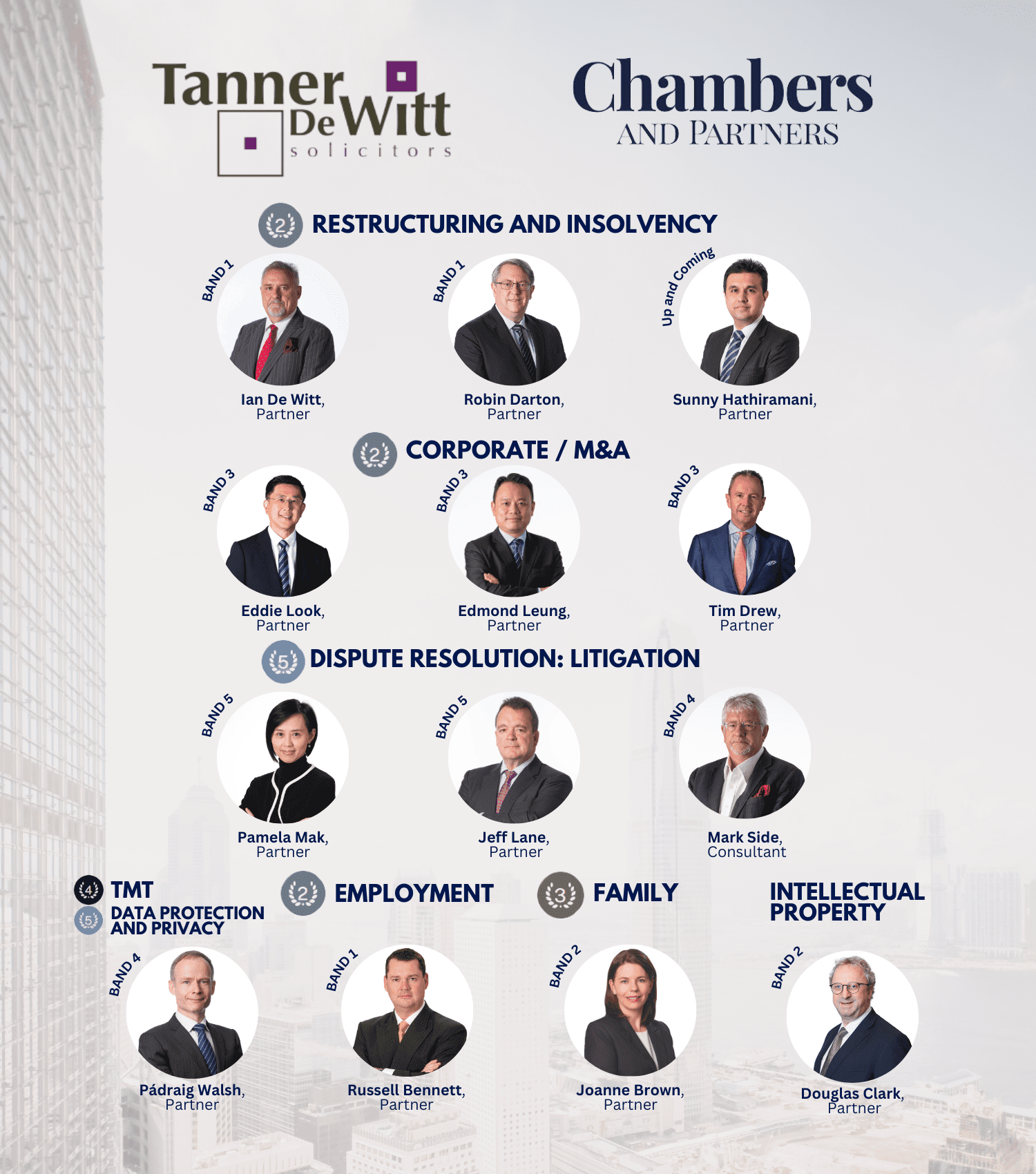
Tanner De Witt is delighted that our law firm has achieved consistent recognition in Chambers and Partners Greater China Region Guide 2024. We are honoured to have maintained top-notch rankings for an impressive 14-year stretch. Big congratulations to our exceptional team for earning this well-deserved recognition.

Restructuring & Insolvency: 14 years and 3 lawyers ranked
Corporate/M&A: Independent Hong Kong Firms: 12 years and 3 lawyers ranked
Dispute Resolution: Litigation: 10 years and 3 lawyers ranked
Family & Matrimonial: 6 years and 1 lawyer ranked
Employment: 3 years and 1 lawyer ranked
TMT: 2 years and 1 lawyer ranked
Data Protection & Privacy: 1 year and 1 lawyer ranked

Featured Articles

Insights
What Is the Right Measure of Compensation in Hong Kong Discrimination Claims?
Insights
News update: Finfluencers on the SFC regulatory radar
Insights
News update: Secondary Trading of Tokenised Authorised Investment Products Permitted in Hong Kong
Insights
News update: Hong Kong Privacy Commissioner claws back privacy protection from agentic AI tools
Insights
Enforcement action follows PCPD finding of ineffective data privacy training
Insights
What you need to know about the Protection of Critical Infrastructures (Computer Systems) Ordinance, the cybersecurity legislation in Hong Kong (Part 6)

title

Nov 22 2023

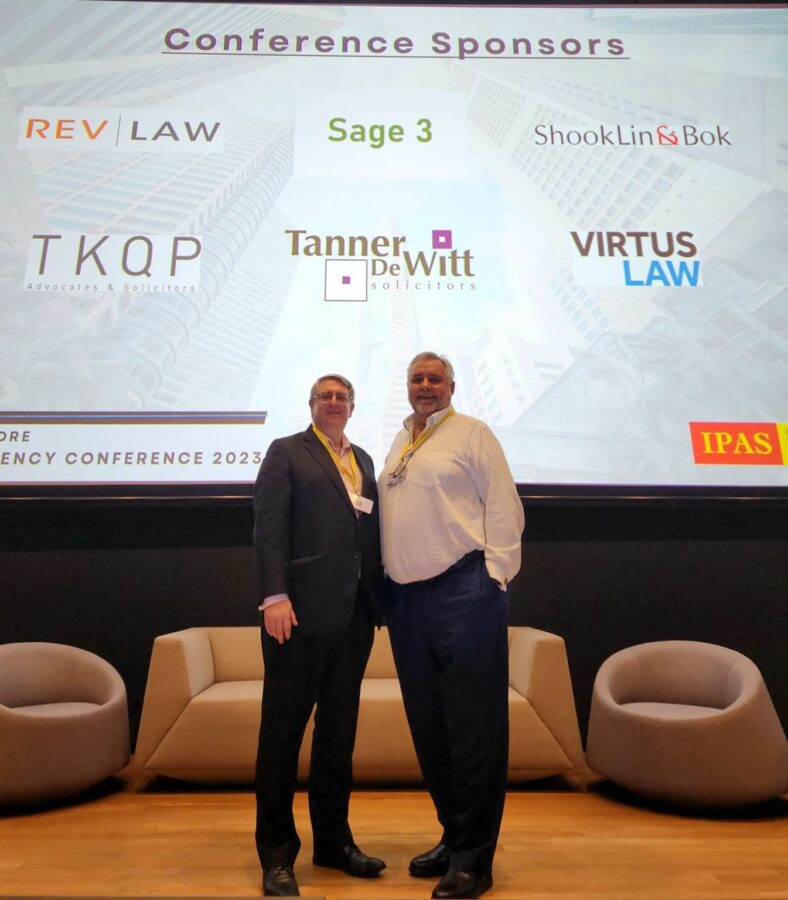
Ian De Witt and Robin Darton represent Tanner De Witt at the Singapore Insolvency Conference 2023. Their participation showcases our commitment to staying abreast of industry trends and fostering meaningful connections with the insolvency community.

Featured Articles

Insights
What Is the Right Measure of Compensation in Hong Kong Discrimination Claims?
Insights
News update: Finfluencers on the SFC regulatory radar
Insights
News update: Secondary Trading of Tokenised Authorised Investment Products Permitted in Hong Kong
Insights
News update: Hong Kong Privacy Commissioner claws back privacy protection from agentic AI tools
Insights
Enforcement action follows PCPD finding of ineffective data privacy training
Insights
What you need to know about the Protection of Critical Infrastructures (Computer Systems) Ordinance, the cybersecurity legislation in Hong Kong (Part 6)

title

Sep 25 2023

Where a bankruptcy order is set aside after a successful appeal by the debtor, who should be liable for the fees and expenses of the trustees in bankruptcy (whether the Official Receiver (as provisional trustee) or trustees appointed by the creditors)? Should such fees and expenses be borne by the bankruptcy estate, or should the unsuccessful petitioner bear those costs on the basis the bankruptcy order ought not to have been made in the first place?

On the making of a bankruptcy order, the property of the bankrupt vests in the trustees and if the order is then set aside (or annulled) that property re-vests in the debtor (former bankrupt). If the fees and expenses of the trustees are first deducted from that property, then the debtor is of course worse off – the value of his estate being diminished as a result of expenses that would not have been incurred if the (now dismissed) order had not been made. On the other hand, there are sound policy reasons for allowing the trustees to first recover the fees and expenses from the bankruptcy estate. Why should trustees (or liquidators in a winding up) who were validly appointed and have carried out work to properly perform their duties, have to look to the petitioner just because the order pursuant to which they were appointed is set aside, through no fault of their own? Indeed, a petitioner may or may not pay, or may not have the ability to pay. This could deter practitioners from taking appointments as officeholders as they will not know whether their fees and expenses will be met even if substantial realisations are made. Similarly, if trustees are required to look to the petitioner for their fees and expenses where a bankruptcy order is set aside, this would put trustees in a difficult position as to what steps they take when a bankrupt files an appeal against the bankruptcy order, it being clear that in such circumstances office-holders are expected not to prejudge the result of such appeal and should continue to act in the best interests of the creditors (per Re Joseph Phillips Ltd [1]).

A recent decision of the Court of Appeal (Re Guy Kwok Hung Lam [2]) considered these issues for the first time in Hong Kong.

A bankruptcy order had been made against Mr. Lam by an order of the Court of First Instance. Trustees were appointed at a meeting of creditors; work was carried out by those trustees, and realisations into the estate were made.  The Court of Appeal then allowed Mr. Lam’s appeal and set aside the bankruptcy order, on the ground that the petition should not have been presented in the first place given the existence of an exclusive jurisdiction clause in the contract upon which the petitioned debt was based. That decision was upheld by the Court of Final Appeal[3].   

Mr. Lam argued that in these circumstances all of the fees and expenses of the trustees should be borne by the petitioner directly or, in the alternative, that even if the trustees’ fees and expenses are to be met out of assets realised by the trustees then the petitioner should compensate Mr. Lam for the ‘loss’ of such assets as are not returned to him.

After considering various English cases including Oraki v Dean, Thornhill v Atherton and Appleyard v Wewelwala, the Court of Appeal held that although it had an unfettered discretion as to the treatment of fees and expenses incurred in a bankruptcy where a bankruptcy order is set aside (or annulled) those fees and expenses should, in the absence of special circumstances,  first be met out of realisations made in the bankruptcy estate, even if thereafter the petitioner is to be required to compensate the bankrupt.

As to the latter point, although the Court stated that there is no rule or presumption that a successful appeal means the (former) bankrupt is automatically entitled to shift the burden of the fees and expenses to the petitioner, it then adds that “other things being equal” ordinarily there may well be a strong argument for making the petitioner bear such fees and expenses if the bankruptcy order ought not to have been made at all. In the present case, although the appeal was successful on the basis of an issue not previously dealt with by the Hong Kong Court (namely, whether a petition could be pursued in the face of an exclusive jurisdiction clause favouring another jurisdiction), the Court of Appeal considered that the petitioner (as between it and Mr. Lam) should in fact bear those fees and expenses.

However, it should be noted that the Court made such order subject to two qualifications. First, that the conduct of the bankrupt would be relevant as to the extent of the petitioner’s liability; the Court stating that if the fees and expenses were greater than they should have been due to Mr. Lam’s conduct during the bankruptcy then the amount for which the petitioner is responsible should be reduced. The Court directed that the trustees may be required to submit a report to assist with this issue if the parties are unable to agree. Secondly, there is a dispute as to the amount of ad valorem fees that should be payable by the bankruptcy estate (and thus compensated by the petitioner) as Mr. Lam disputes the Official Receiver’s calculation of the amount payable. The Court did not deal with this issue at all, instead directing that an appropriate application be made to the Court of First Instance if no agreement is reached. The resolution of these issues will have an impact on the amount ultimately payable by the petitioner.

A separate point which also arises from the decision, and which could have implications beyond insolvency cases (including as to arbitration matters), is that it was argued that the costs of the hearings at First Instance and on Appeal should be paid by the petitioner on an indemnity basis, the Court having made no order as to costs of the First Instance hearing and an order for costs of the appeal on the standard basis of taxation.

As to the first of these points, it was argued that where costs are incurred in obtaining a stay of proceedings (or, as here, a discharge of a bankruptcy order) brought in breach of an arbitration clause or an exclusive jurisdiction clause then such costs should ‘normally’ be ordered on an indemnity basis. The Court emphasised that all costs orders are in the discretion of the court and that it should “steer clear of any inflexible rule that compromises the discretionary nature of the power”. Further and in any event, after examining various lines of authority in other common law jurisdictions (including England, Australia, Cayman Islands, New Zealand, and Canada) the Court held that it was not persuaded that Hong Kong should adopt a general rule or presumption for ordering indemnity costs against a party who brings proceedings in Hong Kong in breach of a jurisdiction agreement. In the present case, the Court did not consider there were any special circumstances warranting indemnity costs, and in this regard took account of the fact that this was the first known case in Hong Kong where a bankruptcy petition had been dismissed due to the existence of an exclusive jurisdiction clause.

As to the costs at First Instance, the Court maintained its earlier ruling that there be no order as to costs on the basis that the point on which the respondent was ultimately successful (namely that the exclusive jurisdiction clause (in favour of New York) meant the bankruptcy petition should not have been presented in Hong Kong) was just one of a number of arguments raised by Mr. Lam and was one which was only dealt with briefly at the First Instance hearing.

Points of note arising from the decision

  • The court has an unfettered discretion as to the treatment of fees and expenses incurred in a bankruptcy, including as to who should be responsible for paying the same. As an aside, a number of comments within the decision suggest that the Court would take the same position in respect of expenses of a winding-up and the authors respectfully submit that this should indeed be the case;
  • Nevertheless, the Court clearly recognised the importance of the role occupied by office-holders and the need for payment of the fees and expenses incurred by them in carrying out their statutory duties and that the fate of office-holders in this regard should not be tied to the underlying disputes infecting the parties. Thus, the fees and expenses of the office-holder should ordinarily come out of the estate. The authors suggest that in this regard the Court of Appeal’s decision should be of comfort to insolvency practitioners in Hong Kong;
  • Individuals who are made the subject of a bankruptcy order should cooperate with the trustees appointed even if that individual believes he has good prospects of succeeding on an appeal. Again we suggest that this should be of comfort to office-holders in Hong Kong, particularly when coupled with the Court of Appeal’s confirmation that when an appeal is pending the office-holders should continue to execute their duties;
  • The Court’s comments regarding the costs at First Instance are a reminder that litigants and their advisors should carefully marshal arguments and evidence to be presented so as to avoid being deprived of costs even if ultimately successful; and
  • Where a proceeding is commenced in breach of an arbitration clause or exclusive jurisdiction clause, an applicant successfully applying for a stay (or dismissal) of those proceedings on that ground cannot expect the starting point for a costs order to be costs on the indemnity basis.

Robin Darton and Tim Au of our Restructuring and Insolvency team acted for the bankruptcy trustees (Mr Mat Ng and Mr Nigel Trayers of Grant Thornton Hong Kong) who were invited by the Court of Appeal to address certain aspects of Mr. Lam’s application.

Robin Darton and Tim Au

For more information, please contact:

Robin Darton
Partner | [email protected]

Tim Au
Partner | [email protected]

[1] Officeholders should not ”pre-judge the results of the appeal” and they are expected to act according to the interest of creditors once they are appointed.

[2] [2023] HKCA 1099

[3] (2023) 26 HKCFAR 119

Disclaimer: This publication is general in nature and is not intended to constitute legal advice. You should seek professional advice before taking any action in relation to the matters dealt with in this publication.

Featured Articles

Insights
What Is the Right Measure of Compensation in Hong Kong Discrimination Claims?
Insights
News update: Finfluencers on the SFC regulatory radar
Insights
News update: Secondary Trading of Tokenised Authorised Investment Products Permitted in Hong Kong
Insights
News update: Hong Kong Privacy Commissioner claws back privacy protection from agentic AI tools
Insights
Enforcement action follows PCPD finding of ineffective data privacy training
Insights
What you need to know about the Protection of Critical Infrastructures (Computer Systems) Ordinance, the cybersecurity legislation in Hong Kong (Part 6)

title

Aug 23 2023

The recent Hong Kong Court of First Instance decision of Re Shandong Chenming Paper Holdings Limited marks another intersection between the public domain of insolvency and the private realm of arbitration. 

In this and previous decisions, the Hong Kong courts have grappled with the issue of which should take priority – a winding-up petition, or the contractual term in the relevant contract that states disputes are to be resolved through arbitration or litigation. 

Two primary considerations fuel this debate:

  • The need to protect the interests of creditors in the event of insolvency, and the principle that parties cannot contract out of insolvency legislation. 
  • The rights of contracting parties to agree with the terms of their own contract without interference, and therefore to be able to settle any disputes through contractual terms referring such matters to arbitration or litigation. Incidentally, under s 20 of the Arbitration Ordinance, there is the ability to stay in court proceedings if the arbitration agreement is valid and capable of being performed, emphasising the importance of parties’ autonomy to choose how to resolve their disputes. 

So, which is it? Or perhaps the challenge is to strike a balance, which promotes a consistent approach across both ordinary actions and insolvency proceedings, where exclusive jurisdiction or arbitration clauses are engaged. 

An Overview of Recent Case Law

It used to be the case that when the court was faced with a winding up petition, and the relevant contractual terms between the parties included a clause dealing with how disputes between those parties should be settled, the court would first consider whether there was a genuine good faith dispute on substantial grounds. In other words, an arbitration clause, for example, would not have come into play when determining that question. The courts viewed winding up proceedings as a class remedy, a remedy being sought on behalf of all creditors, not to be derailed by the terms of a contract.

Then in Lasmos Ltd v Southwest Pacific Bauxite (HK) Ltd in 2018, when the Court had to decide whether to dismiss a winding-up petition where the relevant contractual terms included an arbitration clause, this time the Court departed from the usual approach after considering case law from other jurisdictions. The court decided that because there was an arbitration clause a winding-up petition should generally be dismissed. Matters to be considered are:

  • Whether the company (which is the subject of the petition) contests the debt on which the petitioner relies.
  • Whether the debt in question arises from a contract that includes an arbitration clause that covers the dispute relating to the debt. 
  • Whether the company has initiated the contractually-mandated dispute resolution process. 

The Court added that, despite this decision, it still retained a discretion to decide whether to make a winding up order in such cases.

In Re But Ka Chon v Interactive Brokers LLC the next year (see TDW’s article here), the Court of Appeal did not have to determine the appropriateness, or otherwise, of the Lasmos approach but commented obiter that the Lasmos approach would be a substantial curtailment of the court’s insolvency jurisdiction, noting that s 20 of the Arbitration Ordinance did not cover winding up petitions.

A similar issue came before the Court of Final Appeal in early May this year, in Re Guy Kwok-Hung Lam. This case concerned the courts’ discretion to decline jurisdiction to make a bankruptcy order where the underlying dispute was subject to an exclusive jurisdiction clause favouring a jurisdiction other than Hong Kong (an exclusive jurisdiction clause).

The majority of the court held that a petition should not proceed where the debt is disputed and the dispute is subject to an exclusive jurisdiction clause in favour of a foreign court. It opined that, in general, parties should be held to their contractual agreements. However, exceptions apply for example where there is a risk of insolvency affecting third parties or if the defence is frivolous or an abuse of process.

Hot on the heels of Guy Lam, the Court at first instance in Simplicity & Vogue Retailing (HK) Co Ltd commented that:

  • it retained a discretion to wind up companies even where there is an arbitration clause, stating that the Guy Lam approach applied only to exclusive jurisdiction clauses and not arbitration clauses, and 
  • that the court should not adopt a purely mechanistic approach that fetters the courts’ discretion.

The Court stated that an arbitration clause should not invariably lead to a refusal to consider the merits of any defence and require the parties to litigate or arbitrate their dispute. Rather, the courts should decide (without considering any detailed arguments or disputed evidence) whether the defence is wholly without merit or one which “borders on the frivolous or abuse of process” (citing Guy Lam). 

Shan Dong: Spotlight on the Latest CFI Decision

The Shandong Chenming litigation concerns a winding-up petition which was presented six years ago based on a debt arising from an arbitration award. The petition was put on hold due to a dispute over whether the second core requirement for making a winding-up order against a foreign company (namely that there must be a reasonable possibility that the winding-up order would benefit those applying for it) could be satisfied. The issue was whether the threat of a winding-up petition could be viewed as a benefit satisfying this requirement. The dispute was resolved in favour of the creditor in June 2022 and the winding-up petition was then “revived”.

In the latest saga of the Shandong case, the debtor company had launched a second arbitration against the petitioner alleging that it had a cross-claim against the petitioner which exceeded the petitioning debt. In a recent judgment (published on 11 August 2023), the debtor company successfully resisted the winding-up petition on the basis that its cross-claim would be subject to arbitration taking place in May 2024.  

The Court held that the principles established in the Guy Lam case applied equally to cases involving arbitration clauses and in relation to cross-claims being raised by debtors. In circumstances where the petitioner was unable to argue that the subject matter of the second arbitration was frivolous or amounted to an abuse of process, the petition stayed pending future arbitration.

The State of Play

The legal landscape in this area is still evolving. Several decisions, including those from the Court of Final Appeal, lean towards giving prominence to exclusive jurisdiction or arbitration clauses. However, as can be seen, the court’s discretion still remains and nothing is certain.  

Ian De Witt, Tim Au, Elizabeth Chan

If you would like to discuss any of the matters raised in this article, please contact:

Ian De Witt

Partner | [email protected]

Tim Au

Partner | [email protected]

Disclaimer: This publication is general in nature and is not intended to constitute legal advice. You should seek professional advice before taking any action in relation to the matters dealt with in this publication. 

Featured Articles

Insights
What Is the Right Measure of Compensation in Hong Kong Discrimination Claims?
Insights
News update: Finfluencers on the SFC regulatory radar
Insights
News update: Secondary Trading of Tokenised Authorised Investment Products Permitted in Hong Kong
Insights
News update: Hong Kong Privacy Commissioner claws back privacy protection from agentic AI tools
Insights
Enforcement action follows PCPD finding of ineffective data privacy training
Insights
What you need to know about the Protection of Critical Infrastructures (Computer Systems) Ordinance, the cybersecurity legislation in Hong Kong (Part 6)

title

Aug 14 2023

Introduction

In a landmark decision issued in July, Re Leading Holdings Group Limited [2023] HKCFI 1770, the Hong Kong Courts addressed, for the first time, the right of an investor of a global note to present a winding-up petition as a contingent creditor.

The Case

The relevant company was incorporated in the Cayman Islands and was listed on the Hong Kong Stock Exchange. It issued 12% Senior Notes which were due in 2022 and the petitioner was the beneficial owner of a sub-interest in those notes.

The company defaulted on 27 June 2022, which led to the presentation of a petition.

The key issue before the Court of First Instance was whether the petitioner, as a beneficial owner of the notes, had the right (the standing) to present the petition. Ultimately, the Court found that it did not.  

The Court distinguished between the rights of a beneficiary of trust property, and the rights of an equitable assignee to sue. Contrary to potentially conflicting authority, it clarified that although it is possible for an equitable assignee to present a winding-up petition, the same reasoning does not apply to a trust beneficiary under the global note structure.

Global note structures, such as the one featured in this case, are a type of debt security commonly used in international finance. In a typical global note structure, only the trustee can take enforcement action against the note’s issuer. This structure ensures that all bondholders act collectively through the trustee, preventing individual bondholders from acting unilaterally.

The Court stated it was important to respect the integrity of the global note structure to avoid the duplicity of actions, and in this context, the Court described the global note structure as a “seamless regime”.

The reason for the distinction is because a bondholder, like the beneficiary of trust property, does not have a direct contractual relationship with the issuer and so cannot sue it directly to enforce a debt. By contrast, an equitable debt assignee is the property’s true owner, with a personal right to enforce the debt, and the assignor is a bare trustee.

Relying on the recent Cayman Grand Court decision in Re Shinsun Holdings (Group) Co., Ltd, the Court held that the petitioner cannot be characterised as a contingent creditor as the Company did not owe it an “existing obligation”. In a situation involving a contingent creditor, an obligation (or liability) owed would arise only on the happening of a future event.

The situation would be different, however, if an individual account holder (such as the petitioner) had been entitled to require the holder to exchange the global note for a definitive bond (e.g., consequent on the company’s default on a debt), under which they acquired direct rights to sue.

In a very recent British Virgin Islands High Court, Cithara Global Multi-Strategy SPC v Haimen Zhongnan Investment Development (International) Co. Ltd., the Court cast doubt on the statement in Shinshun that a contingent creditor must have a direct contractual claim. It observed that the “modern trend” was to recognise an “expanded definition of contingent obligation”.

Nonetheless, even in Cithara, the Court’s finding that the creditor had standing turned on the fine print of the indenture. Under its terms, the ultimate beneficial holder became entitled to enforce its claim against the issuer by obtaining a certificated note following which the debt becoming immediately due and payable. The Court concluded that this effectively “remove[d] the intermediaries from the chain between it [i.e., the beneficial holder] and the issuer”.

Conclusion

This case is an important decision offering guidance on when a noteholder of global notes would have standing to present a winding-up petition. It is always necessary to focus on the terms of the applicable indenture as different terms can lead to different conclusions. 

Ian De Witt, Tim Au, and Elizabeth Chan

If you would like to discuss any of the matters raised in this article, please contact:

Ian De Witt

Partner | [email protected][email protected]

Tim Au

Partner | [email protected]

Disclaimer: This publication is general in nature and is not intended to constitute legal advice. You should seek professional advice before taking any action in relation to the matters dealt with in this publication. This article was last updated on 14 August 2023.

Featured Articles

Insights
What Is the Right Measure of Compensation in Hong Kong Discrimination Claims?
Insights
News update: Finfluencers on the SFC regulatory radar
Insights
News update: Secondary Trading of Tokenised Authorised Investment Products Permitted in Hong Kong
Insights
News update: Hong Kong Privacy Commissioner claws back privacy protection from agentic AI tools
Insights
Enforcement action follows PCPD finding of ineffective data privacy training
Insights
What you need to know about the Protection of Critical Infrastructures (Computer Systems) Ordinance, the cybersecurity legislation in Hong Kong (Part 6)

title

Aug 07 2023

The Government of Hong Kong continues its push towards favouring digitisation over using hardcopy documents.  The new changes to local bankruptcy laws allows: (1) electronic service of statutory demands; (2) using electronic bundles and skeletons for winding-up and bankruptcy applications; and (3) allowing electronic submission of documents to the Official Receiver. 

Electronic service of statutory demands: A game changer for creditors and debtors

The introduction of electronic service of statutory demands through amendments to Practice Direction 3.1 is a significant shift that has practical implications for creditors and debtors. 

For creditors, this change provides a powerful new tool to serve statutory demands, especially in cases where a debtor may be trying to evade service.  Creditors can now serve debtors more quickly and efficiently by electronic service through email, WhatsApp, WeChat or “other similar means” (the wording in Practice Direction 3.1).

However, service of a statutory demand electronically is only possible if: (1) the debtor and the creditor agreed to use electronic means of communication; or (2) the debtor has used any electronic means of communication with the creditor during the 12 months prior to the date of the statutory demand.

For debtors, monitoring their electronic communications closely is now more critical than ever.  With the recent changes it is much harder to evade service, and failure to respond to a statutory demand can have serious and permanent consequences e,g, having a bankruptcy order made against you.

However, there are open questions surrounding the specifics of these changes, such as:

  • How the court will handle undeliverable emails.
  • Which electronic accounts will be considered authoritative.
  • What is necessary to show that the debtor has used electronic means to communicate with the creditor during the relevant 12-month period.
  • Whether “other similar means” will extend to other electronic platforms, such as service by air-dropping a statutory demand as a Non-Fungible Token (as has been accepted as service in other jurisdictions, such as England and Wales). 

No doubt these issues will be dealt with by the Hong Kong Courts in the coming months, so watch this space for updates.

Electronic bundles and skeletons for applications: a win for nature

In addition to statutory demands, there have also been changes to electronic bundles and skeletons for applications relating to company winding-up and bankruptcy matters.  Under new Practice Direction 3.8, parties can serve documents in electronic form to the court via the e-Lodgement platform or USB or via USB to all other parties, eliminating the environmental waste associated with hard copy documents. 

For clients, this change reduces the monetary costs imposed by using physical paperwork by making the process of submitting and accessing these documents more efficient.  This is particularly beneficial for clients who are dealing with complex cases with many documents.

The Official Receiver’s electronic submission system: continuing the culture shift

The Official Receiver performs various statutory duties relating to bankruptcy and winding up, including being a provisional trustee on the making of bankruptcy orders, a trustee in bankruptcy and the trustee of last resort under the Bankruptcy Ordinance (Cap. 6), as well as being the provisional liquidator or the liquidator of last resort in court winding-up cases under the Companies (Winding-Up and Miscellaneous Provisions) Ordinance (Cap. 32).  In discharge her duties, the Official Receiver receives an average of 180,000 documents and forms annually from various stakeholders.

Implementing the Official Receiver’s electronic submission system via the Bankruptcy and Companies Legislation (Miscellaneous Amendments) Bill 2023 (gazetted in July 2023) is another example of a Government Department reducing its reliance upon hardcopy documents. 

This system, set to be implemented in phases starting from the fourth quarter of this year, is designed to automate the processing of documents, making it easier and more efficient for clients to comply with their obligations. 

Key takeaways

While there may be some initial challenges in adapting to these digitisation changes, they offer numerous benefits for clients, including simplified processes, reduced costs, and improved efficiency.  Adapting to them is vital to successfully navigating the bankruptcy process in the digital age.

Ian De Witt and Elizabeth Chan

If you would like to discuss any of the matters raised in this article, please contact:

Ian De Witt

Partner | [email protected]

Disclaimer: This publication is general in nature and is not intended to constitute legal advice. You should seek professional advice before taking any action in relation to the matters dealt with in this publication.

Featured Articles

Insights
What Is the Right Measure of Compensation in Hong Kong Discrimination Claims?
Insights
News update: Finfluencers on the SFC regulatory radar
Insights
News update: Secondary Trading of Tokenised Authorised Investment Products Permitted in Hong Kong
Insights
News update: Hong Kong Privacy Commissioner claws back privacy protection from agentic AI tools
Insights
Enforcement action follows PCPD finding of ineffective data privacy training
Insights
What you need to know about the Protection of Critical Infrastructures (Computer Systems) Ordinance, the cybersecurity legislation in Hong Kong (Part 6)

title

Jul 28 2023

It is almost impossible to open a newspaper these days without being confronted by a dozen or so articles about Artificial Intelligence. OK , so I guess the reference to a ‘newspaper’ was the first clue to the fact that I may not be in the first flush of youth, and there will be those who say this makes me predisposed against technology. However, I am in fact a keen adopter of technology and have been since my father bought my brother and I a Sinclair ZX80. …And I did of course mean to refer to news websites or apps, not newspapers.

Sinclair ZX80 (from 1980)

Anyway, the point is that news about AI and its impact on various industries is everywhere. It may “enhance personal productivity and enterprise work efficiency” according to the Hong Kong government’s then Acting Secretary for Innovation, Technology and Industry. Or, on a somewhat more sinister note, the Center for AI Safety has made this statement: “Mitigating the risk of extinction from AI should be a global priority alongside other societal-scale risks such as pandemics and nuclear war”, signed by a great many scientists and “other notable figures” (whatever that means)[1]. Go to the UK Parliament’s website and you can sign a petition to “seek a global moratorium on development of AI technology due to extinction risk”.[2] At 100,000 signatures the petition will be considered for debate in Parliament. At the time of writing, about 2 months after the petition’s launch, there are 37 signatories.

So, what about us lawyers? Any number of reports on AI seem to predict that we will all be out of a job in the not too distant future as a result of AI developments. Although AI goes far beyond ChatGPT, that tool is one which appears to have attracted the most attention, in particular as regards ‘language based’ roles such as those occupied by lawyers. A common saying in Chinese is that someone is after your rice bowl (搶飯碗 or qiǎng fàn wǎn ) if they are trying to take away your living. So, is ChatGPT coming for my rice bowl?

A few months ago, we all read about the US lawyer who relied on ChatGPT to prepare a court submission, with AI’s (current) poster-child incorporating citations to a number of previous decisions which, er, did not exist. Cue angry judge, and subsequent disciplinary sanctions. However, AI is said to learn quickly. How does it shape up for a Hong Kong insolvency lawyer? The answer is ‘not very impressive’.

With ChatGPT (at least a free version) not being available in Hong Kong, I gave it a try-out whilst on a recent visit to the UK, asking it a few questions of the type regularly coming across my desk. For example, questions as to winding up a company; voluntary liquidation; appointment of receivers; freezing injunctions; and enforcement of judgments. From a language perspective, some reasonably well-structured sentences and paragraphs were produced. Unfortunately, the content was in large part sub-optimal (at best) and in parts was downright wrong.

As an initial observation, when giving its answers, ChatGPT did warn me on several occasions that it is not a lawyer, with statements such as “remember, the exact legal process and options available to you may vary depending on the specifics of your situation, so it’s crucial to consult with a lawyer who can provide advice tailored to your case.” Naturally, I agree with this, and if that is how my competition feels about its own abilities then, in the early stages at least, my confidence is not shaken.

More disturbing is the fact some of these statements by ChatGPT started with “I am not a lawyer…”. Taking on a personality does make the whole thing a bit unnerving. Like HAL with Dave in 2001: A Space Odyssey[3] will my AI assistant try to murder me? If ChatGPT starts getting somewhere with its ability to advise on Hong Kong law and I ask it to stop, will I get the response “I’m sorry Robin, I’m afraid I can’t do that….”?[4]

I started off with a common question: “Can I enforce a judgment made by the English court in Hong Kong?”. As most Hong Kong lawyers will know, the Foreign Judgments (Reciprocal Enforcement) Ordinance (Cap. 319) (“FJREO”) identifies a number of jurisdictions from which judgments can be registered in Hong Kong for enforcement here. The schedule identifying the jurisdictions includes the Commonwealth (which in turn includes the United Kingdom[5]). However, on the resumption of sovereignty over Hong Kong by the People’s Republic of China on 1 July 1997, any provision conferring a benefit on a member of the Commonwealth shall have no further effect, except where there is reciprocity[6]. The court has confirmed[7] that there being no reciprocity for enforcement of Hong Kong judgments in the UK, the FJREO no longer applies to English judgments. Those same Hong Kong lawyers will also know that notwithstanding this, a UK judgment can be enforced here by way of a common law action.

Unfortunately, ChatGPT insisted that the FJREO applied to a UK judgment.

Moving on to injunctions: “What is a Mareva injunction and can I get one in Hong Kong?” To be fair, this produced an OK answer, save that in several places ChatGPT referred to non-existent Orders of the Rules of the High Court. This remained the case with follow up questions, including the direct “which provisions of which Ordinance and which Rules do I need to review?” ChatGPT was pretty insistent on referring me to Order 29A (and in one case Order 29B) of the Rules of the High Court. Neither exist.

A similar result arose when asking about appointment of receivers. Asked “I am owed money by a Hong Kong company. Can I appoint a receiver over shares it holds in another Hong Kong company?” our opponent answers “In Hong Kong, the appointment of a receiver over shares held by a company is generally governed by the Companies (Winding Up and Miscellaneous Provisions) Ordinance (Cap. 32) (CWUMPO).” Although there are elements of CWUMPO dealing with receivers, that statute does not deal with appointment of receivers. A bad question will get a bad answer, I hear a number of Hong Kong lawyers say. So, to refine the point, a follow up question was asked, being whether I need to go to court if I have a debenture. That yielded a better response, being that the client “may not necessarily need to go to court” but further questions to narrow the point saw the model reverting to the same mistake, telling me that “it’s important to note that the appointment of a receiver over shares in a Hong Kong company is primarily governed by the Companies (Winding Up and Miscellaneous Provisions) Ordinance (CWUMPO) and the company’s articles of association. These laws specifically address the process and requirements for the appointment of a receiver in relation to shares held by a company.

So far then, the would-be rice bowl thief is not doing very well. What about some insolvency questions. Given many of the issues will derive from statute, surely ChatGPT will do better on these questions? It is, after all, supposed to be able to instantly search and identify the relevant information and then wrap that information in credible sounding paragraphs using its language model. Right? Well, not so much it seems.

I started with a simple question: “A Hong Kong company owes me HK$500,000. Can I bankrupt it?”. Hong Kong lawyers will immediately observe the improper use of the word “bankrupt”, used in Hong Kong law only in relation to the insolvency of an individual, not a corporate entity. However, it is the type of language that a “real life” client could very well use. ChatGPT’s answer ignores this and blithely assumes the word is used in the sense it is often used in the US (and doubtless elsewhere): “Bankruptcy typically refers to the process where an individual or a company declares themselves unable to pay their debts and seeks legal protection and assistance to resolve their financial obligations.” The answer then goes on to describe (in basic terms) an action to recover a debt. The follow up question “…but what if the company is insolvent?” sees an improved response, with “if the company is insolvent, meaning it is unable to pay its debts, you may explore the option of initiating winding-up proceedings…”. That’s better. Or it would be if the sentence did not go on to read “…instead of trying to bankrupt the company.” Oh dear. Aside from the misuse of the word “bankrupt”, it seems the AI brain has not identified that its two scenarios are effectively the same.

As mentioned earlier a bad question can get a bad answer, but this is an example of a “real life” skill. A lawyer listening to a direct question from a lay-client can use her experience to work out what the client is getting at or really needs to address and can clarify so that the appropriate advice is given accordingly. ChatGPT does not seem to cope very well with that, at least at present but it is not hard to imagine that this is precisely the kind of thing models like ChatGPT will only get better at.

Moving back to our ChatGPT test-drive and another common question received by practitioners, being how a shareholder may wind up the company. The question was again framed in the vernacular, because that is how lay-clients often ask their questions: “I own 50% of the shares in a Hong Kong company. How can I liquidate it?” ChatGPT’s answer deals with checking the company’s Articles and any shareholders’ agreements regarding the need to offer shares to other shareholders, and to transfers of shares. I assume ChatGPT interpreted “liquidate” to mean turn into cash, rather than wind-up, or implement a liquidation process. This is another good example of the point made above, namely the importance of framing a question properly if advice is sought.

The follow up questions were therefore refined, to be aimed more directly at voluntary liquidations. Instead of better answers, ChatGPT reverts to doing very badly. As much of the correct answers lie in the procedures encompassed in the legislation (all of which is online[8]) it should be the type of issue that ChatGPT copes with well. But no, the answers are poor. The follow up question asked was “but can I liquidate the company itself?” which produces a tolerably good answer, making reference to the need for shareholders to pass a resolution to liquidate the company. However, it misses the important requirement for a creditors’ meeting. Perhaps it thought the company was solvent? If so, lawyers are taught at tender age that assumptions are (well, the polite version is that assumptions should not be made) and that if assumptions are necessary, then we should identify what they are and advise accordingly, with the reader aware of those assumptions.

So, let’s clarify further: “is this the case even if the company is insolvent?”. The requirement for a creditors’ meeting is now identified. Unfortunately, there is now no reference to the shareholders’ resolution, and it is that resolution which commences the liquidation[9]. Ignoring that and asking our onboard assistant “and what is the timeline for the meetings?” yields an answer of the type one gets from the smart student who is clever enough to know how to write something which looks convincing but has clearly not even read the materials. If it was an answer to an exam question, ChatGPT’s parents would be checking the cost of a retake (HK$841 by the way). Even the parts of the answer relating to procedural issues such as the time required for notices are just wrong.

AI is of course not just about ChatGPT and it already appears in our daily lives (Google advertisements related to our search history for example) and it will, I am sure, get more and more sophisticated. However, notwithstanding parts of the media already predicting the demise of us lawyers (a little too gleefully I might add), I think our rice bowl is safe for now. For how long is a different question…

Postscript: With plenty of AI evangelists out there, it should be emphasised that this is intended to be a light-hearted tongue-in-cheek take on the media references to ChatGPT being the death of lawyers and no real-life client issues were harmed during production. Mind you, I did agree with one response. In answer to the question “I need an insolvency and restructuring law firm in Hong Kong. Can you please recommend one?”, the response was “Certainly! One notable insolvency and restructuring law firm in Hong Kong is: Tanner De Witt”. A true story, but whether a search by a lawyer from another firm gets the same result, I do not know: perhaps ChatGPT has evolved sufficiently to attempt sycophancy…

If you would like to discuss any of the matters raised in this article, please contact:

Robin Darton
Partner | [email protected]

[1] https://www.safe.ai/statement-on-ai-risk#open-letter

[2] https://petition.parliament.uk/petitions/639956

[3] Which is now more than 50 years old, being released in 1968!

[4] https://www.youtube.com/watch?v=Wy4EfdnMZ5g

[5] Paragraph 1 of Schedule 9 to the Interpretation and General Clauses Ordinance (Cap. 1)

[6] Section 2A(2)(b) of the Interpretation and General Clauses Ordinance (Cap. 1).

[7] for example, see Morgan Stanley & Co International Ltd v Pilot Lead Investment Ltd [2006] 4 HKC 93

[8] https://www.elegislation.gov.hk/

[9] Section 230 of CWUMPO


Disclaimer: This publication is general in nature and is not intended to constitute legal advice. You should seek professional advice before taking any action in relation to the matters dealt with in this publication.

Featured Articles

Insights
What Is the Right Measure of Compensation in Hong Kong Discrimination Claims?
Insights
News update: Finfluencers on the SFC regulatory radar
Insights
News update: Secondary Trading of Tokenised Authorised Investment Products Permitted in Hong Kong
Insights
News update: Hong Kong Privacy Commissioner claws back privacy protection from agentic AI tools
Insights
Enforcement action follows PCPD finding of ineffective data privacy training
Insights
What you need to know about the Protection of Critical Infrastructures (Computer Systems) Ordinance, the cybersecurity legislation in Hong Kong (Part 6)