
text

Jul 18 2024

In a recent decision of Guting, Joan Sarmiento, Deceased v Choy Chiu Yee Rita [2024] HKDC 747 handed down by the District Court, an employer was successful in defending against a disability discrimination claim by a domestic helper. It appears from the judgment that the WhatsApp chat records from the employer showing her dissatisfaction about the helper’s work performance were key evidence which led to the decision.

Summary of Case

  • The Claimant was employed by the Defendant as a foreign domestic helper.
  • The Claimant was later hospitalized and diagnosed with cancer.
  • About a month later, the Claimant was dismissed by the Defendant.
  • The Claimant passed away in 2018 and the executrix of her estate commenced legal action against the Defendant claiming, among other things, disability discrimination and harassment.

The Court’s assessment of the claim can be summarised as follows.

  • Having considered the relevant case law, the Court considered the test in determining whether an employer has, in terminating the employment, discriminated against an employee is:

if an employer is able to prove some other reason for dismissal which, although falls short of sufficient reason to justify summary dismissal, is unrelated to the employee’s disability, dismissal by notice or payment of wages in lieu of notice is not unlawful under [the Disability Discrimination Ordinance]”

  • After assessing the evidence and the credibility of witnesses, the Court considered that the employer’s claim about the unsatisfactory work performance of the helper was supported by contemporaneous and substantive WhatsApp messages (including audio messages) between them and those of the employer’s family members.
  • Further, based on the employer’s family treatment of the helper after she had become ill and the amount of care in executing the dismissal, the Court found it unlikely that the employer would discriminate against the helper. The conclusion was also indirectly supported by the CCTV recording showing that the helper did not feel frightened, vulnerable, intimidated or threatened when moving out of the employer’s residence.
  • In respect of the employer’s remark of calling the helper “溫神” (which may be regarded as having the meaning of evil spirits), the Court found that the WhatsApp messages support the employer’s explanation of calling the helper those names due to her anger (about the helper’s work). It went on to hold that being mean, making demeaning and abusive remarks or false accusations, or abusive acts, if not connected to the employee’s disability, does not constitute harassment.

Key Takeaways

  • The decision illustrates the importance of keeping a detailed and continuous “paper trail” showing the legitimate reason for dismissal of an employee. The Court in this case seemed to rely quite heavily on the contemporaneous records in reaching the conclusion that the reason for dismissal of the Claimant is unrelated to her disability.
  • In respect of any employment in a commercial context, such contemporaneous records can take the form of internal memoranda, messages or emails demonstrating the real and legitimate reason behind the decision to terminate an employment, which should be unrelated to any protected characteristics under the anti-discrimination legislations[1] .
  • Contemporaneous records will help show the legitimacy of any decision to terminate an employee and defend against allegations of discrimination and unlawful termination should they arise.

Postscript

  • Even though it may not have been a significant part of the judgment, another area of dispute was whether the helper was on statutory sick leave and therefore unlawfully terminated.
  • In dismissing such claim, the Court appeared to focus on the fact that there was no sick leave certificate covering the day of termination (even though the sick leave certificate was obtained subsequently which the Court held that it did not assist the claim[2]).

54.  To put it simply, sickness allowance is pay made to an employee on a “sickness day” (see generally Part VII of the Ordinance). “Sickness day” is defined under Section 2(1) of the Ordinance to mean “a day on which an employee is absent from his work by reason of his being unfit therefor on account of injury or sickness.” This definition presupposes there is the need to work that day. The corollary is that when there is no need to work, then that day does not qualify as a “sickness day” and considerations of sickness allowance are irrelevant. The Defendant is entitled to full (and not only 4/5) daily pay for rest days and holidays (when there is no need to work) within the sick leave period covered by sick leave or medical certificates.” [underlined is our emphasis]

  • This is of great significance to employer as section 33(4B) of the Employment prohibits and makes it a criminal offence for any employer to terminate an employment (other than by summary dismissal) on any statutory sickness day.
  • Suzuya seems to suggest that an employer may lawfully terminate an employee on a rest day (which occurs at least once a week) even if there is a sickness certificate covering that day.
  • Whilst the above proposition may greatly reduce protection afforded to employees on sick leave under the Employment Ordinance, it remains unclear whether this may truly be the correct legal position. In this sense, the Court in Guting may have missed a valuable opportunity to clarify the law.

Russell Bennett and Mark Chiu

If you want to know more about the content of this article, please contact:

Russell Bennett

Partner | [email protected]

Disclaimer: This publication is general in nature and is not intended to constitute legal advice. You should seek professional advice before taking any action in relation to the matters dealt with in this publication. This article was last updated on 18 July 2024.

[1] The Hong Kong anti-discrimination legislations protect discrimination on grounds of sex, disability, family status and race. Dismissal will be rendered unlawful as long as discrimination is found to be one of the reasons (N.B. it does not need to be the main or operative reason) for the dismissal.

[2] The Court agreed with the observation in Sin Bik Yin v Carat Jewellery Ltd (Unrep) HCLA 49/2004, 6 May 2005.

Featured Articles

Insights
What Is the Right Measure of Compensation in Hong Kong Discrimination Claims?
Insights
News update: Finfluencers on the SFC regulatory radar
Insights
News update: Secondary Trading of Tokenised Authorised Investment Products Permitted in Hong Kong
Insights
News update: Hong Kong Privacy Commissioner claws back privacy protection from agentic AI tools
Insights
Enforcement action follows PCPD finding of ineffective data privacy training
Insights
What you need to know about the Protection of Critical Infrastructures (Computer Systems) Ordinance, the cybersecurity legislation in Hong Kong (Part 6)

text

Jan 18 2024
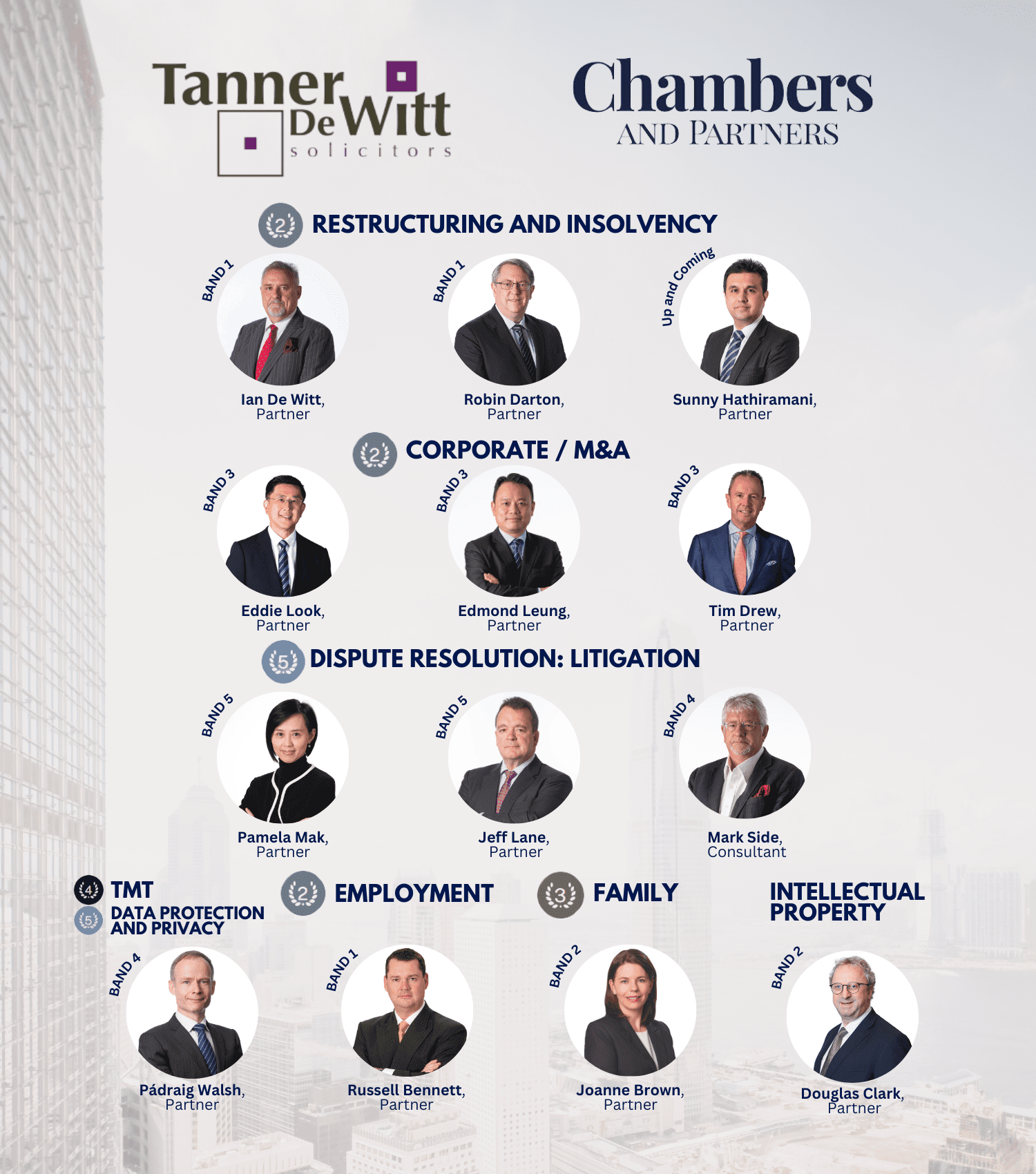
Tanner De Witt is delighted that our law firm has achieved consistent recognition in Chambers and Partners Greater China Region Guide 2024. We are honoured to have maintained top-notch rankings for an impressive 14-year stretch. Big congratulations to our exceptional team for earning this well-deserved recognition.

Restructuring & Insolvency: 14 years and 3 lawyers ranked
Corporate/M&A: Independent Hong Kong Firms: 12 years and 3 lawyers ranked
Dispute Resolution: Litigation: 10 years and 3 lawyers ranked
Family & Matrimonial: 6 years and 1 lawyer ranked
Employment: 3 years and 1 lawyer ranked
TMT: 2 years and 1 lawyer ranked
Data Protection & Privacy: 1 year and 1 lawyer ranked

Featured Articles

Insights
What Is the Right Measure of Compensation in Hong Kong Discrimination Claims?
Insights
News update: Finfluencers on the SFC regulatory radar
Insights
News update: Secondary Trading of Tokenised Authorised Investment Products Permitted in Hong Kong
Insights
News update: Hong Kong Privacy Commissioner claws back privacy protection from agentic AI tools
Insights
Enforcement action follows PCPD finding of ineffective data privacy training
Insights
What you need to know about the Protection of Critical Infrastructures (Computer Systems) Ordinance, the cybersecurity legislation in Hong Kong (Part 6)

text

Nov 30 2023
Russell Bennett, partner in our employment team has been listed as Who’s Who Legal Recommended 2023 for Labour Employment & Benefits in Mainland China, Hong Kong SAR and Macao SAR.

Featured Articles

Insights
What Is the Right Measure of Compensation in Hong Kong Discrimination Claims?
Insights
News update: Finfluencers on the SFC regulatory radar
Insights
News update: Secondary Trading of Tokenised Authorised Investment Products Permitted in Hong Kong
Insights
News update: Hong Kong Privacy Commissioner claws back privacy protection from agentic AI tools
Insights
Enforcement action follows PCPD finding of ineffective data privacy training
Insights
What you need to know about the Protection of Critical Infrastructures (Computer Systems) Ordinance, the cybersecurity legislation in Hong Kong (Part 6)

text

Aug 29 2023

The District Court has recently handed down a judgment against a logistics company (“Respondent”), for refusing to pay a former pregnant employee (“Claimant”) her year-end bonus and for not renewing her employment contract after she had informed the Respondent about her pregnancy. 

Background

The Claimant in the case of 周露娜 v 中旅貨運物流中心有限公司 [2023] HKCU 3488 was a former responsible personnel of the Respondent’s Logistics Business Unit and Sales and Marketing Unit. After informing the Respondent of her pregnancy, the Claimant received a “Notification of Non-Renewal” from the Respondent that her employment with the Respondent will not be renewed due to restructuring and downsizing of the Respondent’s business.  The Respondent also did not and refused to pay the Claimant her year-end bonus.

The Claimant made a complaint to the Equal Opportunities Commission (“EOC”) alleging that the Respondent had discriminated against her on the ground of her pregnancy. After failing to resolve the complaint at the EOC, the Claimant commenced legal proceedings against the Respondent at the District Court.   

The Claimant sought, among other things, compensation for injury to feelings, loss of future income, loss of bonus, a letter of apology and a reference letter from the Respondent.

The Court’s analysis

The Court noted the starting point that the burden is on the claimant to prove discrimination on the balance of probabilities.

At the same time, the Court also referred to a number of past local cases (such as Haden v Leighton Contractors (Asia) Ltd and Tan, Shaun Zhi Ming v Euromoney Institutional Investor (Jersey) Ltd and Yeung Chung Wai v St Paul’s Hospital) that a claimant may rely upon inferences based on the primary facts as there is seldom direct evidence on discrimination which is usually not overt. 

Inference may be rebutted if the court accepts a respondent’s reasons as genuine even if they may be unjustified (relying on Kamlesh Bahl v The Law Society, Robert Sayer, Jane Betts). 

The Court reached the following conclusions by applying the above principle and taking into account all relevant evidence.

Non-renewal of employment

    1. The Court considered that the Respondent’s reasons for not renewing the Claimant’s employment based on “business restructuring” and “business downsizing” was unsubstantiated mainly due to the fact that:-
        • the Respondent has not produced any document whether by way of internal discussion, plan, analysis, report or email and such concerning its “business restructuring” rather it was only through the “Notification of Non-Renewal” that the Claimant had heard about the “business restructuring” from the Respondent for the first time; and


      • the Respondent had only presented broad and general figures on its revenue and profitability to support its case but did not divulge other known facts other than the simplistic picture portrayed by the Respondent.  


    1. The Court also considered that the various accusations regarding the Claimant’s work performance were baseless and unfair as the Respondent had never issued to the Claimant any written warning or complaint against or concerning any of the allegations of unsatisfactory performance made against her in the proceedings.


  1. The Court further took into account of the proximity of time between the Claimant informing the Respondent of her pregnancy and the Respondent hiring another staff to take up the Claimant’s role which was another strong indication that the non-renewal of the Claimant’s employment was partly, if not wholly, due to her pregnancy. 

Based on the above facts, the Court inferred that the Claimant’s pregnancy was one, if not the substantial, reason for not renewing her employment with the Respondent (regardless of whether there might be other reasons). As such, the Court concluded that the Respondent is liable for discrimination against the Claimant by not renewing her employment due to her pregnancy.

Refusal to pay the Claimant her year-end bonus

    1. The Court noted that it is the Respondent’s usual practice and treatment for not paying an employee discretionary bonus if during that year the employee either left the Respondent’s employment, was dismissed or the employee retired that year.  Such policy applied to staff of the same or similar grade as that of the Claimant.


    1. The Court, however, considered that the Respondent’s claim of its refusal to pay the Claimant her year-end bonus due to her lack of legal entitlement under the above policy to be an after-thought.


    1. The Court considered that the refusal to pay the Claimant her year-end bonus was consequential upon the non-renewal of her employment, and therefore the refusal was also discriminatory as the non-renewal was.


  1. All the unsatisfactory performance reasons put forth by the Respondent for the refusal to pay the year-end bonus were not properly substantiated. 

In the circumstances, the Court inferred that the refusal to pay the Claimant her 2017 year-end bonus was based on her pregnancy (or at least one of the reasons) and held that the failure to pay the Claimant her year-end bonus was a less favourable treatment on such discriminatory ground.

Damages for injury to feeling apology, reference letter and other relief

Judgment was entered against the Respondent to pay the Claimant the following: –

    1. Loss of income in the HK$306,680 and interest thereof at half judgment rate from 28 February 2018 (the date the Claimant would have received the first monthly salary) to the date of the judgment;


    1. Year-end bonus in the sum of HK$498,500 and interest thereof from 1 April 2018 (the date the Claimant would have received the bonus) to the date of the judgment at prime lending rate;


  1. Interest on both sums thereafter at judgment rate until full payment.

In addition to the above compensation, the Court also awarded compensation for injury to feelings in the sum of HK$130,000 which was assessed provisionally on the basis that the Respondent will issue to the Claimant an apology and a reference letter in appropriate form and terms. Subject to the Respondent’s willingness to issue an apology and reference letter to the Claimant, the Court may likely vary this compensation figure and/or possibly award further exemplary damages to the Claimant based on the guidelines given by the CFA in the case of Ma Bik Yung v Ko Chuen.

In our view, the provisional amount assessed is on the lower end given the factual circumstances and the nature of the discriminatory conduct.    

What does the outcome of the judgment mean for employers?

    1. The judgment sends a strong reminder to all employers that pregnancy discrimination in the workplace will not be tolerated. An employer should have appropriate anti-discrimination policy in place to prevent such conduct.


    1. When dealing with an employee with protected characteristics, especially in cases of termination, employers should ensure that its decision to terminate such employee does not involve consideration of any of the employee’s protected characteristics.  It is critical for employers to be able to demonstrate the genuine reason(s) for termination (or other “less favourable treatment”) and that the reason(s) are not in any way unrelated to any protected characteristics.  Failure to do so may lead to the Court drawing an adverse inference of unlawful discrimination against the employer.


  1. Accordingly, employers should clearly document in its contemporaneous internal records of its decisions to dismiss employees with detailed true and legitimate reason(s) for its decision.  Having in place such records may help defend against discrimination claim by former employees and minimise the risk of any allegation that a protected characteristic is one of the employer’s dismissal decisions.

Employers should consider seeking legal advice before making the relevant decisions if they consider that there may be a risk of discrimination allegation by the employees.

Russell Bennett, Mark Chiu and Abby Wong

For more information on employment matters, please contact:

Russell Bennett
Partner | [email protected]

Disclaimer: This publication is general in nature and is not intended to constitute legal advice. You should seek professional advice before taking any action in relation to the matters dealt with in this publication.

Featured Articles

Insights
What Is the Right Measure of Compensation in Hong Kong Discrimination Claims?
Insights
News update: Finfluencers on the SFC regulatory radar
Insights
News update: Secondary Trading of Tokenised Authorised Investment Products Permitted in Hong Kong
Insights
News update: Hong Kong Privacy Commissioner claws back privacy protection from agentic AI tools
Insights
Enforcement action follows PCPD finding of ineffective data privacy training
Insights
What you need to know about the Protection of Critical Infrastructures (Computer Systems) Ordinance, the cybersecurity legislation in Hong Kong (Part 6)

text

Jul 21 2023

We are pleased to say that the firm is well represented in rankings published in the 2023 edition of Who’s Who Legal (WWL). in the fields of Restructuring and Insolvency; Asset Recovery; Labour and Employment; and Pensions and Benefits.

Partners Ian De Witt, Robin Darton, Pamela Mak, Jeff Lane, and Russell Bennett all feature in the rankings.

Asset Recovery

Ian De Witt and Jeff Lane are ranked as Global Elite Thought Leaders under Asset Recovery, With the publication noting that “Ian is persistent in finding the best solutions for his clients” and that “Jeff understands the implications arising from multi-jurisdictional cases“. Jeff is also ranked as a Global Elite Thought Leader in the WWL Thought Leaders Global Elite Asset Recovery Guide 2023. Robin Darton and Pamela Mak are also recommended as Global Leaders.

Restructuring and Insolvency

Ian De Witt and Robin Darton rank as Thought Leaders in Restructuring and Insolvency and are recommended as Global Leaders.

Labour and Employment, Pensions and Benefits

Russell Bennett is listed as a Thought Leader and recommended as a Global Leader for Labour and Employment, with the publication noting that “Russell is an excellent practitioner.” Russell is also recommended as a Global Leader in the field of Pensions and Benefits.

Featured Articles

Insights
What Is the Right Measure of Compensation in Hong Kong Discrimination Claims?
Insights
News update: Finfluencers on the SFC regulatory radar
Insights
News update: Secondary Trading of Tokenised Authorised Investment Products Permitted in Hong Kong
Insights
News update: Hong Kong Privacy Commissioner claws back privacy protection from agentic AI tools
Insights
Enforcement action follows PCPD finding of ineffective data privacy training
Insights
What you need to know about the Protection of Critical Infrastructures (Computer Systems) Ordinance, the cybersecurity legislation in Hong Kong (Part 6)

text

Jun 26 2023

Tanner De Witt is delighted to announce that we have been recognised by China Business Law Journal in the China Business Law Awards 2023 in three categories, Pro-Bono, Data Protection and Privacy and Employment and Labour.

The Pro Bono Achievers Award recognises our team’s exceptional efforts to provide legal services to individuals in need and we strongly believe in promoting pro bono work to make a positive impact on society.

The Employment and Labour Award acknowledges our outstanding performance and achievements in the realm of employment law. Our team’s comprehensive understanding of the complex dynamics within the employment landscape has enabled us to deliver effective solutions to our clients.

The Data Protection and Privacy Award serves as a testament to our experience in navigating the ever-evolving landscape of data protection laws and regulations. With data privacy becoming increasingly crucial in today’s digital age, we have consistently provided our clients with top-notch guidance, strategies, and compliance measures, ensuring the safeguarding of their sensitive information, and maintaining their trust.

If you have any enquiries, please contact:

Tanner De Witt
[email protected]

Featured Articles

Insights
What Is the Right Measure of Compensation in Hong Kong Discrimination Claims?
Insights
News update: Finfluencers on the SFC regulatory radar
Insights
News update: Secondary Trading of Tokenised Authorised Investment Products Permitted in Hong Kong
Insights
News update: Hong Kong Privacy Commissioner claws back privacy protection from agentic AI tools
Insights
Enforcement action follows PCPD finding of ineffective data privacy training
Insights
What you need to know about the Protection of Critical Infrastructures (Computer Systems) Ordinance, the cybersecurity legislation in Hong Kong (Part 6)

text

May 18 2023

Introduction 

We previously published two articles “Can and will an employee claiming discrimination be liable for legal costs if they lose?” and “Important points for making discrimination claims highlighted in a recent District Court case by a former student against a local university” which discuss the Court’s approach on assessing claims and costs in discrimination proceedings.  

In another recent case of Lee Chick Choi v Hong Kong Golf Club [2023] HKDC 515, the District Court not only ordered the Employee to pay the costs to the Employer, but also that this be on an indemnity basis. This is a more generous basis of assessment for the successful party. It means that all costs will be allowed except in so far as they are unreasonable and/or have been unreasonably occurred *(see note 1). 

Lee Chick Choi is one of the few, but increasingly common, local cases where the Court departed from the usual rule that parties in discrimination proceedings to bear their own costs. 

Case Background  

In mid-September 2015, the Employee entered an employment contract with Hong Kong Golf Club as an Assistant Chief Marshal / Bag Drop. From around April 2016, the Employee started to experience pain in his left shoulder (“Disability”) and in early September 2016, his employment was terminated by the Employer by payment of one month’s payment in lieu of notice. 

The Employee claimed compensation under the Disability Discrimination Ordinance (“DDO”) and also an order for his reinstatement. While the Employee alleged that he was terminated due to the Disability and/or related sick leave , the Employer’s case was that the termination was solely due to the Employee’s unsatisfactory work performance and attitude.  

In the circumstances, the Court had to consider whether the Employee’s termination was connected to and by reason of the Disability (whether in whole or part).  

The Legal Principles  

Hong Kong courts often adopt the two-stage comparator approach when dealing with discrimination claims: – 

  1. The first stage is the comparator issue, namely, to identify a comparator to determine whether there has been less favourable treatment.  
  1. The second stage is the causation issue, which is to determine whether the less favourable treatment is done on the grounds of the prohibited attribute.  

However, in this case, the Court decided it was more appropriate to adopt the alternative and simplified approach which primarily asks the question “why” was he terminated, especially because identifying the appropriate comparator causes unnecessary complications.  

Under the alternative approach, the burden of proof is on the employee to prove discrimination on a balance of probabilities, and there is no shifting of the evidential burden. In addition, the employee has to prove that the dismissal is connected to the disability.  

The Court emphasised that under section 3 of the DDO, if an act is done for two or more reasons and one of the reasons is because of the prohibited attribute (whether it is the dominant or a substantial reason for doing the act), then for the purposes of the DDO. the act is deemed to have been done for the reason of the protected characteristic.  

The Court’s Key Findings  

  1. The Court preferred the evidence of the Employer as the Employee changed his evidence several times or admitted that multiple parts of his evidence amounted to exaggerations or mischaracterisations.  
  1. The Court did not accept the Employee’s case that his ability or inability to lift heavy objects was a material consideration for the termination decision of the Employer. The Employee was not required to carry golf bags for the club members or guests, and his primary responsibility was to assist the golfers with on-course policies, golf course rules, and etiquette.  
  1. There were many complaints against the Employee by members as to his attitude, and it was unlikely the Employer orchestrated such complaints. In any event, the Disability did not prevent the Employee from properly discharging his duties. Therefore, Court found that there existed genuine performance issues on the part of the Employee.  

The Court’s Decision  

Based on the factual findings, the Court ruled that the Employee had failed to prove, on the balance of probabilities, that his termination was connected to the Disability. As noted by the Court, the cause of the Employee’s termination by the Employer was due to his performance issues rather than the Disability. Also, it is plain that the discrimination allegation was an afterthought on the part of the Employee who exaggerated his evidence.  

Having regard to all the above circumstances, the Court dismissed the Employee’s discrimination claims against the Employer and ordered him to pay the costs to the Employer on an indemnity basis.     

Key takeaways 

This judgement serves as a useful reminder to parties pursuing discrimination claims of the possible costs consequences. The Court has the discretion to order indemnity costs if the proceedings were brought maliciously or frivolously, or if there are special circumstances that warrant an award of costs*(see note 2).    

It is crucial for parties to carefully assess the strength of their cases before bringing discrimination claims. Otherwise, there is a real possibility that the parties might have to bear the legal costs of the successful party (in addition to paying his own legal costs) even though the starting point is that both parties pay their own costs.   

*Note 1: O.62, r.28(4A) of the Rules of the District Court (Cap.336H) 

*Note 2: s.73C(3) of the District Court Ordinance (Cap. 336) 

Russell Bennett and Stephanie Sy

For more information on employment matters, please contact:

Russell Bennett
Partner | [email protected]

Disclaimer: This publication is general in nature and is not intended to constitute legal advice. You should seek professional advice before taking any action in relation to the matters dealt with in this publication.

Featured Articles

Insights
What Is the Right Measure of Compensation in Hong Kong Discrimination Claims?
Insights
News update: Finfluencers on the SFC regulatory radar
Insights
News update: Secondary Trading of Tokenised Authorised Investment Products Permitted in Hong Kong
Insights
News update: Hong Kong Privacy Commissioner claws back privacy protection from agentic AI tools
Insights
Enforcement action follows PCPD finding of ineffective data privacy training
Insights
What you need to know about the Protection of Critical Infrastructures (Computer Systems) Ordinance, the cybersecurity legislation in Hong Kong (Part 6)

text

May 10 2023

We are pleased to announce that Tanner De Witt has received recognition in the Benchmark Litigation Asia Pacific Guide 2023 across five practice areas, including Insolvency, Commercial and Transactions, Family and Matrimonial, Private Client, and Labor and Employment. 

Tanner De Witt has received the following awards:

Tier 1

Tier 2

Tier 3

Recommended

Furthermore, our partners, Ian De Witt, Robin Darton, Russell Bennett, and Jeff Lane, have been individually ranked as Litigation Stars. We extend our congratulations to all those involved.

For detailed ranking, please visit the Benchmark Litigation Asia Pacific Guide 2023.

Featured Articles

Insights
What Is the Right Measure of Compensation in Hong Kong Discrimination Claims?
Insights
News update: Finfluencers on the SFC regulatory radar
Insights
News update: Secondary Trading of Tokenised Authorised Investment Products Permitted in Hong Kong
Insights
News update: Hong Kong Privacy Commissioner claws back privacy protection from agentic AI tools
Insights
Enforcement action follows PCPD finding of ineffective data privacy training
Insights
What you need to know about the Protection of Critical Infrastructures (Computer Systems) Ordinance, the cybersecurity legislation in Hong Kong (Part 6)

text

Apr 12 2023

Introduction

We previously published two articles (“Recent District Court decision on whether ‘gweilo’ remark discriminatoryandLegal update: What’s the problem with “gweilo” and various local slangs applied to certain ethnicities?”)  on this site in respect of the case of Haden, Francis William v Leighton Contractors (Asia) Limited [2022] HKDC 152, where the District Court dismissed a race discrimination claim by a British construction professional (the “Employee”) who alleged that his former employer (the “Employer”) had discriminated against him by terminating his employment.

The District Court subsequently handed down its decision on costs which varied its earlier order that each party bear its own costs and ordered the Employee to pay the Employer’s costs on a party-to-party basis.

We summarise below the main reasoning of the Court and its helpful remarks/ guidance in determining the cost issues in discrimination proceedings.

Costs in discrimination proceedings

Many people may be aware of the normal rule in litigation that a losing party will need to pay the costs of the successful party in the litigation. However, this does not apply as the normal and usual rule in discrimination claims.

Under specific provisions of the District Court Ordinance*, the normal rule in discrimination proceedings is for each party to bear its own costs unless the Court orders otherwise on the ground that:-

  1. The proceedings were brought maliciously or frivolously; or
  2. There are special circumstances which warrant an award of costs.

Having regard to the objectives of the anti-discrimination legislation to eliminate discrimination and to change prejudicial attitudes that may exist in society, the Court had in past cases described the rationale for the above rule as avoiding individuals who may have legitimate grievances from being discouraged from enforcing their rights due to potential costs concern.

Relevant tests

The Court in Haden elaborated the tests for the above rule as follows:

  1. Proceedings are brought maliciously if the claimant commenced them not only out of spite or ill will but also where there is an improper motive;
  2. Proceedings are brought frivolously when the claimant subjectively knew that the claim had no substance and was bound to fail, or it is objectively considered that the claim is so manifestly misconceived that it can have no prospect of success; and
  3. Special circumstances are considered at the wide discretion of the Court which could take into account the litigation conduct of a party and the pre-litigation conduct.

The burden is on the party seeking costs to show that the proceedings fall within one or more of the above situations.

Application of tests

The application of the above tests can be seen from the Court’s consideration of the Employer’s arguments for costs in the case.

  1. In respect of the Employer’s argument that the proceedings were brought frivolously, the Court agreed that this is should be assessed on an objective basis, not on a subjective basis.
    1. The Court considered that the Employee did not subjectively know that his claim was hopeless as:-
      1. There was evidence to show that the Employee believed there was ‘racism’ during his employment; and
      2. It was the Court’s view that the Employee had a high ego and was likely to insist that he had a valid complaint even if he was legally advised about the merits of his claim.
    2. On the other hand, based on the evidence objectively assessed, the action should not have been brought in the first place.
      1. The Court dismissed the Employee’s argument that he had put extensive and detailed evidence in support of his claim as it considered much of his evidence to be irrelevant or weak.
      2. It also dismissed his argument that the Court found certain submissions or facts in the Employee’s favour as they were not related to the main question that the Court was considering.
  2. In respect of the Employer’s argument that the proceedings were brought maliciously, the Court did not consider it to be the case.
    1. The Court did not agree with the Employer’s argument that the Employee brought the action as a means to retaliate against the Employer for having dismissed him given the Court’s earlier view that the Employee subjectively believed that he had a claim.
    2. As for the Employer’s argument that the Employee sought to make unwarranted financial gain by commencing the proceedings and making a settlement offer of HK$1.8 million, the Court considered that such an offer was a mere counteroffer made in response to the Employer’s settlement offer to ‘drop hands’.
  3. In respect of the Employer’s argument that there were ‘special circumstances’ (within the meaning of the relevant paragraph of the District Court Ordinance) which warrant making an adverse costs order against the Employee, the Court accepted it partially as:
    1. The Court agreed that the Employee should have accepted the Employer’s offer to ‘drop hands’ by the time the Employer had filed its defence and the parties had completed the relevant discovery processes as there were adequate reasons for him to do so.
    2. It considered the Employee’s unreasonable refusal to accept the offer by the Employer amounted to ‘special circumstances’.
    3. On the other hand, despite the Court’s criticisms of the Employee’s undesirable conduct (such as seeking to rely on matters not properly pleaded) and his solicitors’ conduct in litigation, it did not consider them to amount to ‘special circumstances’.

Order to pay Employer’s costs

Given its conclusion that the Employee should not have commenced the legal proceedings against the Employer, the Court ordered the Employee to bear the Employer’s costs of the action (including its counsel’s costs) on a party and party basis.

It should be noted that the Court refused the Employer’s request to order the costs on an indemnity basis as it referred again to its view that the Employee did not have an improper motive when commencing the proceedings.

Conclusion

Haden is one of the few local cases where the Court departed from the usual rule for parties in discrimination proceedings to bear their own costs, particularly against an individual claimant.

Notably, this also occurred in Sit Ka Yin Priscilla v Equal Opportunities Commission and Others (DCEO 11/1999), where a former senior staff member of the Commission claimed that she was treated less favourably on the ground of disability and/ or sex. The claim was dismissed by the District Court which found that there was no evidence to substantiate the claim and dismissed it with costs to the Commission. The Court of Appeal also dismissed the staff’s appeal to it with costs.

Conversely, it should be noted that the ‘special circumstances’ proviso to the normal rule of costs can apply to the respondent (namely an employer) in a discrimination claim. This was the case in 秦秀清 對 長鴻鋁窗裝飾工程有限公司 (DECO 3/2018) where the Court ordered the respondent, in that case, to pay the costs to the claimant due to his unreasonable conduct during litigation.

Notwithstanding the ruling in Haden, a party in discrimination proceedings may still have to spend considerable time handling the litigation and either party may not be able to recover all of the legal costs it incurred even if a costs order has been made against the other party.

Employers should take reasonably practicable steps to prevent any discrimination or harassment claim or complaint from arising in the first place and seek legal advice at an early stage to explore any possible option of an early resolution of a dispute.

*Section 73B(3), 73C(3), 73D(3) and 73E(3) and Cap. 336 District Court Ordinance (elegislation.gov.hk)  

Russell Bennett and Mark Chiu

For more information on employment matters, please contact:

Russell Bennett
Partner | [email protected]

Disclaimer: This publication is general in nature and is not intended to constitute legal advice. You should seek professional advice before taking any action in relation to the matters dealt with in this publication.

Featured Articles

Insights
What Is the Right Measure of Compensation in Hong Kong Discrimination Claims?
Insights
News update: Finfluencers on the SFC regulatory radar
Insights
News update: Secondary Trading of Tokenised Authorised Investment Products Permitted in Hong Kong
Insights
News update: Hong Kong Privacy Commissioner claws back privacy protection from agentic AI tools
Insights
Enforcement action follows PCPD finding of ineffective data privacy training
Insights
What you need to know about the Protection of Critical Infrastructures (Computer Systems) Ordinance, the cybersecurity legislation in Hong Kong (Part 6)

text

Mar 24 2023

Earlier this week, the Equal Opportunities Commission (the “EOC”) in its update to the Legislative Council (“LegCo”) had reiterated its plan to:-

  • … tackle discrimination, harassment and vilification between people from Hong Kong and those from the Mainland through legislation …

Currently, the Race Discrimination Ordinance (“RDO”) provides:-

  • in section 8(1) that:-

    race (種族), in relation to a person, means the race, colour, descent or national or ethnic origin of the person, and includes a race, colour, descent or national or ethnic origin that is imputed to the person;

  • in section 8(3)(b) that the following characteristics (among others) are excluded from the definition of “race”:-
    • Hong Kong permanent resident status;
    • right of abode or right to land in Hong Kong;
    • length of residence in Hong Kong; and
    • the nationality, citizenship or resident status of the person under the law of any country or place;
  • in section 8(5), that for the purpose of determining if there has been discriminatory treatment, a comparison is to be made between:-

    … a person of a particular racial group with that of a person not of that group must be such that the relevant circumstances in the one case are the same, or not materially different, in the other.” [underlined is our emphasis]

The combined effect of the above provisions is that if a Chinese person treats another Chinese person less favourably or harasses that person on racial ground in Hong Kong, it is unlikely to be considered unlawful under the RDO.

There is currently no detailed and concrete proposal for the intended legislative amendments above. It is unclear whether it will expand or elaborate on the statutory definition of “race” in the RDO to include, for example, an accent of a person and the birthplace/ specific region of origin of a person.

Employers should remain vigilant and keep themselves updated of any changes to the anti-discrimination legislations in Hong Kong. Employers should also consider seeking legal advice promptly if in doubt.

Russell Bennett and Mark Chiu

For specific advice on your situation, please contact:

Disclaimer: This publication is general in nature and is not intended to constitute legal advice. You should seek professional advice before taking any action in relation to the matters dealt with in this publication.

Featured Articles

Insights
What Is the Right Measure of Compensation in Hong Kong Discrimination Claims?
Insights
News update: Finfluencers on the SFC regulatory radar
Insights
News update: Secondary Trading of Tokenised Authorised Investment Products Permitted in Hong Kong
Insights
News update: Hong Kong Privacy Commissioner claws back privacy protection from agentic AI tools
Insights
Enforcement action follows PCPD finding of ineffective data privacy training
Insights
What you need to know about the Protection of Critical Infrastructures (Computer Systems) Ordinance, the cybersecurity legislation in Hong Kong (Part 6)